

136
The Migrant Biota
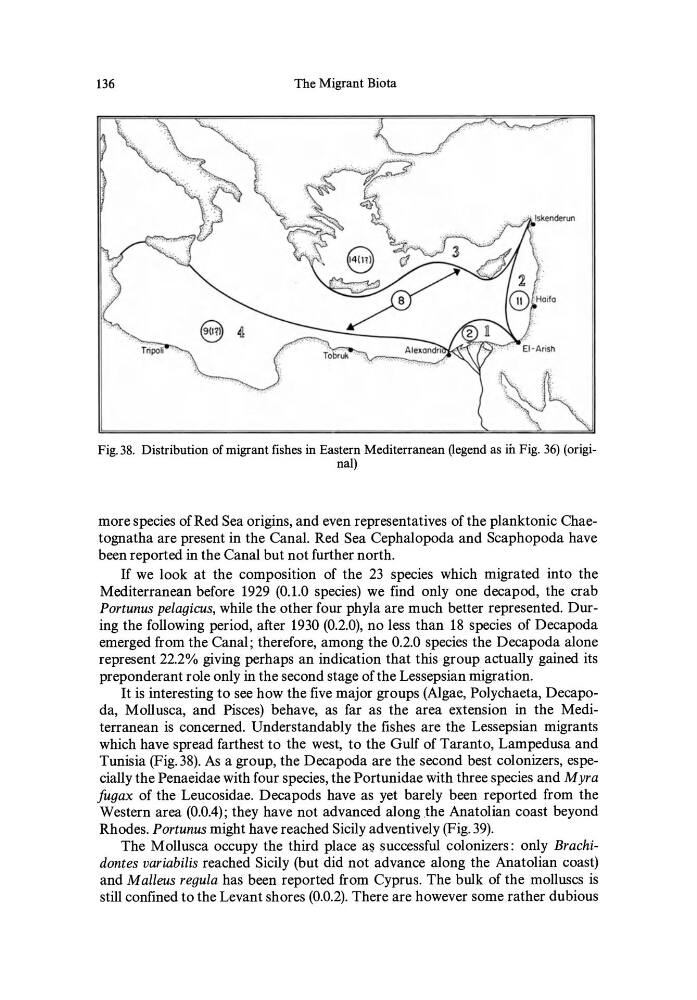
Fig.38. Distribution of migrant fishes in Eastem Mediterranean (legend as in Fig. 36) (original)
more species of Red Sea origins, and even representatives of the planktonic Chaetognatha are present in the Canal. Red Sea Cephalopoda and Scaphopoda have
been reported in the Canal but not further north.
If we look at the composition of the 23 species which migrated into the
Mediterranean before 1929 (0.1.0 species) we find only one decapod, the crab
Portunus pelagicus, while the other four phyla are much better represented. During the following period, after 1930 (0.2.0), no less than 18 species of Decapoda
emerged from the Canal; therefore, among the 0.2.0 species the Decapoda alone
represent 22.2% giving perhaps an indication that this group actually gained its
preponderant role only in the second stage ofthe Lessepsian migration.
It is interesting to see how the five major groups (Algae, Polychaeta, Decapoda, MOllusca, and Pisces) behave, as far as the area extension in the Mediterranean is concerned. Understandably the fishes are the Lessepsian migrants
which have spread farthest to the west, to the Gulf of Taranto, Lampedusa and
Tunisia (Fig.38). As a group, the Decapoda are the second best colonizers, especiallY the Penaeidae with four species, the Portunidae with three species and Myra
fugax of the Leucosidae. Decapods have as yet barely been reported from the
Western area (0.0.4); they have not advanced along .the Anatolian coast beyond
Rhodes. Portunus might have reached Sicily adventively (Fig. 39).
The Mollusca occupy the third place as successful colonizers: only Brachidontes variabilis reached Sicily (hut did not advance along the Anatolian coast)
and M alleus regula has been reported from Cyprus. The bulk of the molluscs is
still confined to the Levant shores (0.0.2). There are however some rather dubious
The Migrant Biota
Fig.38. Distribution of migrant fishes in Eastem Mediterranean (legend as in Fig. 36) (original)
more species of Red Sea origins, and even representatives of the planktonic Chaetognatha are present in the Canal. Red Sea Cephalopoda and Scaphopoda have
been reported in the Canal but not further north.
If we look at the composition of the 23 species which migrated into the
Mediterranean before 1929 (0.1.0 species) we find only one decapod, the crab
Portunus pelagicus, while the other four phyla are much better represented. During the following period, after 1930 (0.2.0), no less than 18 species of Decapoda
emerged from the Canal; therefore, among the 0.2.0 species the Decapoda alone
represent 22.2% giving perhaps an indication that this group actually gained its
preponderant role only in the second stage ofthe Lessepsian migration.
It is interesting to see how the five major groups (Algae, Polychaeta, Decapoda, MOllusca, and Pisces) behave, as far as the area extension in the Mediterranean is concerned. Understandably the fishes are the Lessepsian migrants
which have spread farthest to the west, to the Gulf of Taranto, Lampedusa and
Tunisia (Fig.38). As a group, the Decapoda are the second best colonizers, especiallY the Penaeidae with four species, the Portunidae with three species and Myra
fugax of the Leucosidae. Decapods have as yet barely been reported from the
Western area (0.0.4); they have not advanced along .the Anatolian coast beyond
Rhodes. Portunus might have reached Sicily adventively (Fig. 39).
The Mollusca occupy the third place as successful colonizers: only Brachidontes variabilis reached Sicily (hut did not advance along the Anatolian coast)
and M alleus regula has been reported from Cyprus. The bulk of the molluscs is
still confined to the Levant shores (0.0.2). There are however some rather dubious