

The Diversity of Lessepsian Migrants
135
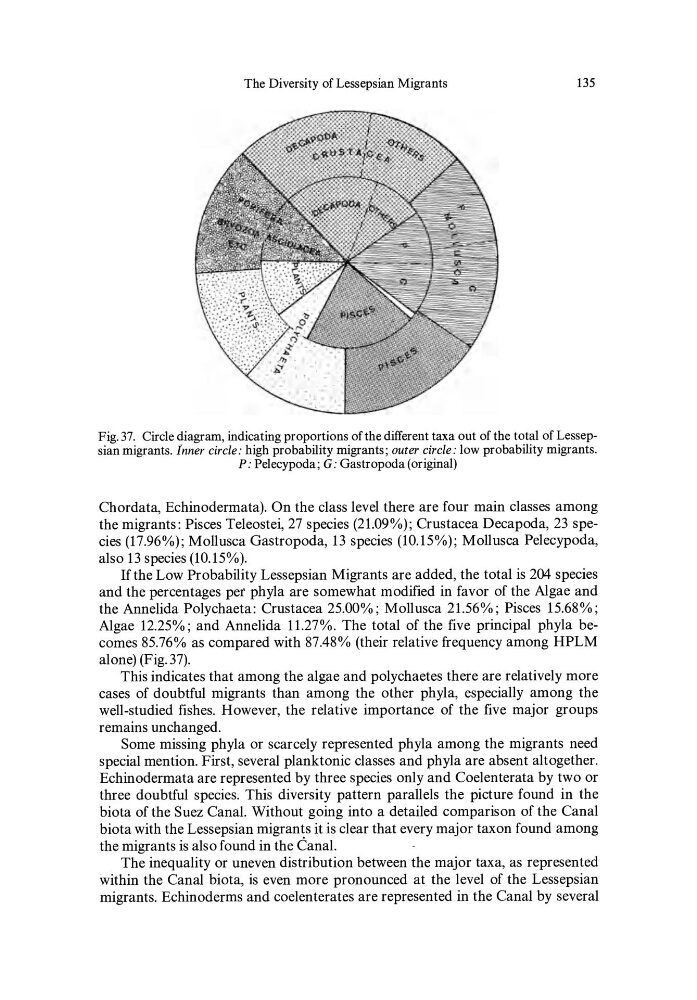
Fig.37. Circle diagrarn, indicating proportions ofthe different taxa out of the total of Lessepsian migrants. inner circle: high probability migrants; Duter circle: low probability migrants.
P: Pelecypoda; G: Gastropoda (original)
Chordata, Echinodermata). On the class level there are four main classes among
the migrants: Pis ces Teleostei, 27 species (21.09%); Crustacea Decapoda, 23 species (17.96%); Mollusca Gastropoda, 13 species (10.15%); Mollusca Pelecypoda,
also 13 species (10.15%).
If the Low Probability Lessepsian Migrants are added, the total is 204 species
and the percentages per phyla are somewhat modified in favor of the Algae and
the Annelida Polychaeta: Crustacea 25.00%; Mollusca 21.56%; Pis ces 15.68%;
Algae 12.25%; and Annelida 11.27%. The total of the five principal phyla becomes 85.76% as compared with 87.48% (their relative frequency among HPLM
alone) (Fig.37).
This indicates that among the algae and polychaetes there are relatively more
cases of doubtful migrants than among the other phyla, especially among the
well-studied fishes. However, the relative importance of the five major groups
remains unchanged.
Some missing phyla or scarcely represented phyla among the migrants need
special mention. First, several planktonic classes and phyla are absent altogether.
Echinodermata are represented by three species only and Coelenterata by two or
three doubtful species. This diversity pattern paralleIs the picture found in the
biota of the Suez Canal. Without going into a detailed comparison of the Canal
biota with the Lessepsian migrants it is clear that every major taxon found among
the migrants is also found in the Canal.
The inequality or uneven distribution between the major taxa, as represented
within the Canal biota, is even more pronounced at the level of the Lessepsian
migrants. Echinoderms and coelenterates are represented in the Canal by several
135
Fig.37. Circle diagrarn, indicating proportions ofthe different taxa out of the total of Lessepsian migrants. inner circle: high probability migrants; Duter circle: low probability migrants.
P: Pelecypoda; G: Gastropoda (original)
Chordata, Echinodermata). On the class level there are four main classes among
the migrants: Pis ces Teleostei, 27 species (21.09%); Crustacea Decapoda, 23 species (17.96%); Mollusca Gastropoda, 13 species (10.15%); Mollusca Pelecypoda,
also 13 species (10.15%).
If the Low Probability Lessepsian Migrants are added, the total is 204 species
and the percentages per phyla are somewhat modified in favor of the Algae and
the Annelida Polychaeta: Crustacea 25.00%; Mollusca 21.56%; Pis ces 15.68%;
Algae 12.25%; and Annelida 11.27%. The total of the five principal phyla becomes 85.76% as compared with 87.48% (their relative frequency among HPLM
alone) (Fig.37).
This indicates that among the algae and polychaetes there are relatively more
cases of doubtful migrants than among the other phyla, especially among the
well-studied fishes. However, the relative importance of the five major groups
remains unchanged.
Some missing phyla or scarcely represented phyla among the migrants need
special mention. First, several planktonic classes and phyla are absent altogether.
Echinodermata are represented by three species only and Coelenterata by two or
three doubtful species. This diversity pattern paralleIs the picture found in the
biota of the Suez Canal. Without going into a detailed comparison of the Canal
biota with the Lessepsian migrants it is clear that every major taxon found among
the migrants is also found in the Canal.
The inequality or uneven distribution between the major taxa, as represented
within the Canal biota, is even more pronounced at the level of the Lessepsian
migrants. Echinoderms and coelenterates are represented in the Canal by several