

642
16 Sterols and Steroids
the urine. In all mammals except the primates,
oestrone is the main oestrogen in the urine,
whereas in humans and the anthropoid apes it is
oestriol. In addition, the primates produce
oestradiol-17~ and the other mammals produce
oestradiol-17a.
Enzymes that can aromatize the A ring and
produce oestrogens have been found in the testis
of mammals, reptiles and teleosts. The production of oestrone and oestradiol-17~ is especially
high in the testes of the horse and pig; these are
amongst the most oestrogen-rich tissues and stallion urine was formerly used as a copious source
of oestrogen. The possible biological importance
of this female hormone in the testis is not known.
In males of the zebra finch Poephila guttata there
is intensive oestrogen synthesis in the hypothalamus-hypophysis region of the brain; the hormone is involved in the regulation of song activity
[103]. The biosynthesis of oestrogen in mammals
occurs by either the ~ 5 (cattle) or the ~ 4 pathway
(horse, pig). Inactivation of oestrogen in this case
is not by reduction of the A ring, as for other steroid hormones, but by substitution of various ring
positions with hydroxy or oxo groups; this increases the water solubility, and with it the excretability. Thus, oestradiol-17~ is converted via oestrone
to oestriol, during which the biological activity
declines in the ratio 100: 20 : 1. The female hormones control the reproductive processes in
mammals, with oestrogens regulating the growth
and progesterone the differentiation of the uterus
lining and the maintenance of pregnancy. The
oestrogens are also involved in regulating the
reproductive rhythms of all other vertebrate
classes, but comparative studies are hindered by
their relatively low concentrations compared with
those of the corticosteroids and androgens. As in
the mammals, oestradiol-17~ appears to be the
most important female sex hormone in the other
vertebrates, but the biological role of progesterone is not so clear [39].
Certain steroids in vertebrates function as sex
pheromones. For example, in various fish species
oestrogens excreted into the water by females
attract and activate the males. Females of the
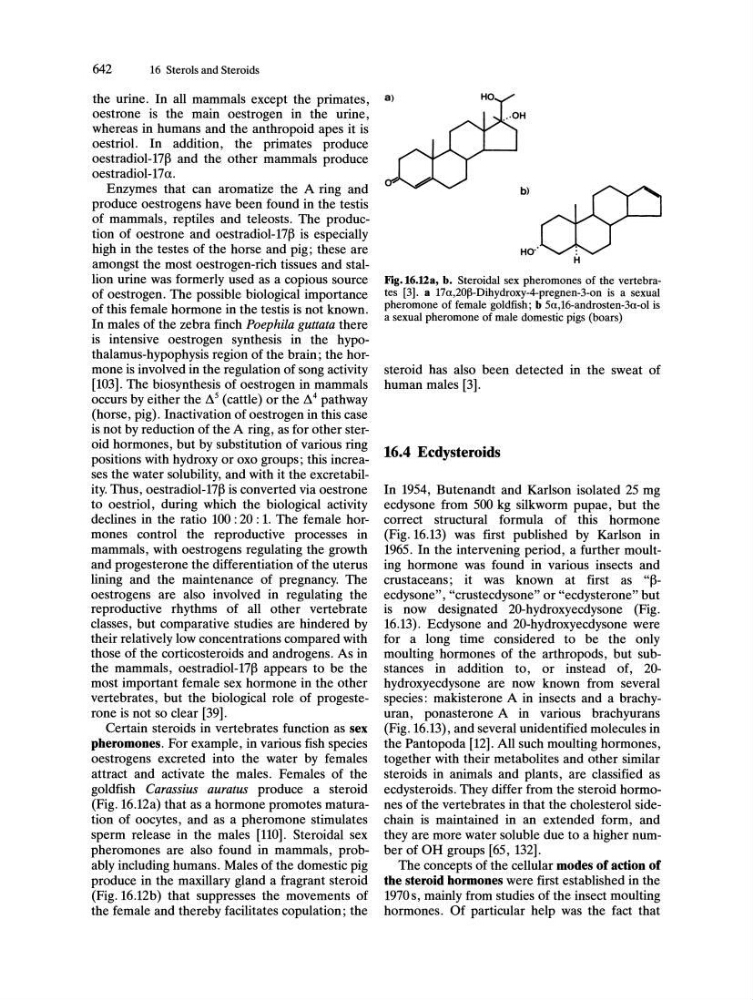
goldfish Carassius auratus produce a steroid
(Fig. 16.12a) that as a hormone promotes maturation of oocytes, and as a pheromone stimulates
sperm release in the males [110]. Steroidal sex
pheromones are also found in mammals, probably including humans. Males of the domestic pig
produce in the maxillary gland a fragrant steroid
(Fig. 16.12b) that suppresses the movements of
the female and thereby facilitates copulation; the
Fig. 16.12a, b. Steroidal sex pheromones of the vertebrates [3]. a 17a,20~-Dihydroxy-4-pregnen-3-on is a sexual
pheromone of female goldfish; b 5a,16-androsten-3a-ol is
a sexual pheromone of male domestic pigs (boars)
steroid has also been detected in the sweat of
human males [3].
16.4 Ecdysteroids
In 1954, Butenandt and Karlson isolated 25 mg
ecdysone from 500 kg silkworm pupae, but the
correct structural formula of this hormone
(Fig. 16.13) was first published by Karlson in
1965. In the intervening period, a further moulting hormone was found in various insects and
crustaceans; it was known at first as "~ecdysone", "crustecdysone" or "ecdysterone" but
is now designated 20-hydroxyecdysone (Fig.
16.13). Ecdysone and 20-hydroxyecdysone were
for a long time considered to be the only
moulting hormones of the arthropods, but substances in addition to, or instead of, 20hydroxyecdysone are now known from several
species: makisterone A in insects and a brachyuran, ponasterone A in various brachyurans
(Fig. 16.13), and several unidentified molecules in
the Pantopoda [12]. All such moulting hormones,
together with their metabolites and other similar
steroids in animals and plants, are classified as
ecdysteroids. They differ from the steroid hormones of the vertebrates in that the cholesterol sidechain is maintained in an extended form, and
they are more water soluble due to a higher number of OH groups [65, 132].
The concepts of the cellular modes of action of
the steroid hormones were first established in the
1970 s, mainly from studies of the insect moulting
hormones. Of particular help was the fact that