

Cholesterol
Phytosterol
Makisterone A
?
- - " - - - - HO
5~- Ketodiol
Ponasterone A
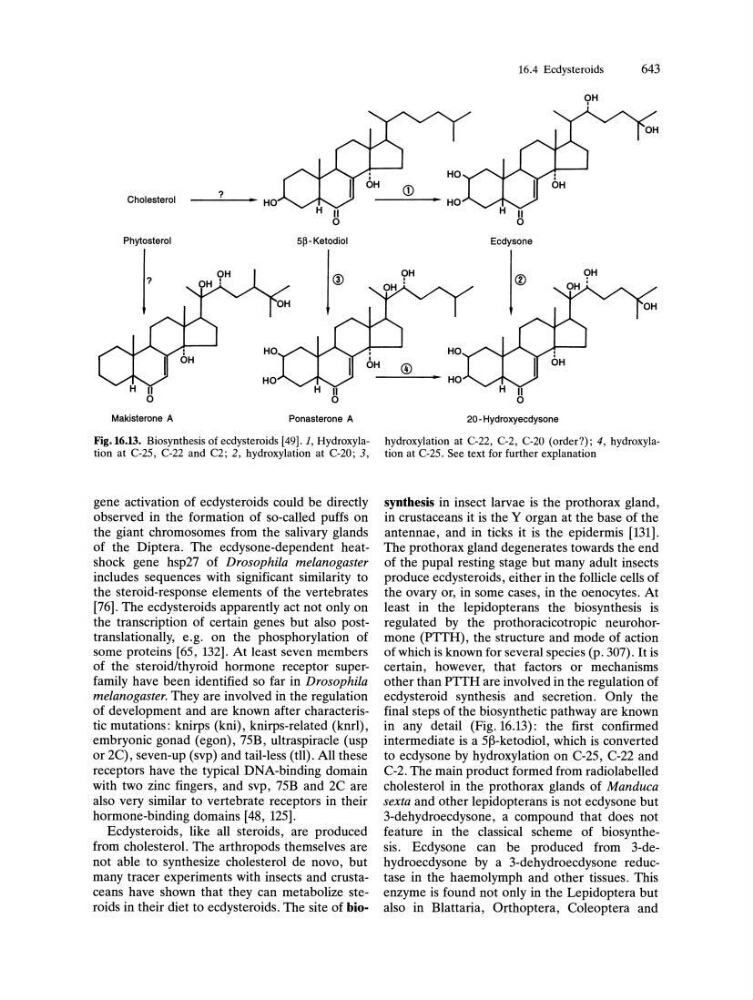
Fig.16.13. Biosynthesis of ecdysteroids [49]. 1, Hydroxylation at C-25, C-22 and C2; 2, hydroxylation at C-20; 3,
gene activation of ecdysteroids could be directly
observed in the formation of so-called puffs on
the giant chromosomes from the salivary glands
of the Diptera. The ecdysone-dependent heatshock gene hsp27 of Drosophila melanogaster
includes sequences with significant similarity to
the steroid-response elements of the vertebrates
[76]. The ecdysteroids apparently act not only on
the transcription of certain genes but also posttranslation ally, e.g. on the phosphorylation of
some proteins [65, 132]. At least seven members
of the steroidlthyroid hormone receptor superfamily have been identified so far in Drosophila
melanogaster. They are involved in the regulation
of development and are known after characteristic mutations: knirps (kni), knirps-related (knrl),
embryonic gonad (egon), 75B, ultraspiracle (usp
or 2C), seven-up (svp) and tail-less (tll). All these
receptors have the typical DNA-binding domain
with two zinc fingers, and svp, 75B and 2C are
also very similar to vertebrate receptors in their
hormone-binding domains [48, 125].
Ecdysteroids, like all steroids, are produced
from cholesterol. The arthropods themselves are
not able to synthesize cholesterol de novo, but
many tracer experiments with insects and crustaceans have shown that they can metabolize steroids in their diet to ecdysteroids. The site of bio16.4 Ecdysteroids
643
Ecdysone
20-Hydroxyecdysone
hydroxylation at C-22, C-2, C-20 (order?); 4, hydroxylation at C-25. See text for further explanation
synthesis in insect larvae is the prothorax gland,
in crustaceans it is the Y organ at the base of the
antennae, and in ticks it is the epidermis [131].
The prothorax gland degenerates towards the end
of the pupal resting stage but many adult insects
produce ecdysteroids, either in the follicle cells of
the ovary or, in some cases, in the oenocytes. At
least in the lepidopterans the biosynthesis is
regulated by the prothoracicotropic neurohormone (PTTH), the structure and mode of action
of which is known for several species (p. 307). It is
certain, however, that factors or mechanisms
other than PTTH are involved in the regulation of
ecdysteroid synthesis and secretion. Only the
final steps of the biosynthetic pathway are known
in any detail (Fig. 16.13): the first confirmed
intermediate is a 5~-ketodiol, which is converted
to ecdysone by hydroxylation on C-25, C-22 and
C-2. The main product formed from radio labelled
cholesterol in the prothorax glands of Manduca
sexta and other lepidopterans is not ecdysone but
3-dehydroecdysone, a compound that does not
feature in the classical scheme of biosynthesis. Ecdysone can be produced from 3-dehydro ecdysone by a 3-dehydroecdysone reductase in the haemolymph and other tissues. This
enzyme is found not only in the Lepidoptera but
also in Blattaria, Orthoptera, Coleoptera and