

>
OH
C)
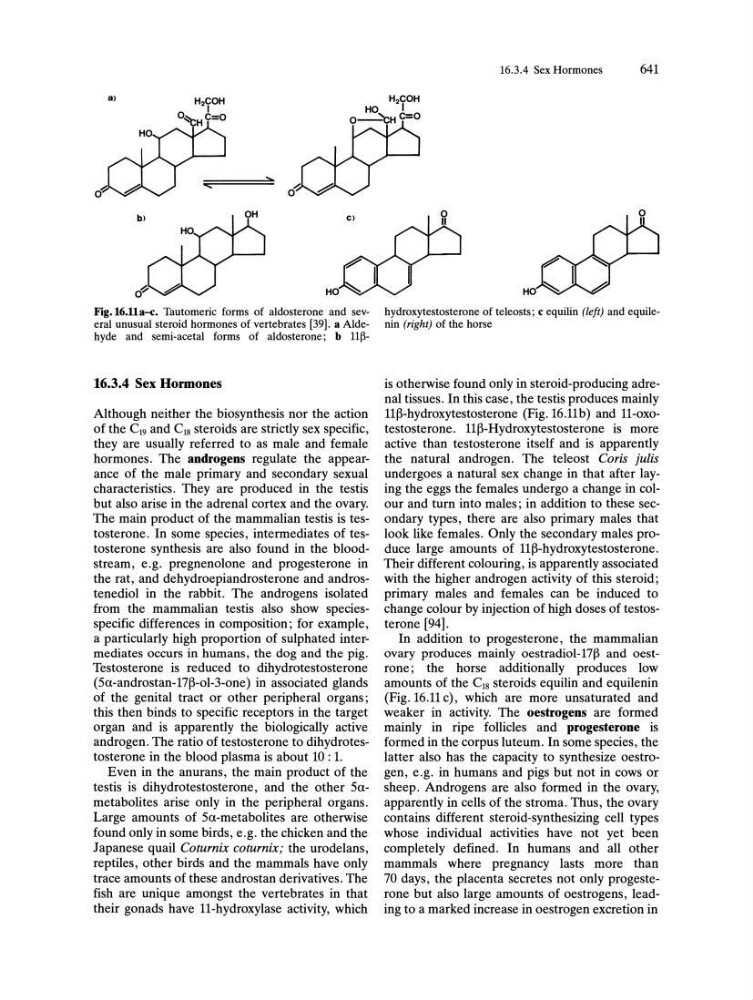
Fig.16.11a-<:. Tautomeric forms of aldosterone and several unusual steroid hormones of vertebrates [39]. a Aldehyde and semi-acetal forms of aldosterone; b 11~16.3.4 Sex Hormones
Although neither the biosynthesis nor the action
of the C19 and C18 steroids are strictly sex specific,
they are usually referred to as male and female
hormones. The androgens regulate the appearance of the male primary and secondary sexual
characteristics. They are produced in the testis
but also arise in the adrenal cortex and the ovary.
The main product of the mammalian testis is testosterone. In some species, intermediates of testosterone synthesis are also found in the bloodstream, e.g. pregnenolone and progesterone in
the rat, and dehydroepiandrosterone and androstenediol in the rabbit. The androgens isolated
from the mammalian testis also show speciesspecific differences in composition; for example,
a particularly high proportion of sulphated intermediates occurs in humans, the dog and the pig.
Testosterone is reduced to dihydrotestosterone
(Sa-androstan-17~-01-3-one) in associated glands
of the genital tract or other peripheral organs;
this then binds to specific receptors in the target
organ and is apparently the biologically active
androgen. The ratio of testosterone to dihydrotestosterone in the blood plasma is about 10 : 1.
Even in the anurans, the main product of the
testis is dihydrotestosterone, and the other Sametabolites arise only in the peripheral organs.
Large amounts of Sa-metabolites are otherwise
found only in some birds, e.g. the chicken and the
Japanese quail Coturnix coturnix; the urodelans,
reptiles, other birds and the mammals have only
trace amounts of these androstan derivatives. The
fish are unique amongst the vertebrates in that
their gonads have 11-hydroxylase activity, which
o
II
16.3.4 Sex Hormones
641
hydroxy testosterone of teleosts; c equilin (left) and equilenin (right) of the horse
is otherwise found only in steroid-producing adrenal tissues. In this case, the testis produces mainly
11~-hydroxytestosterone (Fig. 16.11 b) and 11-oxotestosterone. 11~-Hydroxytestosterone is more
active than testosterone itself and is apparently
the natural androgen. The teleost Coris julis
undergoes a natural sex change in that after laying the eggs the females undergo a change in colour and turn into males; in addition to these secondary types, there are also primary males that
look like females. Only the secondary males produce large amounts of 11~-hydroxytestosterone.
Their different colouring, is apparently associated
with the higher androgen activity of this steroid;
primary males and females can be induced to
change colour by injection of high doses of testosterone [94].
In addition to progesterone, the mammalian
ovary produces mainly oestradiol-17~ and oestrone; the horse additionally produces low
amounts of the C18 steroids equilin and equilenin
(Fig. 16.11 c), which are more unsaturated and
weaker in activity. The oestrogens are formed
mainly in ripe follicles and progesterone is
formed in the corpus luteum. In some species, the
latter also has the capacity to synthesize oestrogen, e.g. in humans and pigs but not in cows or
sheep. Androgens are also formed in the ovary,
apparently in cells of the stroma. Thus, the ovary
contains different steroid-synthesizing cell types
whose individual activities have not yet been
completely defined. In humans and all other
mammals where pregnancy lasts more than
70 days, the placenta secretes not only progesterone but also large amounts of oestrogens, leading to a marked increase in oestrogen excretion in