

involved in the triggering of immune reactions in
the moth Manduca sexta [254].
From PGHz, the first stable intermediate of
prostaglandin synthesis, further metabolic pathways lead to the other eicosanoids, thromboxanes
and prostacyclins (Fig. 15.30b), about which,
however, there is little comparative information.
Arachidonic acid is oxidized not only by the cyclooxygenase activity of PG synthase but also by
lipoxygenases, without ring closure, to hydroperoxy-5,8,10,14- eicosatetraenic acids (HPETEs);
it is further converted to leucotrienes (Fig.
15 .30 c) and hydroxy-eicosatetraenic acids
(HETEs) [201,247]. The specific lipoxygenases
show large differences in their sequences, e.g. the
human 15-lipoxygenase has only 39 % of its 660
amino acids in common with the 5-lipoxygenase
[241]. Leucotriene B4 (LTB4) has proinflammatory and immune-mediator activities in mammals,
and has similar functions in the frog Rana temporaria and the trout Salmo gairdneri [72, 205].
HETEs and related hydroxy fatty acids with certain localizations and stereo-configurations of the
hydroxy group act in lower vertebrates and invertebrates as triggers for oocyte maturation, e.g.
15(S)- and 12(S)-HETE in the frog Xenopus laevis, 8(R)-HETE in several starfish, and U(R)and 12(R)-HETE in the sea urchin Strongylocentrotus purpuratus [88]. The trihydroxyeicosatrienic, -eicosatetraenic and -docosapentaenic acids, synthesized by the barnacle Balanus
balanoides and excreted into the water, function
as hatching factors [248]. In the sea snail Aplysia
cali/ornica, the 12-ketoeicosatetraenic acid produced from 12-HPETE appears to be an intracellular signal mediating the effects of the peptide
15.5.2 Insect Juvenile Hormones
613
hormone FMRF amide [206]. The formation of 8HETE and other HETEs from arachidonic acid
has been demonstrated in the thysanuran Thermobia domestica; 5-HETE and 12-HETE have
been found in the freshwater mussel Ligumia subrostrata; and 15-HPETE has been found in the
coral Pseudoplexaura porosa, which produces no
prostaglandins and accordingly has no cyclooxygenase [79, 212].
15.5.2 Insect Juvenile Hormones
Based upon investigations of the bug Rhodnius
prolixus, Wigglesworth in the 1930s postulated
the existence of a hormonal factor that originated
from the corpora allata and, whilst allowing continued growth, prevented metamorphosis. In
1967, Roller defined the chemical structure of
such a juvenile hormone (now known as JH I)
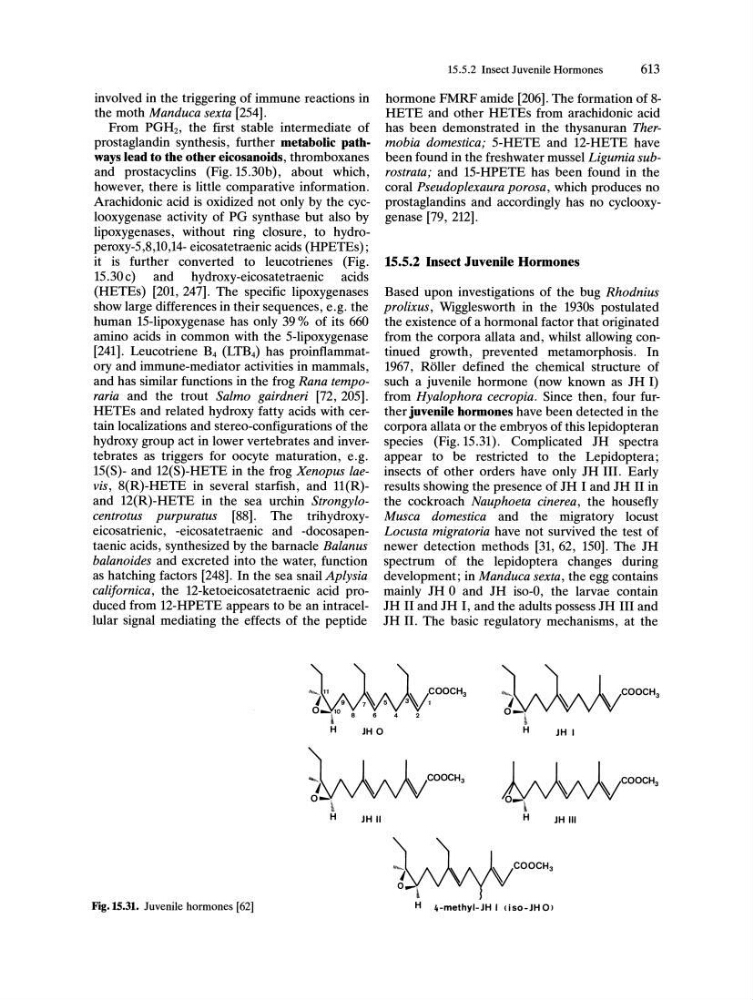
from Hyalophora cecropia. Since then, four further juvenile hormones have been detected in the
corpora allata or the embryos of this lepidopteran
species (Fig. 15.31). Complicated JH spectra
appear to be restricted to the Lepidoptera;
insects of other orders have only JH III. Early
results showing the presence of JH I and JH II in
the cockroach Nauphoeta cinerea, the housefly
Musca domesticaand the migratory locust
Locusta migratoria have not survived the test of
newer detection methods [31, 62, 150]. The JH
spectrum of the lepidoptera changes during
development; in Manduca sexta, the egg contains
mainly JH 0 and JH iso-O, the larvae contain
JH II and JH I, and the adults possess JH III and
JH II. The basic regulatory mechanisms, at the
"Jll lt-. lt-. COOCH3
"tS/!j~AAI,
~ ' \ I\. COOCH,
"j~
0-',10 8
6
4
2
!
~
H
JH 0
H
JH I
~COOCH3
0_,
~
JH II
H
JH III
Fig.15.31. Juvenile hormones [62]
4-methyl-JH I !iso-JH OJ