

612
15 Lipids
a)
~
Arachidonic acid
r
202
r~
PGG 2
0-,
(0) 1 baH
"~COOH
PGH 2
I
I
OH
b)
"~COOH
TXA 2
I
I
I2
0H
II COOH
9\ I ,
PGI 2
,
HOO
c)
5·HPETE
COOH
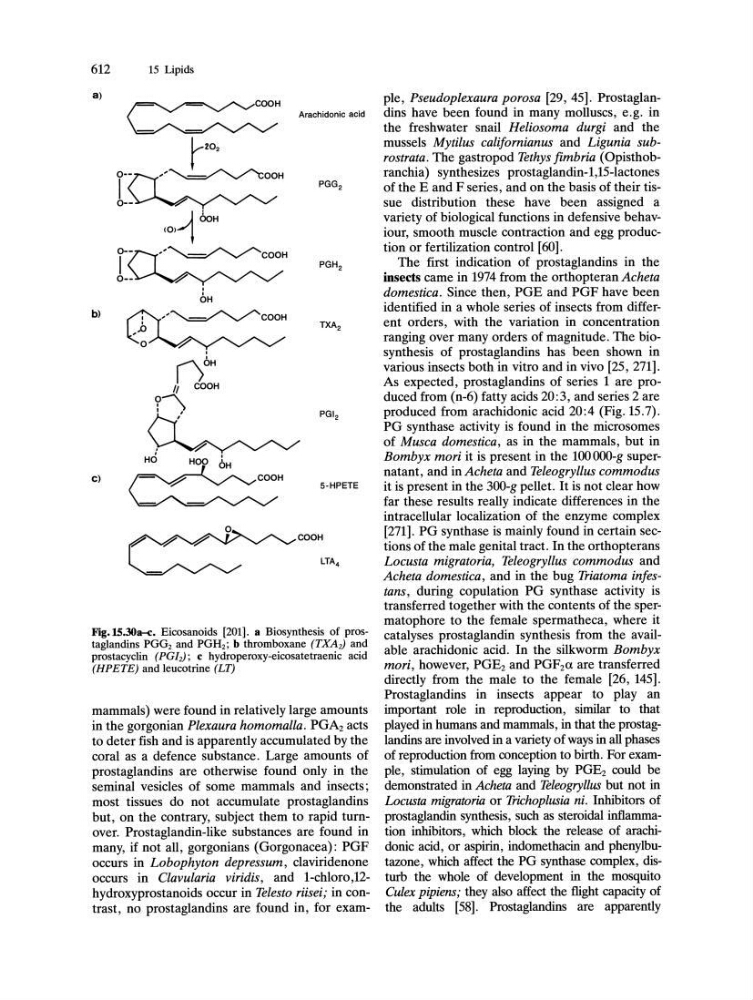
Fig.1S.30It-C. Eicosanoids [201]. a Biosynthesis of prostaglandins PGG2 and PGH2 ; b thromboxane (TXA2) and
prostacyclin (PGI2); c hydroperoxy-eicosatetraenic acid
(HPETE) and leucotrine (LT)
mammals) were found in relatively large amounts
in the gorgonian Plexaura homomalla. PGA2 acts
to deter fish and is apparently accumulated by the
coral as a defence substance. Large amounts of
prostaglandins are otherWise found only in the
seminal vesicles of some mammals and insects;
most tissues do not accumulate prostaglandins
but, on the contrary, subject them to rapid turnover. Prostaglandin-like substances are found in
many, if not all, gorgonians (Gorgonacea): PGF
occurs in Lobophyton depressum, claviridenone
occurs in Clavularia viridis, and 1-chloro,12hydroxyprostanoids occur in Telesto riisei; in contrast, no prostaglandins are found in, for exampIe, PseudopZexaura porosa [29,45]. Prostaglandins have been found in many molluscs, e.g. in
the freshwater snail Heliosoma durgi and the
mussels Mytilus californianus and Ligunia subrostrata. The gastropod Tethys fimbria (Opisthobranchia) synthesizes prostaglandin-1,15-lactones
of the E and F series, and on the basis of their tissue distribution these have been assigned a
variety of biological functions in defensive behaviour, smooth muscle contraction and egg production or fertilization control [60].
The first indication of prostaglandins in the
insects came in 1974 from the orthopteran Acheta
domestica. Since then, PGE and PGF have been
identified in a whole series of insects from different orders, with the variation in concentration
ranging over many orders of magnitude. The biosynthesis of prostaglandins has been shown in
various insects both in vitro and in vivo [25, 271].
As expected, prostaglandins of series 1 are produced from (n-6) fatty acids 20:3, and series 2 are
produced from arachidonic acid 20:4 (Fig. 15.7).
PG synthase activity is found in the microsomes
of Musca domestica, as in the mammals, but in
Bombyx mori it is present in the 100000-g supernatant, and in Acheta and TeZeogryllus commodus
it is present in the 300-g pellet. It is not clear how
far these results really indicate differences in the
intracellular localization of the enzyme complex
[271]. PG synthase is mainly found in certain sections of the male genital tract. In the orthopterans
Locusta migratoria, TeZeogryllus commodus and
Acheta domestica, and in the bug Triatoma infestans, during copulation PG synthase activity is
transferred together with the contents of the spermatophore to the female spermatheca, where it
catalyses prostaglandin synthesis from the available arachidonic acid. In the silkworm Bombyx
mori, however, PGEz and PGF2
Prostaglandins in insects appear to play an
important role in reproduction, similar to that
played in humans and mammals, in that the prostaglandins are involved in a variety of ways in all phases
of reproduction from conception to birth. For example, stimulation of egg laying by PGE2 could be
demonstrated in Acheta and TeZeogryllus but not in
Locusta migratoria or TrichopZusia ni. Inhibitors of
prostaglandin synthesis, such as steroidal inflammation inhibitors, which block the release of arachidonic acid, or aspirin, indomethacin and phenylbutazone, which affect the PG synthase complex, disturb the whole of development in the mosquito
Culex pipiens; they also affect the flight capacity of
the adults [58]. Prostaglandins are apparently