

15.4.4 GlycoJipids
607
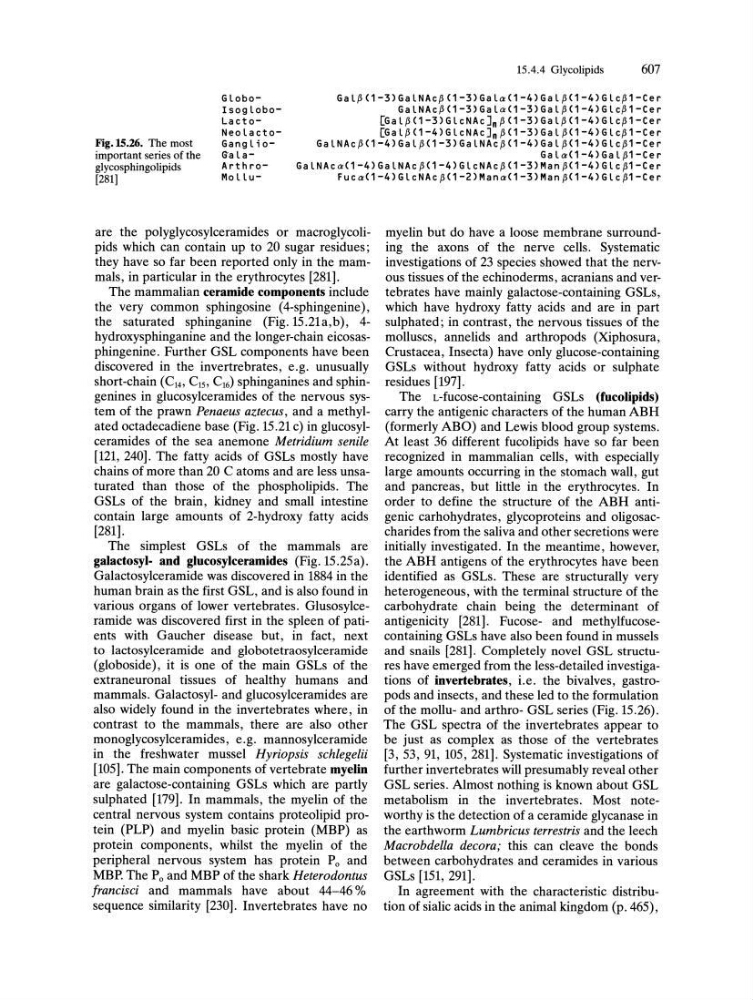
Fig.15.26. The most
important series of the
glycosphingolipids
[281]
MoLLuGaL~(1-3)GaLNAc~(1-3)GaLa(1-4)GaL~(1-4)GLc~1-Cer
GaLNAc~(1-3)GaLa(1-3)GaL~(1-4)GLc~1-Cer
[GaL~(1-3)GLcNAcJn~(1-3)GaL~(1-4)GLc~1-Cer
[GaL~(1-4)GLcNAcJn~(1-3)GaL~(1-4)GLc~1-Cer
GaLNAc~(1-4)GaL~(1-3)GaLNAc~(1-4)GaL~(1-4)GLc~1-Cer
GaLa(1-4)GaL~1-Cer
GaLNAca(1-4)GaLNAc~(1-4)GLcNAc~(1-3)Man~(1-4)GLc~1-Cer
Fuca(1-4)GLcNAc~(1-2)Mana(1-3)Man~(1-4)GLc~1-Cer
are the polyglycosy1ceramides or macroglycolipids which can contain up to 20 sugar residues;
they have so far been reported only in the mammals, in particular in the erythrocytes [281].
The mammalian ceramide components include
the very common sphingosine (4-sphingenine),
the saturated sphinganine (Fig. 15.21a,b), 4hydroxysphinganine and the longer-chain eicosasphingenine. Further GSL components have been
discovered in the invertrebrates, e.g. unusually
short-chain (C14, C15, C16) sphinganines and sphingenines in glucosy1ceramides of the nervous system of the prawn Penaeus aztecus, and a methylated octadecadiene base (Fig. 15.21 c) in glucosylceramides of the sea anemone Metridium senile
[121, 240]. The fatty acids of GSLs mostly have
chains of more than 20 C atoms and are less unsaturated than those of the phospholipids. The
GSLs of the brain, kidney and small intestine
contain large amounts of 2-hydroxy fatty acids
[281].
The simplest GSLs of the mammals are
galactosyl- and glucosylceramides (Fig. 15.25a).
Galactosy1ceramide was discovered in 1884 in the
human brain as the first GSL, and is also found in
various organs of lower vertebrates. Glusosy1ceramide was discovered first in the spleen of patients with Gaucher disease but, in fact, next
to lactosylceramide and globotetraosylceramide
(globoside), it is one of the main GSLs of the
extraneuronal tissues of healthy humans and
mammals. Galactosyl- and glucosylceramides are
also widely found in the invertebrates where, in
contrast to the mammals, there are also other
monoglycosylceramides, e.g. mannosylceramide
in the freshwater mussel Hyriopsis schlegelii
[105]. The main components of vertebrate myelin
are galactose-containing GSLs which are partly
sulphated [179]. In mammals, the myelin of the
central nervous system contains proteolipid protein (PLP) and myelin basic protein (MBP) as
protein components, whilst the myelin of the
peripheral nervous system has protein Po and
MBP. The Po and MBP of the shark Heterodontus
francisci and mammals have about 44-46 %
sequence similarity [230]. Invertebrates have no
myelin but do have a loose membrane surrounding the axons of the nerve cells. Systematic
investigations of 23 species showed that the nervous tissues of the echinoderms, acranians and vertebrates have mainly galactose-containing GSLs,
which have hydroxy fatty acids and are in part
sulphated; in contrast, the nervous tissues of the
molluscs, annelids and arthropods (Xiphosura,
Crustacea, Insecta) have only glucose-containing
GSLs without hydroxy fatty acids or sulphate
residues [197].
The L-fucose-containing GSLs (fucolipids)
carry the antigenic characters of the human ABH
(formerly ABO) and Lewis blood group systems.
At least 36 different fucolipids have so far been
recognized in mammalian cells, with especially
large amounts occurring in the stomach wall, gut
and pancreas, but little in the erythrocytes. In
order to define the structure of the ABH antigenic carhohydrates, glycoproteins and oligosaccharides from the saliva and other secretions were
initially investigated. In the meantime, however,
the ABH antigens of the erythrocytes have been
identified as GSLs. These are structurally very
heterogeneous, with the terminal structure of the
carbohydrate chain being the determinant of
antigenicity [281]. Fucose- and methylfucosecontaining GSLs have also been found in mussels
and snails [281). Completely novel GSL structures have emerged from the less-detailed investigations of invertebrates, i.e. the bivalves, gastropods and insects, and these led to the formulation
of the mollu- and arthro- GSL series (Fig. 15.26).
The GSL spectra of the invertebrates appear to
be just as complex as those of the vertebrates
[3, 53, 91, 105, 281]. Systematic investigations of
further invertebrates will presumably reveal other
GSL series. Almost nothing is known about GSL
metabolism in the invertebrates. Most noteworthy is the detection of a ceramide glycanase in
the earthworm Lumbricus terrestris and the leech
Macrobdella decora; this can cleave the bonds
between carbohydrates and cerami des in various
GSLs [151, 291].
In agreement with the characteristic distribution of sialic acids in the animal kingdom (p. 465),