

606
15 Lipids
ate can be derived from free AEPn by AEPn
transfer from CMP-AEPn to diacylglycerol; however, this appears to be simply a mechanism for
the recycling of free AEPn (salvage pathway).
AEPn biosynthesis starts with phosphoenolpyruvate (PEP). The main route involves the conversion of phosphonopyruvate by a PEP phosphomutase, decarboxylation to phosphonoacetalde hyde and direct amination to 2-aminoethyl
phosphonate (Fig. 15.24). The phosphomutase of
T. pyriformis has been isolated [9, 24].
15.4.4 Glycolipids
Three main types of glycolipid can be distinguished on the basis of structure and function: the
glycosphingolipids, including the sialic acidcontaining gangliosides and the glycoglycerolipids, are important membrane components; the
glycosylphosphopolyprenols (dolichols) are cofactors for the N-glycosylation of proteins; and
sulphated glycoglycerolipids are important components (in addition to glycoproteins) of the
mucosal lining of the stomach wall, protecting it
from mechanical and chemical injury. The characteristic ascaroside from the ovary and eggs of the
roundworm Ascaris is built up from the sugar
ascarylose, a long-chain, monovalent or divalent
fatty alcohol, and sometimes also a fatty acid; this
has already been discussed (p. 463).
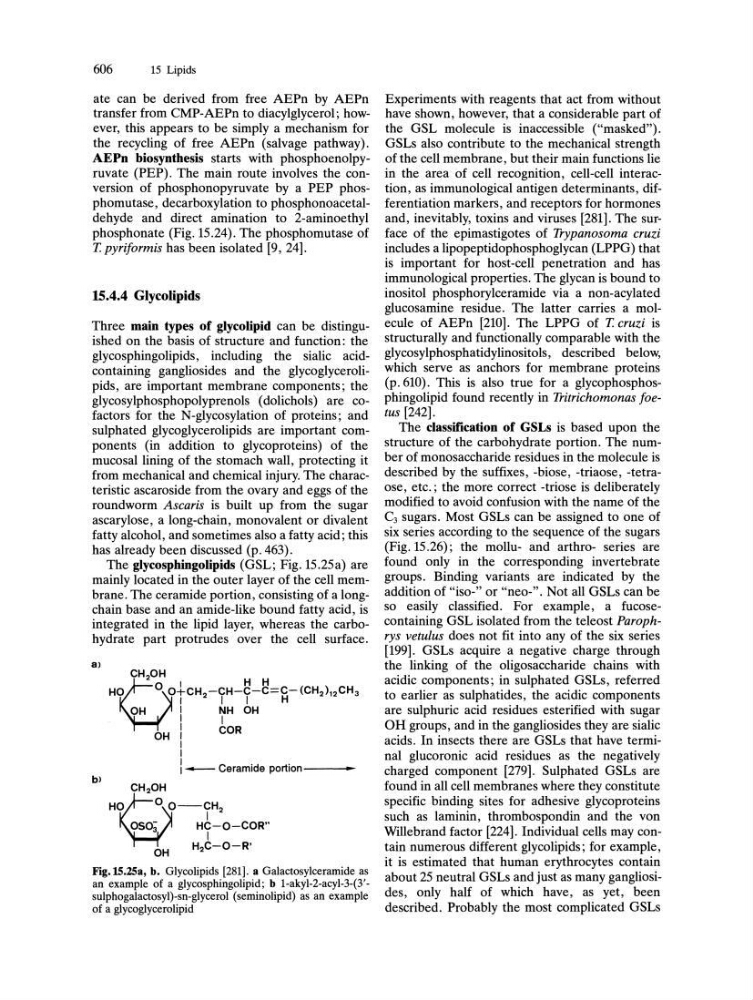
The glycosphingolipids (GSL; Fig. 15.25a) are
mainly located in the outer layer of the cell membrane. The ceramide portion, consisting of a longchain base and an amide-like bound fatty acid, is
integrated in the lipid layer, whereas the carbohydrate part protrudes over the cell surface.
a)
b)
H~H'O~+CH'_CH_~_~=C_ (CH, )"CH,
I
I
I
H
OH
I
NH OH
I
I
OH i
COR
I
I
I
C
'd
.
1 - eraml e portion
..
CH 20H
H G O O - - CH 2
050H6-0-COR"
3
I
OH
H2C-0-R'
Fig.15.25a, b. Glycolipids [281]. a Galactosylceramide as
an example of a glycosphingolipid; b l-akyl-2-acyl-3-(3'sulphogalactosyl)-sn-glycerol (seminolipid) as an example
of a glycoglycerolipid
Experiments with reagents that act from without
have shown, however, that a considerable part of
the GSL molecule is inaccessible ("masked").
GSLs also contribute to the mechanical strength
of the cell membrane, but their main functions lie
in the area of cell recognition, cell-cell interaction, as immunological antigen determinants, differentiation markers, and receptors for hormones
and, inevitably, toxins and viruses [281]. The surface of the epimastigotes of Trypanosoma cruzi
includes a lipopeptidophosphoglycan (LPPG) that
is important for host-cell penetration and has
immunological properties. The glycan is bound to
inositol phosphorylceramide via a non-acylated
glucosamine residue. The latter carries a molecule of AEPn [210]. The LPPG of T. cruzi is
structurally and functionally comparable with the
glycosylphosphatidylinositols, described below,
which serve as anchors for membrane proteins
(p.61O). This is also true for a glycophosphosphingolipid found recently in Tritrichomonas foetus [242].
The classification of GSLs is based upon the
structure of the carbohydrate portion. The number of monosaccharide residues in the molecule is
described by the suffixes, -biose, -triaose, -tetraose, etc.; the more correct -triose is deliberately
modified to avoid confusion with the name of the
C3 sugars. Most GSLs can be assigned to one of
six series according to the sequence of the sugars
(Fig.15.26); the mollu- and arthro- series are
found only in the corresponding invertebrate
groups. Binding variants are indicated by the
addition of "iso-" or "neo-". Not all GSLs can be
so easily classified. For example, a fucosecontaining GSL isolated from the teleost Parophrys vetulus does not fit into any of the six series
[199]. GSLs acquire a negative charge through
the linking of the oligosaccharide chains with
acidic components; in sulphated GSLs, referred
to earlier as sulpha tides , the acidic components
are sulphuric acid residues esterified with sugar
OR groups, and in the gangliosides they are sialic
acids. In insects there are GSLs that have terminal glucoronic acid residues as the negatively
charged component [279]. Sulphated GSLs are
found in all cell membranes where they constitute
specific binding sites for adhesive glycoproteins
such as laminin, thrombospondin and the von
Willebrand factor [224]. Individual cells may contain numerous different glycolipids; for example,
it is estimated that human erythrocytes contain
about 25 neutral GSLs and just as many gangliosides, only half of which have, as yet, been
described. Probably the most complicated GSLs