

total phospholipids, and in other membranes they
constitute about one-quarter (Table 15.15). The
most frequently found are glycero-AEPn lipids
(Fig.lS.23a,b), in particular an ether lipid with
hexadecyl alcohol in position sn-l. Position sn-2
carries fatty acids of the type 18: 2 or 18: 3 in Tetrahymena, but four- to fivefold an amount of polyunsaturated fatty acids in Paramecium. Under
certain culture conditions, the glycero-AEPn
lipids of T.pyriformis strain WH-14 contain
branched 2-hydroxy fatty acids [89]. Like phosphatidylcholine and phosphatidylethanolamine,
the AEPn lipids are also involved in membrane
adaptation to temperature.
The first AEPn-sphingolipid (Fig. 15.23 c) was
discovered in 1963 in the sea anemone Antopleura
elegantissima. Since then, such lipids have been
found in large quantities in various cnidarians and
molluscs; for example, they make up 45 % of the
total sphingolipids in the shell-adductor muscle of
the oyster. In contrast, the ciliate Tetrahymena
contains only small amounts of AEPnsphingolipids. In the molluscs, up to one-third of
these lipids are N-methylated, and in the sphingophosphonolipids of the sea anemone Metridium
senile about one-third of the fatty acids are
branched. In addition to the special case of T. pyriformis mentioned above, this is one of the very
few examples of branched fatty acids in animal
membrane lipids. Two relatively simple sphingophosphonoglycolipids with a terminal AEPn have
been isolated from the gut of the sea snail Turbo
cornutus (Fig. 15.23 d), and several more complicated glycolipids with one to three terminal
AEPn have been isolated from the nervous system of the snail Aplysia kurodai, together with a
pyruvylated galactose residue found here for the
first time as a component of animal sphingolipids
[4, 90]. More recently, sphingophosphonoglycolipids have been detected in the crustaceans:
namely, AEPn-glucosylceramide has been found
in the Antarctic krill Euphausia superba [106].
The sphingosines of the phosphonolipids in Tetrahymena are mainly iso- branched with 16-19 C
atoms and one double bond. In mollusc species,
they are complex mixtures of predominantly
unbranched bases with 16-22 C atoms and one or
two double bonds [89]. AEPn-glycoproteins were
discovered in the slime of sea anemones such as
Metridium senile and M. dianthus (p. 485). A glycolipoprotein with a 22.5-kDa polypeptide, 30 %
carbohydrate and 8 % AEPn has been reported in
the cell membrane of Tetrahymena [24S].
It is essentially a mystery why phosphonocompounds are formed and incorporated into
15.4.3 Phosphonolipids
60S
Coo- 0
I
II
C-o-p-oPEP
II
I
CH 2
0It
cooI
C=o
I
yH2
o=p-oI
0H
C=O
I
o=~~~I
0It
H 2 C-NH 2
I
Phosphonopyruvate
Phosphonoacetaldehyde
CH2
AEPn
I
O=p-OI
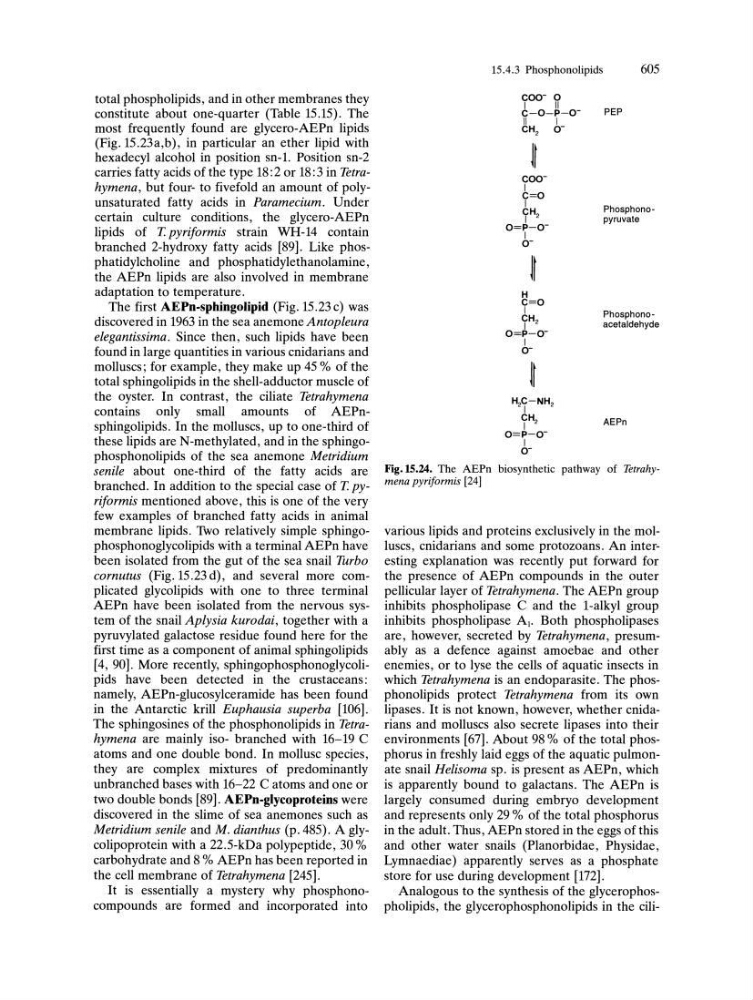
0Fig.lS.24. The AEPn biosynthetic pathway of Tetrahymena pyriformis [24]
various lipids and proteins exclusively in the molluscs, cnidarians and some protozoans. An interesting explanation was recently put forward for
the presence of AEPn compounds in the outer
pellicular layer of Tetrahymena. The AEPn group
inhibits phospholipase C and the I-alkyl group
inhibits phospholipase AI' Both phospholipases
are, however, secreted by Tetrahymena, presumably as a defence against amoebae and other
enemies, or to lyse the cells of aquatic insects in
which Tetrahymena is an endoparasite. The phosphonolipids protect Tetrahymena from its own
lipases. It is not known, however, whether cnidarians and molluscs also secrete lipases into their
environments [67]. About 98 % of the total phosphorus in freshly laid eggs of the aquatic pulmonate snail Helisoma sp. is present as AEPn, which
is apparently bound to galactans. The AEPn is
largely consumed during embryo development
and represents only 29 % of the total phosphorus
in the adult. Thus, AEPn stored in the eggs of this
and other water snails (Planorbidae, Physidae,
Lymnaediae) apparently serves as a phosphate
store for use during development [172].
Analogous to the synthesis of the glycerophospholipids, the glycerophosphonolipids in the cili-