

604
15 Lipids
[63]. Choline is essential for the dipterans but it
can be replaced in the diet by various analogues
which are also incorporated into phospholipids. It
is still not clear whether the three methylation
reactions from phosphatidylethanolamine to
phosphatidylcholine are catalysed in the mammals by one or two enzymes. In lower fungi, such
as yeast and Neurospora, there is genetic evidence for the existence of separate enzymes for the
first and the two following methylation steps. A
protein complex of 140-150 kDa has been isolated from Drosophila melanogaster and this has
all three methylation activities [249]. Tracer
experiments in the crustaceans, whose tissues are
especially rich in phospholipids, have confirmed
the presence of the vertebrate scheme of phospholipid biosynthesis (Fig. 15.22). Phosphatidylethanolamine and phospholipid arise from diacylglycerol (DAG) and a CDP base, and phosphatidylinositol and cardiolipin arise via CDPdiacylglycerol; phosphatidylserine can be decarboxylated to phosphatidylethanolamine [37]. The
phospholipid metabolism of the Porifera coincides with that of the higher animals. In Microciona
prolifera phosphatidylethanolamine and phosphatidylcholine are mainly synthesized from CDP
bases (Fig. 15.22, reactions 6 and 7); the methylation of phosphatidylethanolamine plays only a
minor role [143]. The reactions of the vertebrate
scheme have also been demonstrated in some
Protozoa, e.g. the formation of phosphatidyleta)
b)
hanolamine and phosphatidylcholine with DAG
and CDP bases in Tetrahymena, the production of
phosphatidylinositol from myo-inositol and CDPdiacylglycerol in Crithidia fasciculata, and the
pathway from phosphatidylserine via phosphatidylethanolamine to phosphatidylcholine in the
malarial parasite Plasmodium knowlesi.
15.4.3 Phosphonolipids
In 1959, Horiguchi discovered a novel lipid
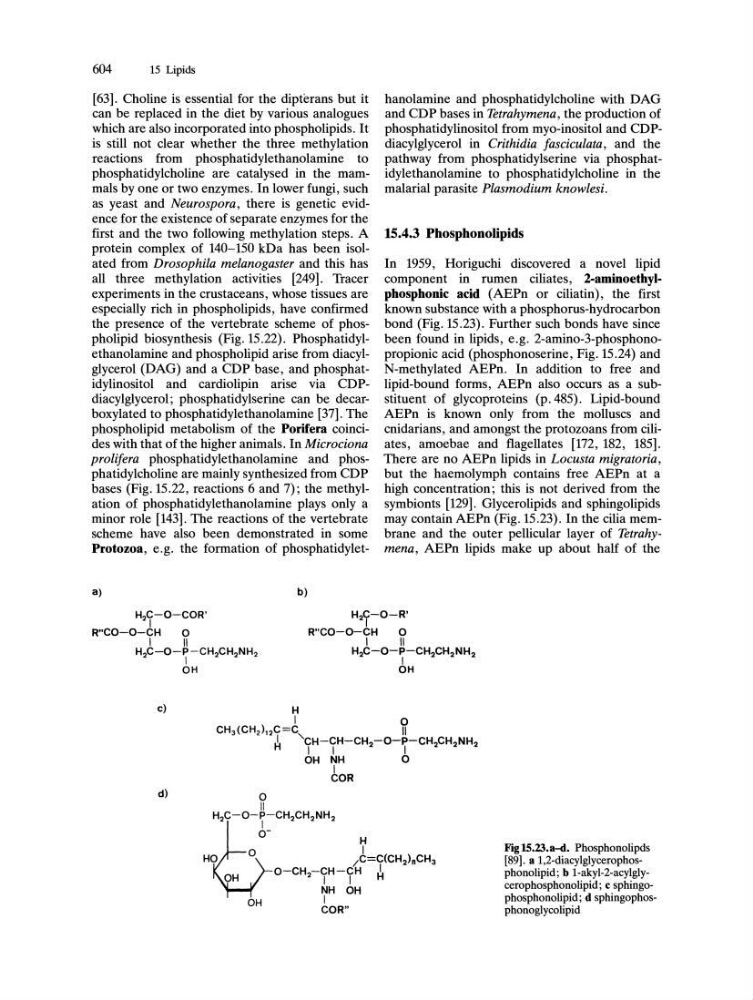
component in rumen ciliates, 2-aminoethylphosphonic acid (AEPn or ciliatin), the first
known substance with a phosphorus-hydrocarbon
bond (Fig. 15.23). Further such bonds have since
been found in lipids, e.g. 2-amino-3-phosphonopropionic acid (phosphonoserine, Fig. 15.24) and
N-methylated AEPn. In addition to free and
lipid-bound forms, AEPn also occurs as a substituent of glycoproteins (p.485). Lipid-bound
AEPn is known only from the molluscs and
cnidarians, and amongst the protozoans from ciliates, amoebae and flagellates [172, 182, 185].
There are no AEPn lipids in Locusta migratoria,
but the haemolymph contains free AEPn at a
high concentration; this is not derived from the
symbionts [129]. Glycerolipids and sphingolipids
may contain AEPn (Fig. 15.23). In the cilia membrane and the outer pellicular layer of Tetrahymena, AEPn lipids make up about half of the
H 2y -O-R'
R"CO-O-CH
0
d)
I
II
H2C-O-P-CH 2 CH2 NH2
I
OH
Fig 15.23.a-d. PhosphonoJipds
[89]. a 1,2-diacylglycerophosphonolipid; b 1-akyl-2-acylglycerophosphonolipid; c sphingophosphonolipid;d sphingophosphonoglycolipid