

608
15 Lipids
sialic acid-containing GSLs (gangliosides) have,
as yet, been found only in the vertebrates and the
echinoderms. The structural variety of the gangliosides is almost impossible to summarize. To the
variability of the carbohydrate portion, the longchain base and the fatty acid of all GSLs, may be
added the variable nature, number and position
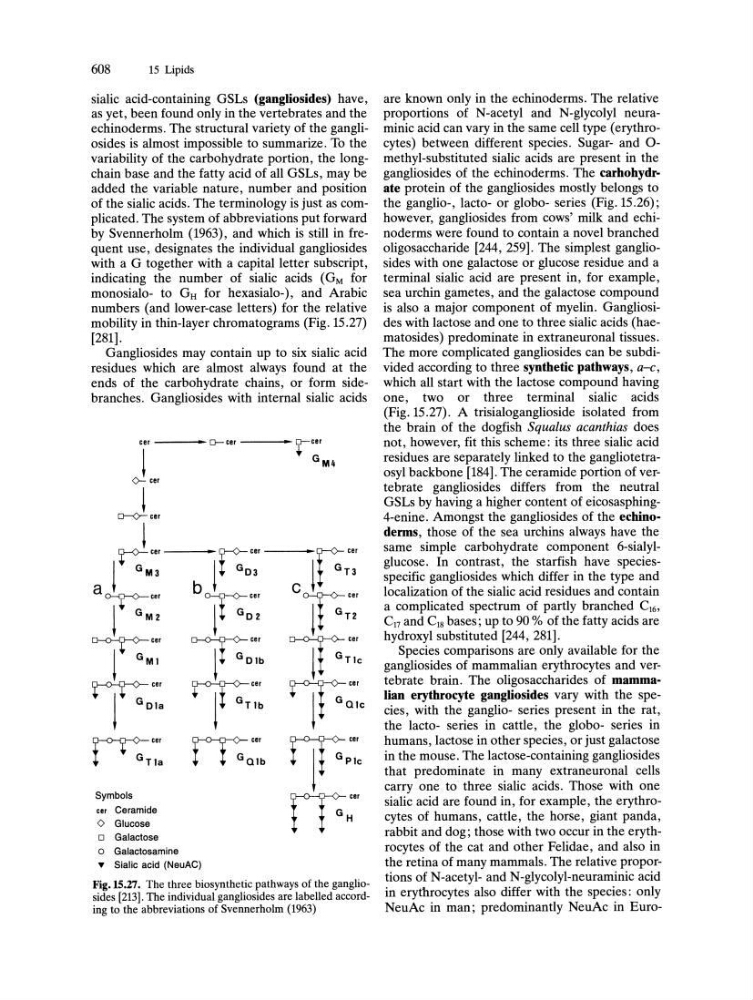
of the sialic acids. The terminology is just as complicated. The system of abbreviations put forward
by Svennerholm (1963), and which is still in frequent use, designates the individual gangliosides
with a G together with a capital letter subscript,
indicating the number of sialic acids (GM for
monosialo- to GH for hexasialo-), and Arabic
numbers (and lower-case letters) for the relative
mobility in thin-layer chromatograms (Fig. 15.27)
[281].
Gangliosides may contain up to six sialic acid
residues which are almost always found at the
ends of the carbohydrate chains, or form sidebranches. Gangliosides with internal sialic acids
cer
., Q-cer
., o-cer
~
... G M4
~cer
l
[]--<)-- cer
~
b l:-::' cW:;:
~cer
a t G
M3
0--0--0- cer
T"~'; !fa;:
...
! G M 2
~cer
T::~ T;;',
! G M1
~cer
~~: T'~';,
j G Dla
K c e r
n-vcer
rr-::~
G T1a
G Q1b
Symbols
n:'"
cer Ceramide
G H
<) Glucose
o Galactose
o Galactosamine
'" Sialic acid (NeuAC)
Fig.15.27. The three biosynthetic pathways of the gangliosides [213]. The individual gangliosides are labelled according to the abbreviations of Svennerholm (1963)
are known only in the echinoderms. The relative
proportions of N-acetyl and N-glycolyl neuraminic acid can vary in the same cell type (erythrocytes) between different species. Sugar- and 0methyl-substituted sialic acids are present in the
gangliosides of the echinoderms. The carhohydrate protein of the gangliosides mostly belongs to
the ganglio-, lacto- or globo- series (Fig. 15.26);
however, gangliosides from cows' milk and echinoderms were found to contain a novel branched
oligosaccharide [244, 259]. The simplest gangliosides with one galactose or glucose residue and a
terminal sialic acid are present in, for example,
sea urchin gametes, and the galactose compound
is also a major component of myelin. Gangliosides with lactose and one to three sialic acids (haematosides) predominate in extraneuronal tissues.
The more complicated gangliosides can be subdivided according to three synthetic pathways, a-c,
which all start with the lactose compound having
one, two or three terminal sialic acids
(Fig. 15.27). A trisialoganglioside isolated from
the brain of the dogfish Squalus acanthias does
not, however, fit this scheme: its three sialic acid
residues are separately linked to the gangliotetraosyl backbone [184]. The ceramide portion of vertebrate gangliosides differs from the neutral
GSLs by having a higher content of eicosasphing4-enine. Amongst the gangliosides of the echinoderms, those of the sea urchins always have the
same simple carbohydrate component 6-sialylglucose. In contrast, the starfish have speciesspecific gangliosides which differ in the type and
localization of the sialic acid residues and contain
a complicated spectrum of partly branched C16,
C17 and C18 bases; up to 90 % of the fatty acids are
hydroxyl substituted [244, 281].
Species comparisons are only available for the
gangliosides of mammalian erythrocytes and vertebrate brain. The oligo saccharides of mammalian erythrocyte gangliosides vary with the species, with the ganglio- series present in the rat,
the lacto- series in cattle, the globo- series in
humans, lactose in other species, or just galactose
in the mouse. The lactose-containing gangliosides
that predominate in many extraneuronal cells
carry one to three sialic acids. Those with one
sialic acid are found in, for example, the erythrocytes of humans, cattle, the horse, giant panda,
rabbit and dog; those with two occur in the erythrocytes of the cat and other Felidae, and also in
the retina of many mammals. The relative proportions of N-acetyl- and N-glycolyl-neuraminic acid
in erythrocytes also differ with the species: only
NeuAc in man; predominantly NeuAc in Euro-