

15.4 Membrane Lipids
597
Table 15.16. The lipid composition (mol %) of the mitochondria from different organs in the rat (R) and sheep (S) and
from the flight muscles of the housefly Musca domestica [55]
Liver
Heart
R
S
R
Cardiolipin
12-17
14
8
Phosphatidylethanolamine
22-36
19
44
choline
34-55
48
41
inositol
5- 8
4
3
serine
1
1
1
glycerol
1
Lyso-glycero-phospholipid
1- 2
27
1
Sphingomyelin
1- 3
1
Plasmalogen
2
3
However, the cell surface (pellicula) of Tetrahymena is atypical of animal cells: beneath the
plasma membrane, which also covers the cilia,
are two further membranes, the inner and outer
alveolar membranes. The membranes of the cell
surface and the cell organelles are significantly
different in their lipid composition but all have
phosphatidylcholine and phosphatidylethanolamine, as well as the unusual aminoethylphosphonolipid (Table 15.15). The usual sterols are
missing, but the rather odd pentacyclic tetrahymanol is present, especially in the cilia membrane
(see Fig. 16.3, p.626) [124]. The taurolipids of
Tetrahymena are also rather unique. In these, a
tri-, tetra- or pentahydroxystearic acid is bound to
the amino group of taurine by an amide bond,
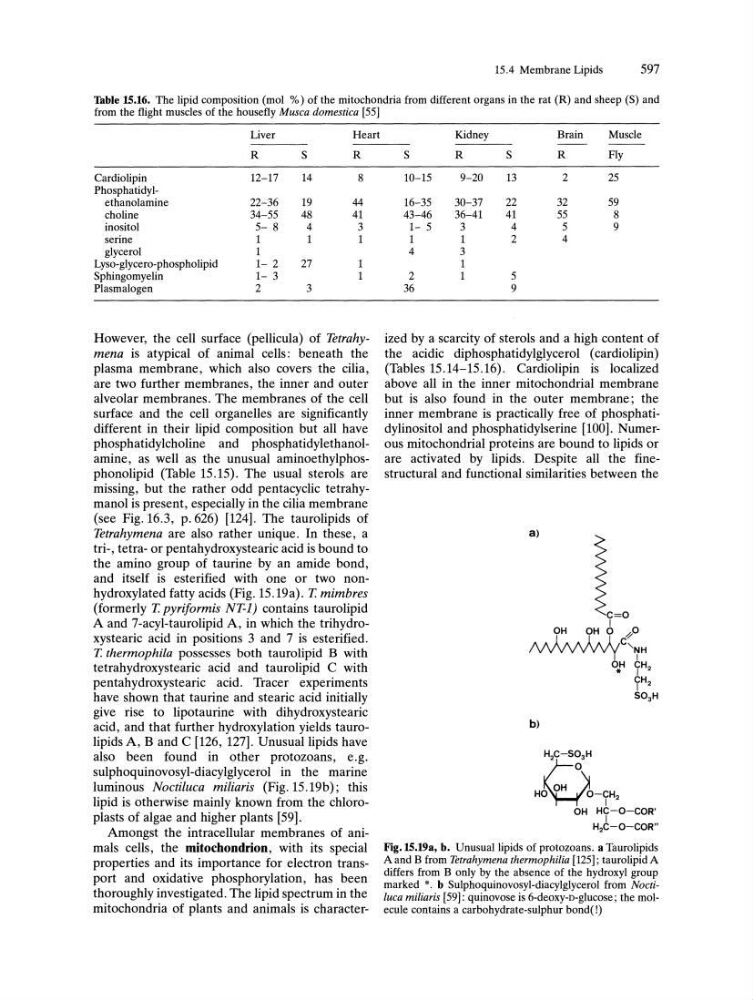
and itself is esterified with one or two nonhydroxylated fatty acids (Fig. 15.19a). T. mimbres
(formerly T. pyriformis NT-i) contains taurolipid
A and 7-acyl-taurolipid A, in which the trihydroxystearic acid in positions 3 and 7 is esterified.
T. thermophila possesses both taurolipid B with
tetrahydroxystearic acid and taurolipid C with
pentahydroxystearic acid. Tracer experiments
have shown that taurine and stearic acid initially
give rise to lipotaurine with dihydroxystearic
acid, and that further hydroxylation yields taurolipids A, Band C [126, 127]. Unusual lipids have
also been found in other protozoans, e.g.
sulphoquinovosyl-diacylglycerol in the marine
luminous Noctiluca miliaris (Fig. 15.19b); this
lipid is otherwise mainly known from the chloroplasts of algae and higher plants [59].
Amongst the intracellular membranes of animals cells, the mitochondrion, with its special
properties and its importance for electron transport and oxidative phosphorylation, has been
thoroughly investigated. The lipid spectrum in the
mitochondria of plants and animals is characterKidney
Brain
Muscle
S
R
S
R
Fly
10-15
9-20
13
2
25
16-35
30-37
22
32
59
43-46
36-41
41
55
8
1- 5
3
4
5
9
1
1
2
4
4
3
1
2
1
5
36
9
ized by a scarcity of sterols and a high content of
the acidic diphosphatidylglycerol (cardiolipin)
(Tables 15.14-15.16). Cardiolipin is localized
above all in the inner mitochondrial membrane
but is also found in the outer membrane; the
inner membrane is practically free of phosphatidylinositol and phosphatidylserine [100]. Numerous mitochondrial proteins are bound to lipids or
are activated by lipids. Despite all the finestructural and functional similarities between the
b)
H 2 C-S0 3 H
H~\CH ~12
OH HC-O-COR'
I
H2C-O-COR"
Fig. 15.19a, b. Unusual lipids of protozoans. a Taurolipids
A and B from Tetrahymena thermophilia [125]; taurolipid A
differs from B only by the absence of the hydroxyl group
marked *. b Sulphoquinovosyl-diacylglycerol from Noctiluca miliaris [59]: quinovose is 6-deoxY-D-glucose; the molecule contains a carbohydrate-sulphur bond(!)