

598
15 Lipids
mitochondria, there are considerable organ- and
species-specific differences [55, 100].
The mobility of membrane components, which
is apparently important for the various functions,
is described by terms like membrane fluidity,
membrane dynamics or the converse, membrane
viscosity. Membrane fluidity is determined by the
structural arrangement of the lipid components.
The relationships between lipid composition,
fluidity and biological function form one of the
most active research areas of cell biology
[124,287]. The fluidity of each cell membrane is
temperature dependent. At the so-called transition temperature (Tc) the membrane lipids suddenly change to higher structural order (crystalline) in which the mobility of the phospholipid
molecules is drastically reduced. Tc is dependent
upon the relative proportions of the different
lipid classes and directly proportional to the
length and degree of saturation of the fatty acids.
The homeothermic mammals and birds have a
constant high body temperature (except during
hibernation and conditions of lethargy). The cells
of all other organisms must be capable of adapting to changes in body temperature. In the process, the lipid composition of the membranes is so
modified that membrane fluidity remains constant. This homeoviscosity adaptation was discovered in 1974 by Sinensky in E. coli, and was
demonstrated in animals on the synaptosomes of
the goldfish brain in 1977. The process is apparently similar in all organisms but has been studied
in particular in bacteria, the ciliate Tetrahymena
and fish. Adaptation to temperature by cellular
membranes involves changes in the relative
amounts of the individual lipid classes as well as
changes in the degree of saturation and in the
chain length of the fatty acids, especially those of
the phospholipids. During cooling, phosphatidylcholine, including the related 1-alkenyl compound (plasmalogen), is reduced in favour of
phosphatidylethanolamine [37,43, 92,287]. In
fish and crustaceans, phosphatidy1choline is deacylated to lyso- compounds during cold periods
[37]. In the same conditions, both phosphatidylcholine and phosphatidylethanolamine are
reduced in Tetrahymena, whereas aminoethylphosphonolipid (AEPL), lyso-AEPL and lysophosphatidylethanolamine are increased. Investigations with Tetrahymena have shown that
the alterations in the lipid spectrum are regulated
independently of the changes in desaturation of
fatty acids and, furthermore, occur to very different extents in different membranes; for example,
they are much more drastic in the cilia membranes than in the microsomes [124, 216]. The rapid
reduction of temperature from 39.5 to 15°C,
which was typical in the Tetrahymena experiments, also appears to effect a reduction in the
tetrahymanol content [124]; this corresponds to
the lowering of cholesterol observed in the carp
[124,287]. A decrease in the degree of saturation
of the fatty acids in membrane lipids has been
recorded in cold-adapted bacteria, higher plants
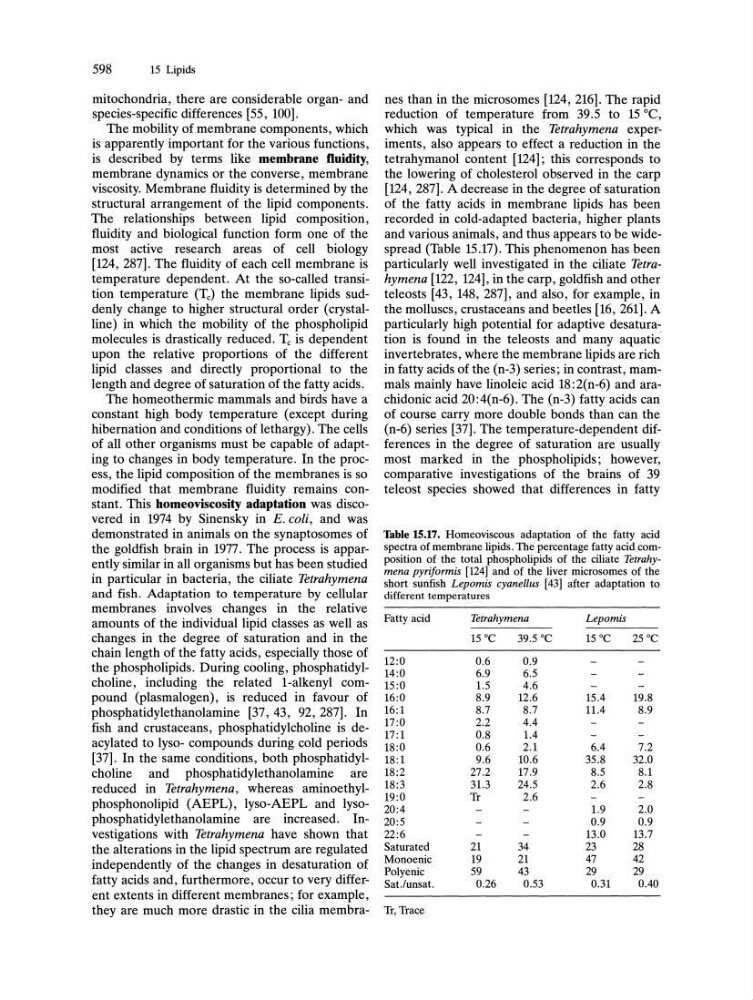
and various animals, and thus appears to be widespread (Table 15.17). This phenomenon has been
particularly well investigated in the ciliate Tetrahymena [122, 124], in the carp, goldfish and other
teleosts [43, 148,287], and also, for example, in
the molluscs, crustaceans and beetles [16, 261]. A
particularly high potential for adaptive desaturation is found in the teleosts and many aquatic
invertebrates, where the membrane lipids are rich
in fatty acids of the (n-3) series; in contrast, mammals mainly have linoleic acid 18:2(n-6) and arachidonic acid 20:4(n-6). The (n-3) fatty acids can
of course carry more double bonds than can the
(n-6) series [37]. The temperature-dependent differences in the degree of saturation are usually
most marked in the phospholipids; however,
comparative investigations of the brains of 39
teleost species showed that differences in fatty
Table 15.17. Homeoviscous adaptation of the fatty acid
spectra of membrane lipids. The percentage fatty acid composition of the total phospholipids of the ciliate Tetrahymena pyriformis [124] and of the liver microsomes of the
short sunfish Lepomis cyanellus [43] after adaptation to
different temperatures
Fatty acid
12:0
14:0
15:0
16:0
16:1
17:0
17:1
18:0
18:1
18:2
18:3
19:0
20:4
20:5
22:6
Saturated
Monoenic
Polyenic
Sat.!unsat.
Tr, Trace
Tetrahymena
15°C
0.6
6.9
1.5
8.9
8.7
2.2
0.8
0.6
9.6
27.2
31.3
Tr
21
19
59
0.26
39.5°C
0.9
6.5
4.6
12.6
8.7
4.4
1.4
2.1
10.6
17.9
24.5
2.6
34
21
43
0.53
Lepomis
15°C
25 °C
15.4
19.8
11.4
8.9
604
7.2
35.8
32.0
8.5
8.1
2.6
2.8
1.9
2.0
0.9
0.9
13.0
13.7
23
28
47
42
29
29
0.31
0040