

596
15 Lipids
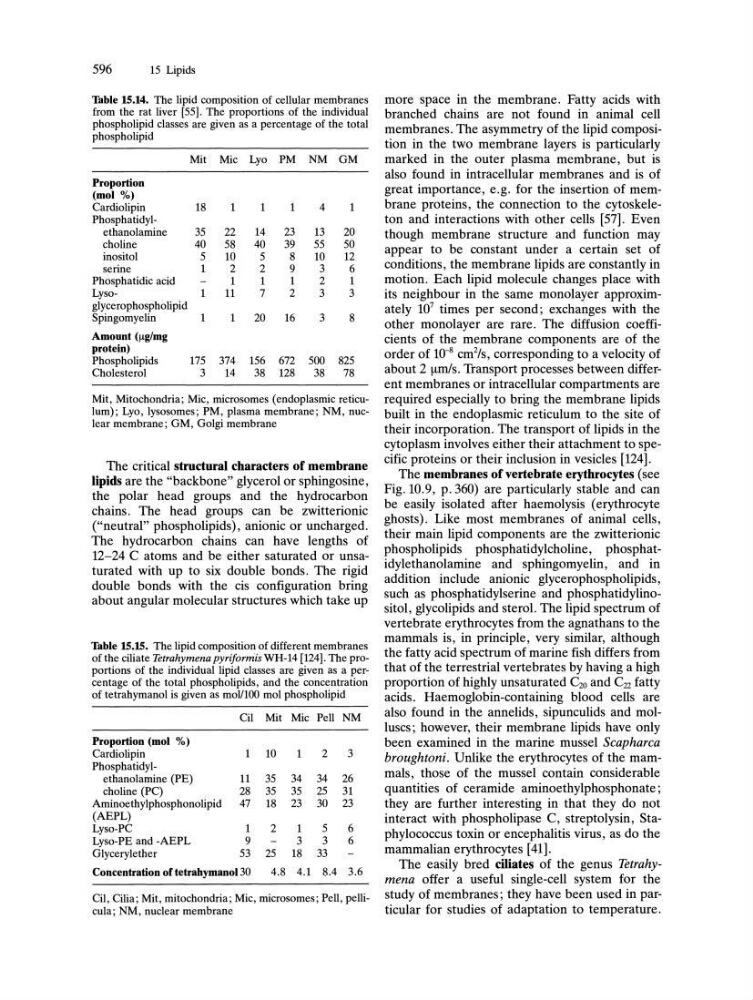
Table 15.14. The lipid composition of cellular membranes
from the rat liver [55]. The proportions of the individual
phospholipid classes are given as a percentage of the total
phospholipid
Mit Mic Lyo PM NM GM
Proportion
(mol %)
Cardiolipin
18
1
1
1
4
1
Phosphatidylethanolamine
35
22
14
23
13
20
choline
40
58
40
39
55
50
inositol
5
10
5
8
10
12
serine
1
2
2
9
3
6
Phosphatidic acid
1
1
1
2
1
Lyso1
11
7
2
3
3
glycerophospholipid
Spingomyelin
1
1
20
16
3
8
Amount (!!g/mg
protein)
Phospholipids
175 374 156 672 500 825
Cholesterol
3
14
38 128
38
78
Mit, Mitochondria; Mic, micro somes (endoplasmic reticulum); Lyo, lysosomes; PM, plasma membrane; NM, nuclear membrane; GM, Golgi membrane
The critical structural characters of membraue
lipids are the "backbone" glycerol or sphingosine,
the polar head groups and the hydrocarbon
chains. The head groups can be zwitterionic
("neutral" phospholipids), anionic or uncharged.
The hydrocarbon chains can have lengths of
12-24 C atoms and be either saturated or unsaturated with up to six double bonds. The rigid
double bonds with the cis configuration bring
about angular molecular structures which take up
Table 15.15. The lipid composition of different membranes
of the ciliate Tetrahymena pyrifomiis WH-14 [124]. The proportions of the individual lipid classes are given as a percentage of the total phospholipids, and the concentration
of tetrahymanol is given as mol/100 mol phospholipid
Cil Mit Mic Pell NM
Proportion (mol %)
Cardiolipin
1 10
1
2
3
Phosphatidylethanolamine (PE)
11 35 34 34 26
choline (PC)
28 35 35 25 31
Aminoethylphosphonolipid
47 18 23 30 23
(AEPL)
Lyso-PC
1
2
1
5
6
Lyso-PE and -AEPL
9
3
3
6
Glycerylether
53 25 18 33
Concentration of tetrahymanol30
4.8 4.1 8.4 3.6
Cil, Cilia; Mit, mitochondria; Mic, microsomes; Pell, pellicula; NM, nuclear membrane
more space in the membrane. Fatty acids with
branched chains are not found in animal cell
membranes. The asymmetry of the lipid composition in the two membrane layers is particularly
marked in the outer plasma membrane, but is
also found in intracellular membranes and is of
great importance, e.g. for the insertion of membrane proteins, the connection to the cytoskeleton and interactions with other cells [57]. Even
though membrane structure and function may
appear to be constant under a certain set of
conditions, the membrane lipids are constantly in
motion. Each lipid molecule changes place with
its neighbour in the same monolayer approximately 10 7 times per second; exchanges with the
other monolayer are rare. The diffusion coefficients of the membrane components are of the
order of 10--8 cm 2 /s, corresponding to a velocity of
about 2 fA.rn/s. Transport processes between different membranes or intracellular compartments are
required especially to bring the membrane lipids
built in the endoplasmic reticulum to the site of
their incorporation. The transport of lipids in the
cytoplasm involves either their attachment to specific proteins or their inclusion in vesicles [124].
The membranes of vertebrate erythrocytes (see
Fig. 10.9, p.360) are particularly stable and can
be easily isolated after haemolysis (erythrocyte
ghosts). Like most membranes of animal cells,
their main lipid components are the zwitterionic
phospholipids phosphatidylcholine, phosphatidylethanolamine and sphingomyelin, and in
addition include anionic glycerophospholipids,
such as phosphatidylserine and phosphatidylinositol, glycolipids and sterol. The lipid spectrum of
vertebrate erythrocytes from the agnathans to the
mammals is, in principle, very similar, although
the fatty acid spectrum of marine fish differs from
that of the terrestrial vertebrates by having a high
proportion of highly unsaturated C20 and C22 fatty
acids. Haemoglobin-containing blood cells are
also found in the annelids, sipunculids and molluscs; however, their membrane lipids have only
been examined in the marine mussel Scapharca
broughtoni. Unlike the erythrocytes of the mammals, those of the mussel contain considerable
quantities of ceramide aminoethylphosphonate;
they are further interesting in that they do not
interact with phospholipase C, streptolysin, Staphylococcus toxin or encephalitis virus, as do the
mammalian erythrocytes [41].
The easily bred ciliates of the genus Tetrahymena offer a useful single-cell system for the
study of membranes; they have been used in particular for studies of adaptation to temperature.