

lipids are lost with the exuviae and the integument
produces a new generation of lipid-synthesizing
oenocytes after every moult [115, 156].
The biosynthesis of branched hydrocarbons
has also been investigated during tracer experiments with insects [39, 74]. The fatty acid precursors of the 2-methylalkanes (iso-) with an even
number of C atoms apparently arise with
isobutyryl-CoA (from valine) as the primer, and
those with an odd number of C atoms have
isovaleryl-CoA (from leucine) as the primer
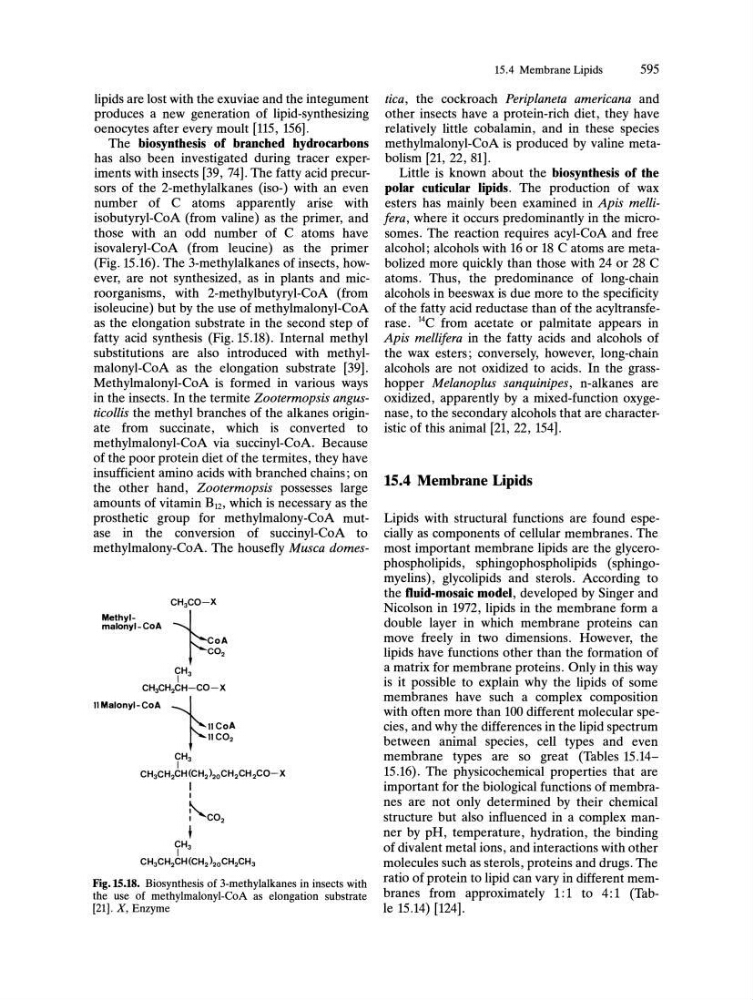
(Fig. 15.16). The 3-methylalkanes of insects, however, are not synthesized, as in plants and microorganisms, with 2-methylbutyryl-CoA (from
isoleucine) but by the use of methylmalonyl-CoA
as the elongation substrate in the second step of
fatty acid synthesis (Fig. 15.18). Internal methyl
substitutions are also introduced with methylmalonyl-CoA as the elongation substrate [39].
Methylmalonyl-CoA is formed in various ways
in the insects. In the termite Zootermopsis angusticollis the methyl branches of the alkanes originate from succinate, which is converted to
methylmalonyl-CoA via succinyl-CoA. Because
of the poor protein diet of the termites, they have
insufficient amino acids with branched chains; on
the other hand, Zootermopsis possesses large
amounts of vitamin B1z, which is necessary as the
prosthetic group for methylmalony-CoA mutase in the conversion of succinyl-CoA to
Methylmalonyl- CoA
CH3
I
CH3CH2CH-CO-X
IIMalonyl-CoA t
IICoA
11 CO2
CH3
I
CH3 CH2CH (CH2)20CH2CH2CO- X
I
I
~C02
~
CH3
I
CH3CH2CH (CH2 )20 CH2CH 3
Fig.15.18. Biosynthesis of 3-methylalkanes in insects with
the use of methylmalonyl-CoA as elongation substrate
[21]. X, Enzyme
15.4 Membrane Lipids
595
tica, the cockroach Periplaneta americana and
other insects have a protein-rich diet, they have
relatively little cobalamin, and in these species
methylmalonyl-CoA is produced by valine metabolism [21, 22, 81].
Little is known about the biosynthesis of the
polar cuticular lipids. The production of wax
esters has mainly been examined in Apis mellifera, where it occurs predominantly in the microsomes. The reaction requires acyl-CoA and free
alcohol; alcohols with 16 or 18 C atoms are metabolized more quickly than those with 24 or 28 C
atoms. Thus, the predominance of long-chain
alcohols in beeswax is due more to the specificity
of the fatty acid reductase than of the acyltransferase. 14C from acetate or palmitate appears in
Apis mellifera in the fatty acids and alcohols of
the wax esters; conversely, however, long-chain
alcohols are not oxidized to acids. In the grasshopper Melanoplus sanquinipes, n-alkanes are
oxidized, apparently by a mixed-function oxygenase, to the secondary alcohols that are characteristic of this animal [21, 22, 154].
15.4 Membrane Lipids
Lipids with structural functions are found especially as components of cellular membranes. The
most important membrane lipids are the glycerophospholipids, sphingophospholipids (sphingomyelins), glycolipids and sterols. According to
the fluid-mosaic model, developed by Singer and
Nicolson in 1972, lipids in the membrane form a
double layer in which membrane proteins can
move freely in two dimensions. However, the
lipids have functions other than the formation of
a matrix for membrane proteins. Only in this way
is it possible to explain why the lipids of some
membranes have such a complex composition
with often more than 100 different molecular species, and why the differences in the lipid spectrum
between animal species, cell types and even
membrane types are so great (Tables 15.1415.16). The physicochemical properties that are
important for the biological functions of membranes are not only determined by their chemical
structure but also influenced in a complex manner by pH, temperature, hydration, the binding
of divalent metal ions, and interactions with other
molecules such as sterols, proteins and drugs. The
ratio of protein to lipid can vary in different membranes from approximately 1: 1 to 4: 1 (Table 15.14) [124].