

590
15 Lipids
a)
b)
CH 30
I
.::./\/\1\./\/\
H-C-O-C' v v v V '\
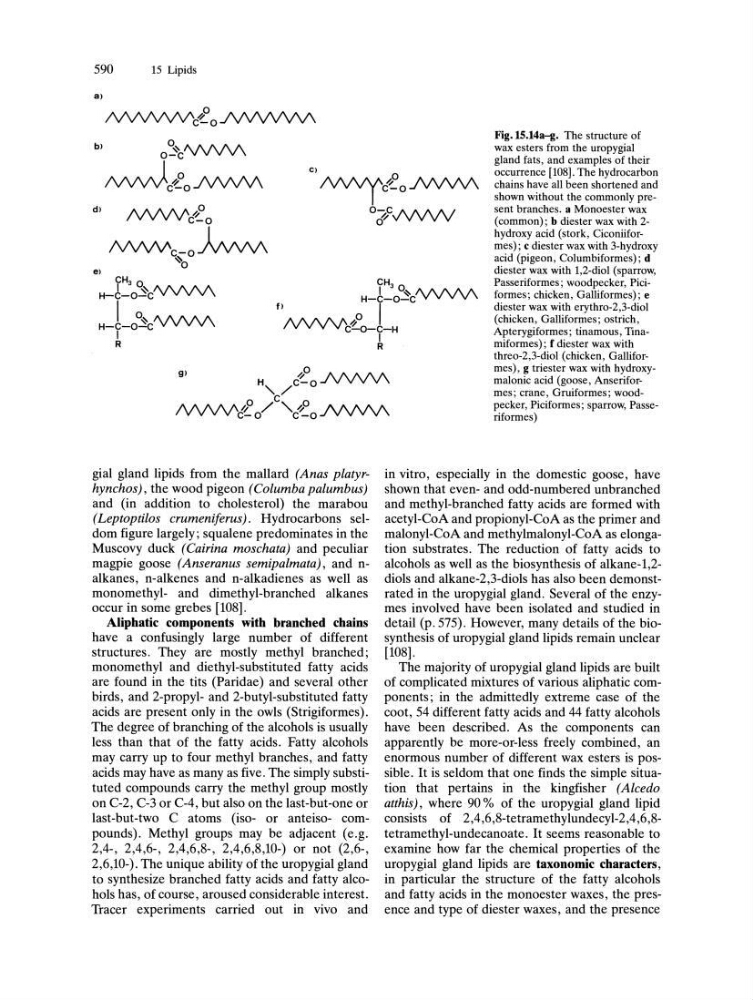
Fig.15.14a-g. The structure of
wax esters from the uropygial
gland fats, and examples of their
occurrence [108]. The hydrocarbon
chains have all been shortened and
shown without the commonly present branches. a Monoester wax
(common); b diester wax with 2hydroxy acid (stork, Ciconiiformes); c diester wax with 3-hydroxy
acid (pigeon, Columbiformes); d
diester wax with 1,2-diol (sparrow,
Passeriformes; woodpecker, Piciformes; chicken, Galliformes); e
diester wax with erythro-2,3-diol
(chicken, Galliformes; ostrich,
Apterygiformes; tinamous, Tinamiformes); f diester wax with
threo-2,3-diol (chicken, Galliformes), g triester wax with hydroxymalonic acid (goose, Anseriformes; crane, Gruiformes; woodpecker, Piciformes; sparrow, Passeriformes)
f)
I
/\ I\. I\. I\. A /,0
I v v V v C~O-C-H
gial gland lipids from the mallard (Anas platyrhynchos), the wood pigeon (Columba palumbus)
and (in addition to cholesterol) the marabou
(Leptoptilos crumeniferus). Hydrocarbons seldom figure largely; squalene predominates in the
Muscovy duck (Cairina moschata) and peculiar
magpie goose (Anseranus semipalmata), and nalkanes, n-alkenes and n-alkadienes as well as
monomethyl- and dimethyl-branched alkanes
occur in some grebes [108].
Aliphatic components with branched chains
have a confusingly large number of different
structures. They are mostly methyl branched;
monomethyl and diethyl-substituted fatty acids
are found in the tits (Paridae) and several other
birds, and 2-propyl- and 2-butyl-substituted fatty
acids are present only in the owls (Strigiformes).
The degree of branching of the alcohols is usually
less than that of the fatty acids. Fatty alcohols
may carry up to four methyl branches, and fatty
acids may have as many as five. The simply substituted compounds carry the methyl group mostly
on C-2, C-3 or C-4, but also on the last-but-one or
last-but-two C atoms (iso- or anteiso- compounds). Methyl groups may be adjacent (e.g.
2,4-, 2,4,6-, 2,4,6,8-, 2,4,6,8,10-) or not (2,6-,
2,6,10-). The unique ability of the uropygial gland
to synthesize branched fatty acids and fatty alcohols has, of course, aroused considerable interest.
Tracer experiments carried out in vivo and
I
R
in vitro, especially in the domestic goose, have
shown that even- and odd-numbered unbranched
and methyl-branched fatty acids are formed with
acetyl-Co A and propionyl-CoA as the primer and
malonyl-CoA and methylmalonyl-CoA as elongation substrates. The reduction of fatty acids to
alcohols as well as the biosynthesis of alkane-1,2diols and alkane-2,3-diols has also been demonstrated in the uropygial gland. Several of the enzymes involved have been isolated and studied in
detail (p. 575). However, many details of the biosynthesis of uropygial gland lipids remain unclear
[108].
The majority of uropygial gland lipids are built
of complicated mixtures of various aliphatic components; in the admittedly extreme case of the
coot, 54 different fatty acids and 44 fatty alcohols
have been described. As the components can
apparently be more-or-Iess freely combined, an
enormous number of different wax esters is possible. It is seldom that one finds the simple situation that pertains in the kingfisher (Alcedo
atthis), where 90 % of the uropygial gland lipid
consists of 2,4,6,8-tetramethylundecyl-2,4,6,8tetramethyl-undecanoate. It seems reasonable to
examine how far the chemical properties of the
uropygial gland lipids are taxonomic characters,
in particular the structure of the fatty alcohols
and fatty acids in the monoester waxes, the presence and type of diester waxes, and the presence