

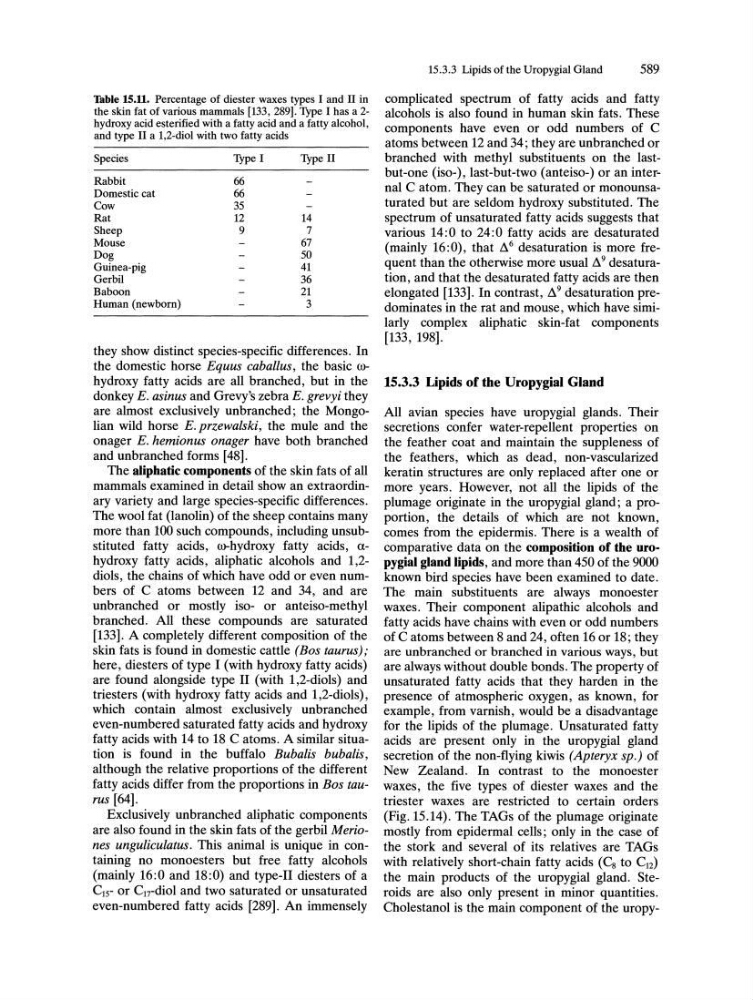
Table 15.11. Percentage of diester waxes types I and II in
the skin fat of various mammals [133, 289]. Type I has a 2hydroxy acid esterified with a fatty acid and a fatty alcohol,
and type II a 1,2-diol with two fatty acids
Species
Rabbit
Domestic cat
Cow
Rat
Sheep
Mouse
Dog
Guinea-pig
Gerbil
Baboon
Human (newborn)
Type I
66
66
35
12
9
Type II
14
7
67
50
41
36
21
3
they show distinct species-specific differences. In
the domestic horse Equus cabal/us, the basic 00hydroxy fatty acids are all branched, but in the
donkey E. asinus and Grevy's zebra E. grevyi they
are almost exclusively unbranched; the Mongolian wild horse E. przewalski, the mule and the
onager E. hemionus onager have both branched
and unbranched forms [48].
The aliphatic components of the skin fats of all
mammals examined in detail show an extraordinary variety and large species-specific differences.
The wool fat (lanolin) of the sheep contains many
more than 100 such compounds, including unsubstituted fatty acids, w-hydroxy fatty acids, ahydroxy fatty acids, aliphatic alcohols and 1,2diols, the chains of which have odd or even numbers of C atoms between 12 and 34, and are
unbranched or mostly iso- or anteiso-methyl
branched. All these compounds are saturated
[133]. A completely different composition of the
skin fats is found in domestic cattle (Bos taurus);
here, diesters of type I (with hydroxy fatty acids)
are found alongside type II (with 1,2-diols) and
triesters (with hydroxy fatty acids and 1 ,2-diols),
which contain almost exclusively unbranched
even-numbered saturated fatty acids and hydroxy
fatty acids with 14 to 18 C atoms. A similar situation is found in the buffalo Bubalis bubalis,
although the relative proportions of the different
fatty acids differ from the proportions in Bos taurus [64].
Exclusively unbranched aliphatic components
are also found in the skin fats of the gerbil Meriones unguliculatus. This animal is unique in containing no monoesters but free fatty alcohols
(mainly 16:0 and 18:0) and type-II diesters of a
C1S- or C17-diol and two saturated or unsaturated
even-numbered fatty acids [289]. An immensely
15.3.3 Lipids of the Uropygial Gland
589
complicated spectrum of fatty acids and fatty
alcohols is also found in human skin fats. These
components have even or odd numbers of C
atoms between 12 and 34; they are unbranched or
branched with methyl substituents on the lastbut-one (iso-), last-but-two (anteiso-) or an internal C atom. They can be saturated or monounsaturated but are seldom hydroxy substituted. The
spectrum of unsaturated fatty acids suggests that
various 14: 0 to 24: 0 fatty acids are desaturated
(mainly 16:0), that 1:1 6 desaturation is more frequent than the otherwise more usual 1:1 9 desaturation, and that the de saturated fatty acids are then
elongated [133]. In contrast, 1:1 9 desaturation predominates in the rat and mouse, which have similarly complex aliphatic skin-fat components
[133, 198].
15.3.3 Lipids of the Uropygial Gland
All avian species have uropygial glands. Their
secretions confer water-repellent properties on
the feather coat and maintain the suppleness of
the feathers, which as dead, non-vascularized
keratin structures are only replaced after one or
more years. However, not all the lipids of the
plumage originate in the uropygial gland; a proportion, the details of which are not known,
comes from the epidermis. There is a wealth of
comparative data on the composition of the uropygial gland lipids, and more than 450 of the 9000
known bird species have been examined to date.
The main substituents are always monoester
waxes. Their component alipathic alcohols and
fatty acids have chains with even or odd numbers
of C atoms between 8 and 24, often 16 or 18; they
are unbranched or branched in various ways, but
are always without double bonds. The property of
unsaturated fatty acids that they harden in the
presence of atmospheric oxygen, as known, for
example, from varnish, would be a disadvantage
for the lipids of the plumage. Unsaturated fatty
acids are present only in the uropygial gland
secretion of the non-flying kiwis (Apteryx sp.) of
New Zealand. In contrast to the monoester
waxes, the five types of diester waxes and the
triester waxes are restricted to certain orders
(Fig. 15.14). The TAGs of the plumage originate
mostly from epidermal cells; only in the case of
the stork and several of its relatives are TAGs
with relatively short-chain fatty acids (C s to Cll)
the main products of the uropygial gland. Steroids are also only present in minor quantities.
Cholestanol is the main component of the uropy-