

588
15 Lipids
a)
b) NVVV'c!::'O/VVVV\/:'o.lVVVV\
C)
NV\f\.I\,p C~O-CH2
/\/VVV\t'o-!.NvVV\
H
e)
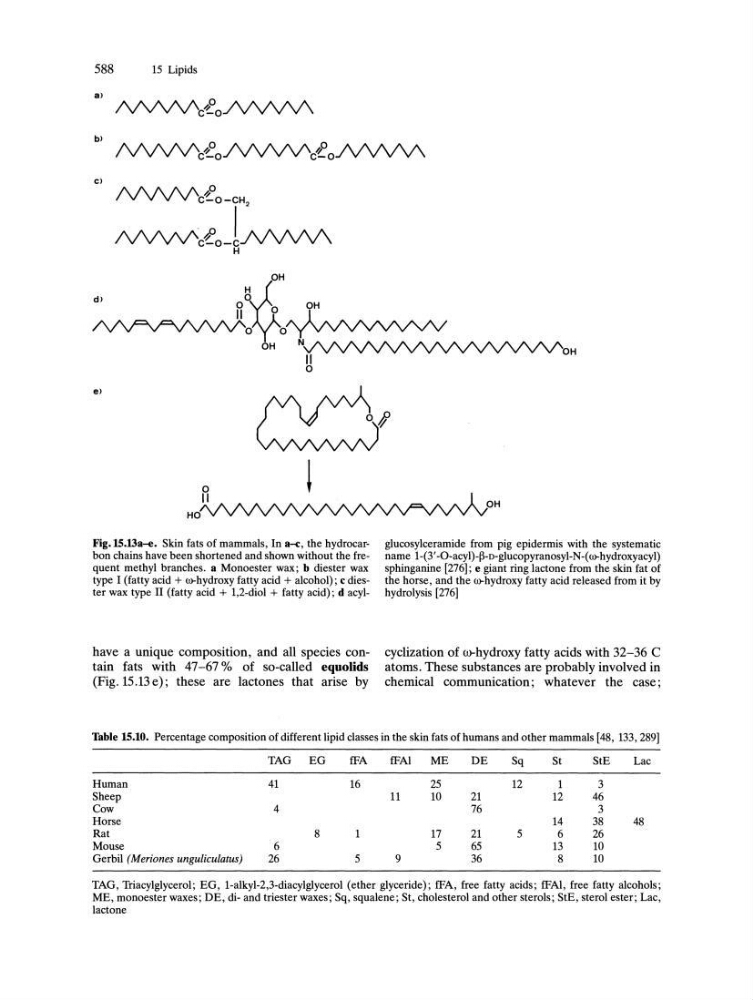
Fig.15.13a-e. Skin fats of mammals, In a-c, the hydrocarbon chains have been shortened and shown without the frequent methyl branches. a Monoester wax; b diester wax
type I (fatty acid + w-hydroxy fatty acid + alcohol); c diester wax type II (fatty acid + 1,2-diol + fatty acid); d acylhave a unique composition, and all species contain fats with 47-67 % of so-called equolids
(Fig. 15.13e); these are lactones that arise by
glucosylceramide from pig epidermis with the systematic
name 1-(3'-0-acyl)-~-D-glucopyranosyl-N-( w-hydroxyacyl)
sphinganine [276]; e giant ring lactone from the skin fat of
the horse, and the w-hydroxy fatty acid released from it by
hydrolysis [276]
cyclization of w-hydroxy fatty acids with 32-36 C
atoms. These substances are probably involved in
chemical communication; whatever the case;
Table 15.10. Percentage composition of different lipid classes in the skin fats of humans and other mammals [48, 133,289]
TAG
EG
fFA
fFAl
ME
DE
Sq
St
StE
Lac
Human
41
16
25
12
1
3
Sheep
11
10
21
12
46
Cow
4
76
3
Horse
14
38
48
Rat
8
1
17
21
5
6
26
Mouse
6
5
65
13
10
Gerbil (Meriones unguliculatus)
26
5
9
36
8
10
TAG, Triacylglycerol; EG, l-alkyl-2,3-diacylglycerol (ether glyceride); fFA, free fatty acids; fFAl, free fatty alcohols;
ME, monoester waxes; DE, di- and triester waxes; Sq, squalene; St, cholesterol and other sterols; StE, sterol ester; Lac,
lactone