

576
15 Lipids
endoplasmic reticulum and is stimulated in vitro
by ascorbic acid, like the plant and mammalian
enzymes, but is not stimulated by ATP, CoA,
NADH or NADPH [44].
15.1.4 Oxidation of Fatty Acids
~-Oxidation cleaves Cz fragments (acetyl-CoA)
from acyl-CoA and these can then function as, for
example, the starting material for the de novo
synthesis of fatty acids and sterols, or energyyielding substrates. The complete degradation of
fatty acids occurs in the mitochondria, and partial
~-oxidation in the peroxisomes. The order of the
reactions is the same for both systems but the
enzymes involved differ significantly. The peroxisomal system brings about the shortening of longchain fatty acids and also the ~-oxidation of other
substances from the body's own metabolism or of
xenobiotics. The two different ~-oxidation systems are found only in animals; plants, lower
fungi and yeast have only one type of peroxisomal
system in the microbodies [235]. In addition to ~oxidation of acyl-CoA, free fatty acids are subject
to a-oxidation in the mitochondria and (Doxidation in the cytoplasm. Because of its relatively large mass, the musculature contributes significantly to the ~-oxidation of fatty acids and to
the metabolism of ketone bodies; the heart is also
very active in this respect. In addition to ~oxidation, the liver and kidney show considerable
ketone-body formation, and the fat tissue also
synthesizes triacylglycerols [195].
Prior to transport into the mitochondria, fatty
acids must be bound to CoA by the activity of
acyl-CoA synthetases of the cytosol or the outer
mitochondrial membrane. An acyl-CoA synthe+
(CH 3 \N-CH2CHCH 2 COO6-CO-R
Acylcarnitine
tase from the rat shows a surprising 36 % agreement with firefly luciferase in part (amino acids
458-592) of its sequence of 699 amino acids
[257]. A further acyl-CoA synthetase that is specific for fatty acids with more than 22 C atoms is
present in the peroxisomes of rat liver but not in
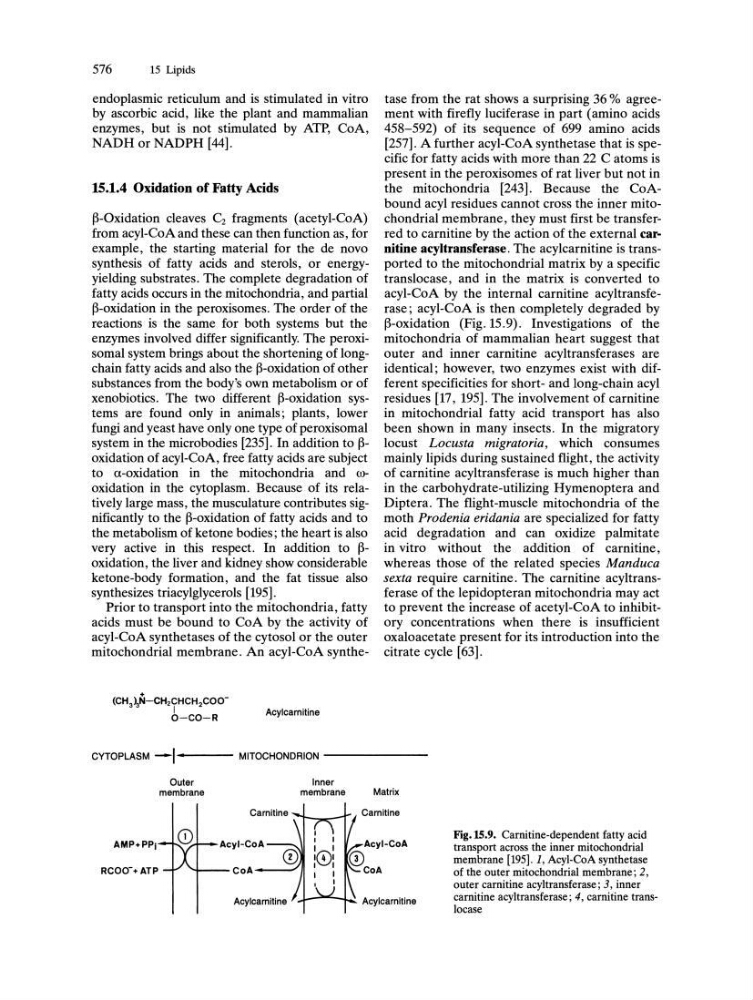
the mitochondria [243]. Because the CoAbound acyl residues cannot cross the inner mitochondrial membrane, they must first be transferred to carnitine by the action of the external carnitine acyltransferase. The acylcarnitine is transported to the mitochondrial matrix by a specific
translocase, and in the matrix is converted to
acyl-CoA by the internal carnitine acyltransferase; acyl-CoA is then completely degraded by
~-oxidation (Fig. 15.9). Investigations of the
mitochondria of mammalian heart suggest that
outer and inner carnitine acyltransferases are
identical; however, two enzymes exist with different specificities for short- and long-chain acyl
residues [17, 195]. The involvement of carnitine
in mitochondrial fatty acid transport has also
been shown in many insects. In the migratory
locust Locusta migratoria, which consumes
mainly lipids during sustained flight, the activity
of carnitine acyltransferase is much higher than
in the carbohydrate-utilizing Hymenoptera and
Diptera. The flight-muscle mitochondria of the
moth Prodenia eridania are specialized for fatty
acid degradation and can oxidize palmitate
in vitro without the addition of carnitine,
whereas those of the related species Manduca
sexta require carnitine. The carnitine acyltransferase of the lepidopteran mitochondria may act
to prevent the increase of acetyl-CoA to inhibitory concentrations when there is insufficient
oxaloacetate present for its introduction into the
citrate cycle [63].
CYTOPLASM -I .
MITOCHONDRION - - - - - - - -
AMP+PPi
RCOO-+ATP
Outer
membrane
Acyl-CoA
' 1 - - - C o A - - -
Acylcarnitine
Inner
membrane
Matrix
Acylcarnitine
Fig.15.9. Carnitine-dependent fatty acid
transport across the inner mitochondrial
membrane [195].1, Acyl-CoA synthetase
of the outer mitochondrial membrane; 2,
outer carnitine acyltransferase; 3, inner
carnitine acyltransferase; 4, carnitine translocase