

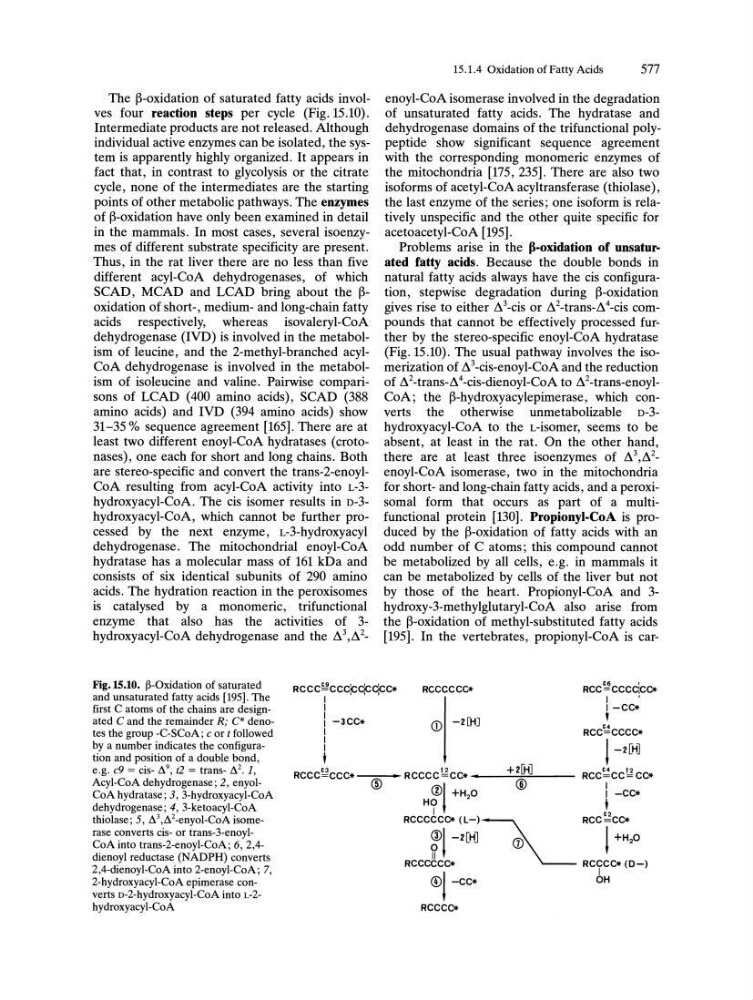
The ~-oxidation of saturated fatty acids involves four reaction steps per cycle (Fig. 15.10).
Intermediate products are not released. Although
individual active enzymes can be isolated, the system is apparently highly organized. It appears in
fact that, in contrast to glycolysis or the citrate
cycle, none of the intermediates are the starting
points of other metabolic pathways. The enzymes
of ~-oxidation have only been examined in detail
in the mammals. In most cases, several isoenzymes of different substrate specificity are present.
Thus, in the rat liver there are no less than five
different acyl-CoA dehydrogenases, of which
SCAD, MCAD and LCAD bring about the ~oxidation of short-, medium- and long-chain fatty
acids respectively, whereas isovaleryl-CoA
dehydrogenase (IVD) is involved in the metabolism of leucine, and the 2-methyl-branched acylCoA dehydrogenase is involved in the metabolism of isoleucine and valine. Pairwise comparisons of LCAD (400 amino acids), SCAD (388
amino acids) and IVD (394 amino acids) show
31-35 % sequence agreement [165]. There are at
least two different enoyl-CoA hydratases (crotonases), one each for short and long chains. Both
are stereo-specific and convert the trans-2-enoylCoA resulting from acyl-CoA activity into L-3hydroxyacyl-CoA. The cis isomer results in D-3hydroxyacyl-CoA, which cannot be further processed by the next enzyme, L-3-hydroxyacyl
dehydrogenase. The mitochondrial enoyl-CoA
hydratase has a molecular mass of 161 kDa and
consists of six identical subunits of 290 amino
acids. The hydration reaction in the peroxisomes
is catalysed by a monomeric, trifunctional
enzyme that also has the activities of 3hydroxyacyl-CoA dehydrogenase and the ~3,~2_
15.1.4 Oxidation of Fatty Acids
577
enoyl-CoA isomerase involved in the degradation
of unsaturated fatty acids. The hydratase and
dehydrogenase domains of the trifunctional polypeptide show significant sequence agreement
with the corresponding monomeric enzymes of
the mitochondria [175, 235]. There are also two
isoforms of acetyl-CoA acyltransferase (thiolase),
the last enzyme of the series; one isoform is relatively unspecific and the other quite specific for
acetoacetyl-CoA [195].
Problems arise in the p-oxidation of unsaturated fatty acids. Because the double bonds in
natural fatty acids always have the cis configuration, stepwise degradation during ~-oxidation
gives rise to either ~3-cis or ~2-trans-~4-cis compounds that cannot be effectively processed further by the stereo-specific enoyl-CoA hydratase
(Fig. 15.10). The usual pathway involves the isomerization of ~ 3 -cis-enoyl-CoA and the reduction
of ~ 2-trans-~ 4-cis-dienoyl-CoA to ~ 2-trans-enoylCoA; the ~-hydroxyacylepimerase, which converts the otherwise unmetabolizable D-3hydroxyacyl-CoA to the L-isomer, seems to be
absent, at least in the rat. On the other hand,
there are at least three isoenzymes of ~3,~2_
enoyl-CoA isomerase, two in the mitochondria
for short- and long-chain fatty acids, and a peroxisomal form that occurs as part of a multifunctional protein [130]. Propionyl-CoA is produced by the ~-oxidation of fatty acids with an
odd number of C atoms; this compound cannot
be metabolized by all cells, e.g. in mammals it
can be metabolized by cells of the liver but not
by those of the heart. Propionyl-CoA and 3hydroxy-3-methylglutaryl-CoA also arise from
the ~-oxidation of methyl-substituted fatty acids
[195]. In the vertebrates, propionyl-CoA is carFig.l5.10. ~-Oxidation of saturated
and unsaturated fatty acids [195]. The
first C atoms of the chains are designated C and the remainder R; C* denotes the group -C-SCoA; c or t followed
by a number indicates the configuration and position of a double bond,
e.g. c9 = cis- /).9, t2 = trans- /).2. 1,
Acyl-CoA dehydrogenase; 2, enyolCoA hydratase; 3, 3-hydroxyacyl-CoA
dehydrogenase; 4, 3-ketoacyl-CoA
thiolase; 5, /). 3 ,/). 2 -enyol-CoA isomerase converts cis- or trans-3-enoylCoA into trans-2-enoyl-CoA; 6, 2,4dienoyl reductase (NADPH) converts
2,4-dienoyl-CoA into 2-enoyl-CoA; 7,
2-hydroxyacyl-CoA epimerase converts o-2-hydroxyacyl-CoA into L-2hydroxyacyl-CoA
RCcc~ccc:Cdcdcc* I
I
1
I
RCCCCCC*
<6
,
RCC=CCCC:CC*
I
'
I -CC*
•
I
I
I -3CC*
CD -2[H]
<.
I
RCC=CCCC*
~
l-2CH]
RCCC~ccc*-~-. RCCCC~cc* •
+2[H]
RCC~CC~cc*
®
01 +H20 ®
I -cC*
HO
t
I
<2
RCCCCCC* (L-)~ RCC=CC*
~l-2[HJ
(])
l +H20
II
RCCCCCC*
RCCCC* (0-)
®l-cc*
6H
RCCCC*