

with phospholipid as the substrate and prefers
NADH as the cosubstrate. In contrast, the insect
~lz-desaturase uses acyl-CoA as the substrate,
like all animal desaturases, and is more active
with NADPH than with NADH [23, 52]. Drosophila melanogaster appears to represent a fourth
group of insects which neither synthesize nor
require PUFAs. Fruit flies reared for ten generations on a PUFA-free diet still contained polyunsaturated Czo fatty acids [23].
Just how sponges and molluscs produce the
PUFAs described above, whose double bonds are
separated by more than one CHz group (nonmethylene interrupted), has not been defined in
detail [293]. The marine sponge Microciona prolifera synthesizes 26:3(5,9,19) from 16:1(9) by
elongation and de saturation at positions 5 and 9,
and the freshwater sponge Ephydatia ftuviatilis
can convert 26:2(5,9) to 26:3(5,9,19) by means of
a ~ 19-desaturase. This is the first evidence for a
~19-desaturase in a living organism [80]. The
metabolism of unsaturated fatty acids by the Protozoa shows even greater deviation from the
metabolic patterns of the Eumetazoa. However,
there is also large variation between the different
groups, indicating once again how the so-called
protozoans are an extremely heterogeneous collection from a comparative biochemistry standpoint. Oleic acid is essential for the ciliate Paramecium aurelia but can be further metabolized to
18:2(n-6), 18:3(n-6) and 20:4(n-6) [221]. The ciliate Tetrahymena can not only desaturate stearic
acid to oleic acid and further to linoleic acid
18:(n-6) and y-linolenic acid 18:3(n-6) but can
also elongate palmitoleic acid 16: l(n-7) to vaccenic acid 18: l(n-7); Acanthamoeba and other
amoeba species have a similar capacity [137].
Many of the Kinetoplastida, e.g. Crithidia, produce mainly 18:0 and 18:1 and the (n-6) fatty
acids 18:2, 18:3 and 22:5 from acetate. Other
Kinetoplastida, like Trypanosoma lewisi, synthesize mainly the highly unsaturated, long-chain
fatty acids 20:5, 22:5 and 22:6; the predominant
C16 and CIS fatty acids of their spectrum are apparently taken up from the blood of the host.
In contrast to desaturation of the fatty acids,
the hydrogenation of double bonds has been relatively little investigated. The utilization of fatty
acids as hydrogen acceptors by rumen symbionts,
and the resulting complete saturation of all unsaturated fatty acids was referred to above. In this
way, for example, oleic and linoleic acids are
quantitatively converted to stearic acid. The corresponding metabolism in animals has been
demonstrated in the mitochondria of rat liver,
15.1.3 Conversion of Fatty Acids
575
where the double bond at C-4 of 22:4(n-9) is
hydrogenated by a specific 4-enoyl reductase.
The reduction of free fatty acids to long-chain
alcohols requires CoA and NADPH. The corresponding reductase activity has been investigated
in, for example, the uropygial glands of the bunting Zonotrichia leucophrys and the ovary of the
gourami Trichogaster cosby, where intensive synthesis of wax esters occurs [108]. Traces of the
presumed intermediate aldehyde have also been
detected; the alcohols produced are simultaneously incorporated into the wax esters. Because
of differences in the specificity of the reductases
and acyltransferases, the fatty acids and alcohols
of the wax esters differ in their chain structure.
The uropygial gland of Zonotrichia can also
reduce 2-hydroxyacyl-CoA to the corresponding
alkane-l,2-diols; 2-hydroxylase activity has been
reported. As has been shown for the pheasant
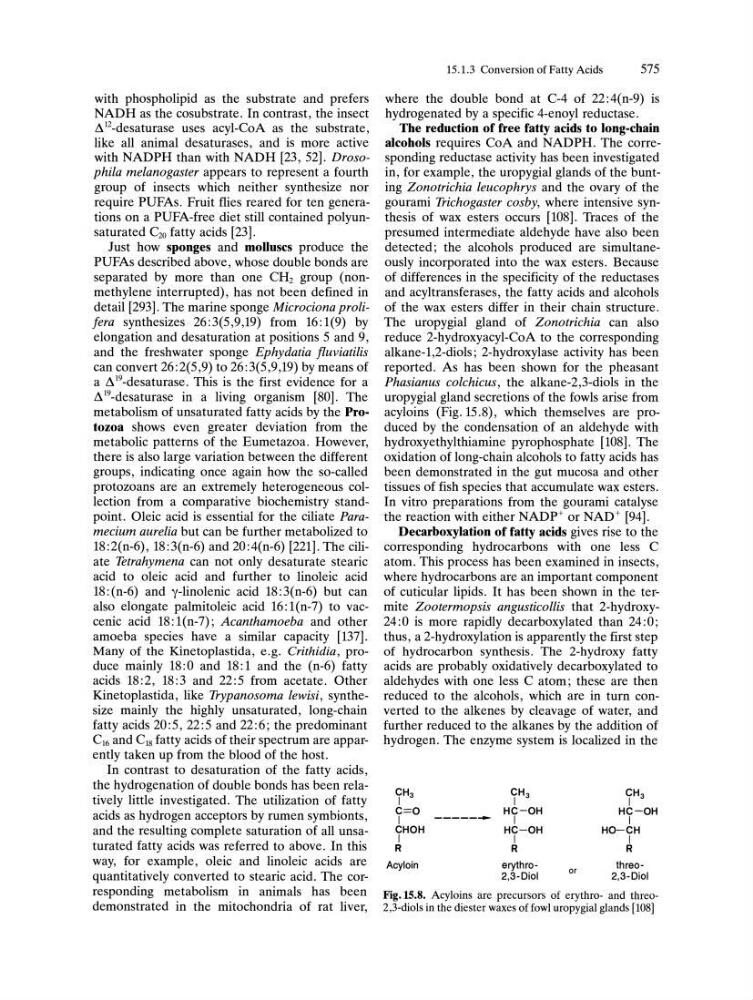
Phasianus colchicus, the alkane-2,3-diols in the
uropygial gland secretions of the fowls arise from
acyloins (Fig. 15.8), which themselves are produced by the condensation of an aldehyde with
hydroxyethylthiamine pyrophosphate [108]. The
oxidation of long-chain alcohols to fatty acids has
been demonstrated in the gut mucosa and other
tissues of fish species that accumulate wax esters.
In vitro preparations from the gourami catalyse
the reaction with either NADP+ or NAD+ [94].
Decarboxylation of fatty acids gives rise to the
corresponding hydrocarbons with one less C
atom. This process has been examined in insects,
where hydrocarbons are an important component
of cuticular lipids. It has been shown in the termite Zootermopsis angusticollis that 2-hydroxy24:0 is more rapidly decarboxylated than 24:0;
thus, a 2-hydroxylation is apparently the first step
of hydrocarbon synthesis. The 2-hydroxy fatty
acids are probably oxidatively decarboxylated to
aldehydes with one less C atom; these are then
reduced to the alcohols, which are in turn converted to the alkenes by cleavage of water, and
further reduced to the alkanes by the addition of
hydrogen. The enzyme system is localized in the
CH3
I
CH 3
I
CH 3
I
c=o
HC-OH
HC-OH
I
-----~
I
I
CHOH
HC-OH
HO-CH
I
I
I
R
R
R
Acyloin
threo2,3-Diol
or
2,3-Diol
Fig.15.8. Acyloins are precursors of erythro- and threo2,3-diols in the diester waxes of fowl uropygial glands [108]