

574
15 Lipids
(n - 9) - series
(n - 6) - series
(n - 3) - series
18:0
", 9 _ Desaturation
~
18:1 (9)
18:2<9,12 )
18:3<9,12,15)
", 6 _ Desaturation
~
l
~
18:2<6,9)
~
18:3<6,9,12 )
~
18:4<6,9,12,15)
Elongation
l
20:2<8,11)
20:3 <8,11,14)
20: 4<8, II, 14, t7l
", 5 _ Desaturation
l
!'PG-1
!
20:3<5,8,11)
20:4<5,8,11,14)
'PG-2
20:5<5,8,11,14,17 )
Elongation
!'PG-3
", 4 _ Desaturation
22:5 < 7,10,13,16,19)
l
22:6 <4,7, 10, 13, 16,19)
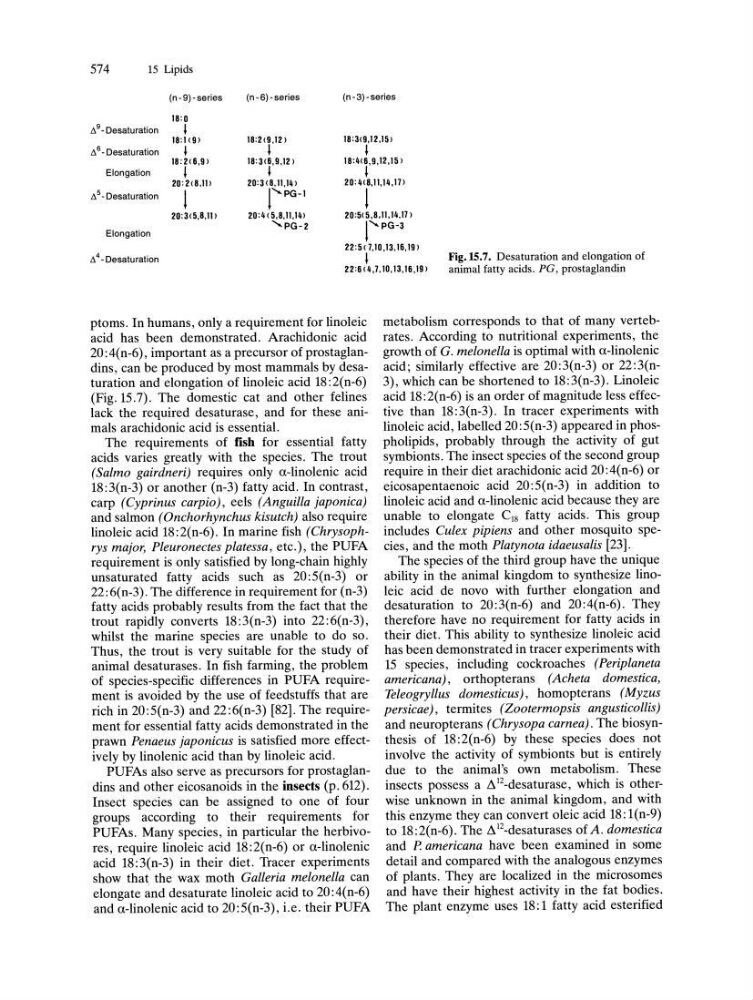
Fig. IS. 7. Desaturation and elongation of
animal fatty acids. PG, prostaglandin
ptoms. In humans, only a requirement for linoleic
acid has been demonstrated. Arachidonic acid
20:4(n-6), important as a precursor of prostaglandins, can be produced by most mammals by desaturation and elongation of linoleic acid 18 :2(n-6)
(Fig. 15.7). The domestic cat and other felines
lack the required desaturase, and for these animals arachidonic acid is essential.
The requirements of fish for essential fatty
acids varies greatly with the species. The trout
(Salmo gairdneri) requires only a-linolenic acid
18:3(n-3) or another (n-3) fatty acid. In contrast,
carp (Cyprinus carpio), eels (Anguilla japonica)
and salmon (Onchorhynchus kisutch) also require
linoleic acid 18:2(n-6). In marine fish (Chrysophrys major, Pleuronectes platessa, etc.), the PUFA
requirement is only satisfied by long-chain highly
unsaturated fatty acids such as 20:5(n-3) or
22:6(n-3). The difference in requirement for (n-3)
fatty acids probably results from the fact that the
trout rapidly converts 18:3(n-3) into 22:6(n-3),
whilst the marine species are unable to do so.
Thus, the trout is very suitable for the study of
animal desaturases. In fish farming, the problem
of species-specific differences in PUFA requirement is avoided by the use of feedstuffs that are
rich in 20:5(n-3) and 22:6(n-3) [82]. The requirement for essential fatty acids demonstrated in the
prawn Penaeus japonicus is satisfied more effectively by linolenic acid than by linoleic acid.
PUFAs also serve as precursors for prostaglandins and other eicosanoids in the insects (p. 612).
Insect species can be assigned to one of four
groups according to their requirements for
PUFAs. Many species, in particular the herbivores, require linoleic acid 18:2(n-6) or a-linolenic
acid 18:3(n-3) in their diet. Tracer experiments
show that the wax moth Galleria melon ella can
elongate and des at urate linoleic acid to 20:4(n-6)
and a-linolenic acid to 20:5(n-3), i.e. their PUFA
metabolism corresponds to that of many vertebrates. According to nutritional experiments, the
growth of G. melonella is optimal with a-linolenic
acid; similarly effective are 20:3(n-3) or 22:3(n3), which can be shortened to 18:3(n-3). Linoleic
acid 18:2(n-6) is an order of magnitude less effective than 18:3(n-3). In tracer experiments with
linoleic acid, labelled 20:5(n-3) appeared in phospholipids, probably through the activity of gut
symbionts. The insect species of the second group
require in their diet arachidonic acid 20:4(n-6) or
eicosapentaenoic acid 20:5(n-3) in addition to
linoleic acid and a-linolenic acid because they are
unable to elongate CIS fatty acids. This group
includes Culex pipiens and other mosquito species, and the moth Platynota idaeusalis [23].
The species of the third group have the unique
ability in the animal kingdom to synthesize linoleic acid de novo with further elongation and
de saturation to 20:3(n-6) and 20:4(n-6). They
therefore have no requirement for fatty acids in
their diet. This ability to synthesize linoleic acid
has been demonstrated in tracer experiments with
15 species, including cockroaches (Periplaneta
americana), orthopterans (Acheta domestica,
Teleogryllus domesticus) , homopterans (Myzus
persicae) , termites (Zootermopsis angusticollis)
and neuropterans (Chrysopa carnea). The biosynthesis of 18:2(n-6) by these species does not
involve the activity of symbionts but is entirely
due to the animal's own metabolism. These
insects possess a ~ 12-desaturase, which is otherwise unknown in the animal kingdom, and with
this enzyme they can convert oleic acid 18: 1(n-9)
to 18:2(n-6). The ~12-desaturases ofA. domestica
and P. americana have been examined in some
detail and compared with the analogous enzymes
of plants. They are localized in the microsomes
and have their highest activity in the fat bodies.
The plant enzyme uses 18: 1 fatty acid esterified