

568
15 Lipids
there are also molecules which carry up to four or
five methyl groups on internal C atoms of the
chain; titmice (Paridae) have fatty acids with one
or two ethyl substitutions, and owls possess 2propyl- and 2-butyl- substituted fatty acids [108].
Cyclopropane fatty acids (Fig. 15.1 d) are
formed in bacteria by the attachment of an activated methyl group from S-adenosylmethionine to
a fatty acid double bond, and they are taken up
into animal lipids in the diet. This explains the
presence of cyclopropane fatty acids in ruminants,
and the detection of 0.2 % cis-9,10-methylene16: 0 and -18: 0 in the body fat of the teleost Fundulus heteroclitus [50]. In contrast, endogenous
production of cyclopropane fatty acids has been
demonstrated in several Kinetoplastida, e.g. a
cyclopropane- and methyl- substituted stearic acid
(Fig. 15.1 d) in Herpetomonas megaseliae [97].
Remarkable in this respect is the large amount of
cyclopropane fatty acids with 17, 18 or 19 C atoms
in millipedes of the order Spirostreptida. They
constitute as much as 30 % of the total fatty acids
in female animals of the species Graphidostreptus
tumuliporus, as high as 35 % in the eggs, and
about 20 % in the related species Orthopterus
ornatus. Males of both species, on the other hand,
show no trace of these unusual fatty acids and
their significance in the female is unknown.
Hydroxy fatty acids are found only occasionally in the animal kingdom. Cerebronic acid (2OH-24:0) from the glycosphingolipids of mammalian brain was mentioned earlier. 2-Hydroxy
and 3-hydroxy fatty acids (earlier known as uand j3-hydroxy acids) are constituents of diester
waxes in the uropygial gland lipids [108]. C30 to
C34 fatty acids with terminal hydroxy groups (whydroxy fatty acids) have been detected in the
epidermial fats of various mammals [278]. 3,7,13Trihydroxy- and 2,3,7,13-tetrahydroxystearic acid
are components of the unusual taurolipids
(Fig. 15.19a) from the ciliate Tetrahymena [125].
The fatty acid spectrum of all tissues includes a
very large number of different molecular species,
the complete description of which is an almost
impossible task even with present-day highly sophisticated analytical methods. The spectrum varies
widely not only between animal groups and species and between the organs of anyone animal,
but also between the different lipid classes of the
same organ. For example, phosphatidylcholines
are often rich in C16 acids, whereas arachidonic
acids, which are important as precursors of prostaglandins, are mainly bound to phosphatidylinositol [14]. Differences in the fatty acid spectrum are
even found between the molecular positions
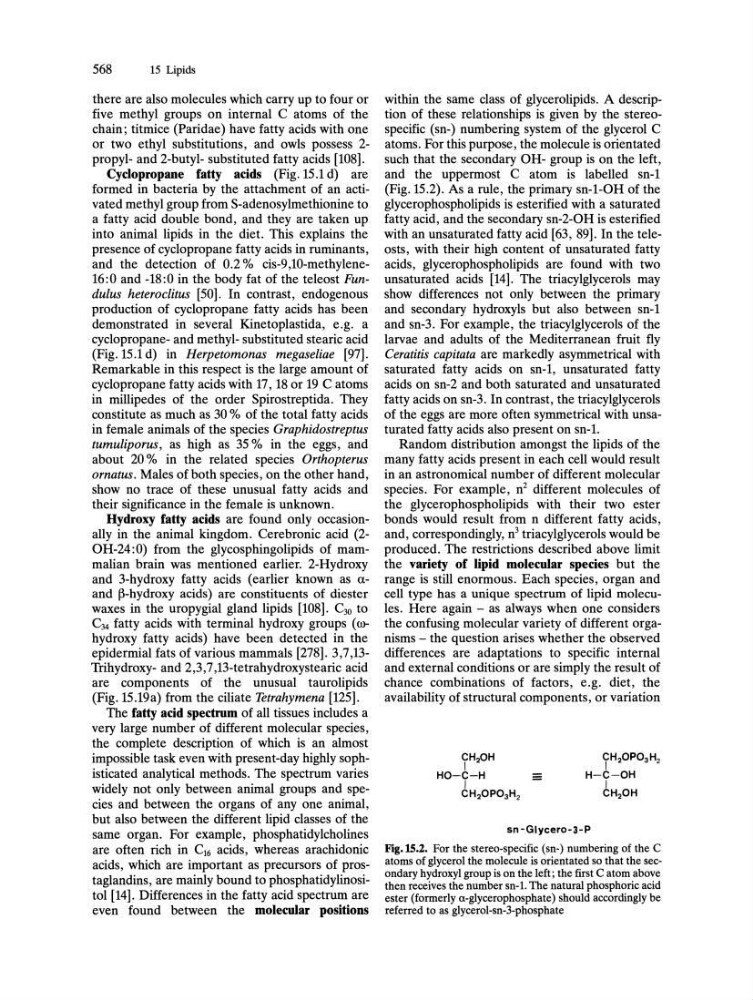
within the same class of glycerolipids. A description of these relationships is given by the stereospecific (sn-) numbering system of the glycerol C
atoms. For this purpose, the molecule is orientated
such that the secondary OH- group is on the left,
and the uppermost C atom is labelled sn-l
(Fig. 15.2). As a rule, the primary sn-l-0H of the
glycerophospholipids is esterified with a saturated
fatty acid, and the secondary sn-2-0H is esterified
with an unsaturated fatty acid [63, 89]. In the teleosts, with their high content of unsaturated fatty
acids, glycerophospholipids are found with two
unsaturated acids [14]. The triacylglycerols may
show differences not only between the primary
and secondary hydroxyls but also between sn-l
and sn-3. For example, the triacylglycerols of the
larvae and adults of the Mediterranean fruit fly
Ceratitis capitata are markedly asymmetrical with
saturated fatty acids on sn-l, unsaturated fatty
acids on sn-2 and both saturated and unsaturated
fatty acids on sn-3. In contrast, the triacylglycerols
of the eggs are more often symmetrical with unsaturated fatty acids also present on sn-1.
Random distribution amongst the lipids of the
many fatty acids present in each cell would result
in an astronomical number of different molecular
species. For example, n 2 different molecules of
the glycerophospholipids with their two ester
bonds would result from n different fatty acids,
and, correspondingly, n 3 triacylglycerols would be
produced. The restrictions described above limit
the variety of lipid molecular species but the
range is still enormous. Each species, organ and
cell type has a unique spectrum of lipid molecules. Here again - as always when one considers
the confusing molecular variety of different organisms - the question arises whether the observed
differences are adaptations to specific internal
and external conditions or are simply the result of
chance combinations of factors, e.g. diet, the
availability of structural components, or variation
sn-Glycero-3-P
Fig.15.2. For the stereo-specific (sn-) numbering of the C
atoms of glycerol the molecule is orientated so that the secondary hydroxyl group is on the left; the first C atom above
then receives the number sn-1. The natural phosphoric acid
ester (formerly a-glycerophosphate) should accordingly be
referred to as glycerol-sn-3-phosphate