

15.1.1 Structure and Nomenclature of the Fatty Acids
567
are located exclusively in the sphingomyelins
[207]. The glycerophospholipids of the photoreceptor membranes in the vertebrate retina, in
contrast to those of other cell membranes, mostly
contain two highly unsaturated fatty acids. These
are similar in structure from the mammals to the
fish and have up to 36 C atoms and six double
bonds [227]. Mammalian brain contains unusual
molecular species of phosphatidylcholine which
carry fatty acids with 32-38 C atoms and four to
six double bonds at position sn-l, and may play
some as yet undefined role in brain physiology
[226]. The fatty acid spectrum of the Porifera
appears to be fundamentally different to that of
all eumetazoans. The Demospongia examined
predominantly contain long-chain CZ4 to C30 fatty
acids which are all 5,9-unsaturated and sometimes branched. It could be shown in Jaspis stellifera that 26:2(5,9), iso-27:2(5,9) and anteiso27:2(5,9) arise from 16:0, iso-15:0 and anteiso15 :0, respectively, by elongation. The unusual
de saturation apparently occurs only after elongation [33]. Cliona celata also contains 30:4(n-6)
and 30:5(n-3), i.e. fatty acids with double bonds
at normal locations. The fatty acids of several
sponge species carry unusual substituents such as
cyclopropyl, methoxy, acetoxy or cyclic peroxide.
The marine species Dictyonella incisa has furan
fatty acids esterified with sterols which release
histamines; their inflammatory effect probably
serves to deter predators [46].
Animals also occasionally have PUFAs in
which neighbouring double bonds are not interspersed with CHz groups, as is usually the case.
Fatty acids with conjugated double bonds are
found only in plants, whereas fatty acids with
widely separated double bonds, known as NMI
fatty acids (non-methylene interrupted), have
been detected in various animals. In marine gastropods and bivalves, fatty acids such as
20:2(5,11),20:2(5,13),22:2(7,13) and 22:2(7,15)
make up more than 15 % of the total [102, 292].
These include the 5,9-unsaturated fatty acids of
the sponges, as mentioned above [33]. Whole
series of 5-unsaturated fatty acids in proportions of up to 6.5 % are present in starfish and
other echinoderms, e.g. 20:1(5), 20:2(5,11),
20:2(5,13), 20:3(5,11,14), 20:4(5,11,14,17) and
20:5(5,11,14,17,20), together with 7-unsaturated
fatty acids like 22:2(7,13) and 22:2(7,15) [134].
The fatty acid 20:3(5,11,14), found in the
domestic cat and related species, the echidna and
some insects, arises from linoleic acid 18:2(n-6)
when reduced activity of the ~6-desaturase prohibits the normal pathway via 20:3(n-6) to arachidonic acid 20:4(n-6) (Fig. 15.7). Linoleic acid
18:2(9,12) is in these animals elongated to
20:2(11,14), and ~5-desaturated to 20:3(5,11,14)
[187]. The fatty acid spectra of the marine invertebrates are all particularly complex. For example, 56 different fatty acids have been identified
in the amphipod Themisto gaudichaudii and 55
have been identified in a holothurian [68, 119].
Fatty acids with branched chains (Fig. 15.1a-c)
are produced by many bacteria and are taken up
by animals in their diet. Quite considerable
quantities of iso- and anteiso- fatty acids have
been found in some animal fats, e.g. over 6 % in
the body fat of the teleost Fundulus heteroclitus
[50], 3-7 % in different phospholipids of the
nematode Turbatrix aceti, and more than 20 % in
the lipids of rat faeces. The endogenous formation of branched fatty acids may be detected in
some animal tissues. This is true, for example, for
the tissues of the forehead projection (melon) of
the toothed whale, the avian uropygial gland and
the sebaceous glands of the mammals. The melon
functions as a "sound lens" in echo navigation in
that differences in concentration and composition
of the lipid components result in a higher velocity
of sound transmission in the inner layers of the
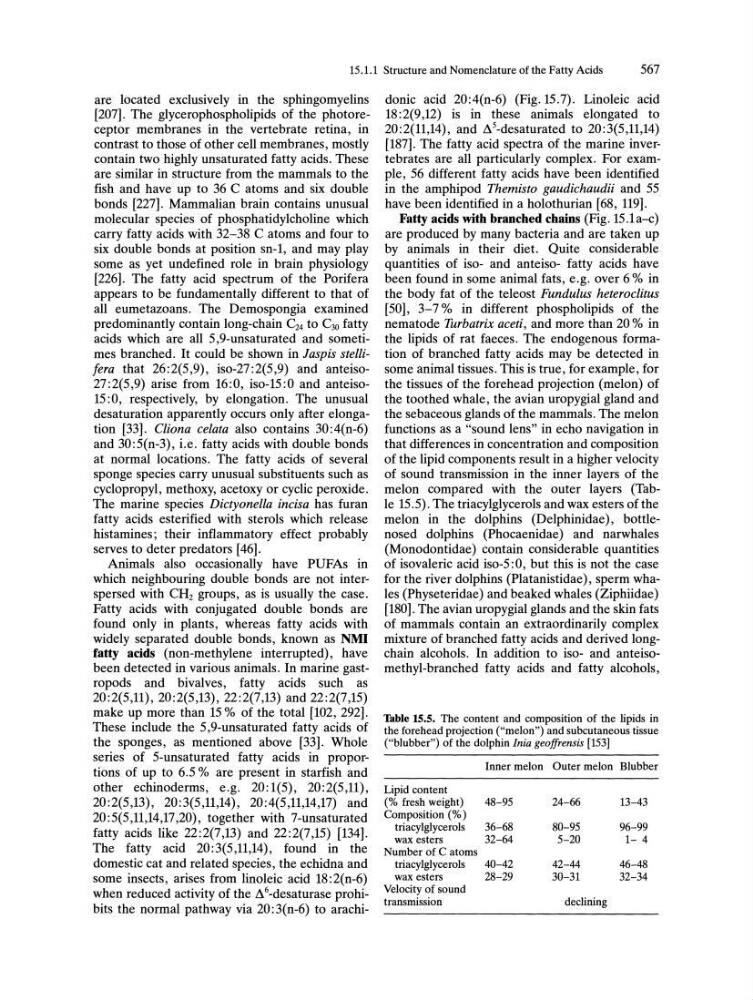
melon compared with the outer layers (Table 15.5). The triacylglycerols and wax esters ofthe
melon in the dolphins (Delphinidae), bottlenosed dolphins (Phocaenidae) and narwhales
(Monodontidae) contain considerable quantities
of isovaleric acid iso-5:0, but this is not the case
for the river dolphins (Platanistidae), sperm whales (Physeteridae) and beaked whales (Ziphiidae)
[180]. The avian uropygial glands and the skin fats
of mammals contain an extraordinarily complex
mixture of branched fatty acids and derived longchain alcohols. In addition to iso- and anteisomethyl-branched fatty acids and fatty alcohols,
Table 15.5. The content and composition of the lipids in
the forehead projection ("melon") and subcutaneous tissue
("blubber") of the dolphin Inia geoffrensis [153]
Inner melon Outer melon Blubber
Lipid content
(% fresh weight)
48-95
24-66
13-43
Composition (% )
triacylglycerols
36-68
80-95
96-99
wax esters
32-64
5-20
1- 4
Number of C atoms
triacylglycerols
40-42
42-44
46-48
wax esters
28-29
30-31
32-34
Velocity of sound
transmission
declining