

in the enzymes of lipid metabolism. In some cases,
the lipid molecules must satisfy very specific functions with corresponding structural specifications,
whereas in other cases their biological importance
only involves simple physicochemical properties
found in molecules of very different structure.
15.1.2 Biosynthesis of Fatty Acids
The de novo synthesis of fatty acids can take
place in various organs of the mammals: in particular, in the fat tissues of the cow, sheep, goat,
pig, dog, cat and guinea-pig, in the human liver,
and in both tissues in the rat, mouse and rabbit.
Acetate is more important than glucose as a
starting substance in the ruminants, as it is also in
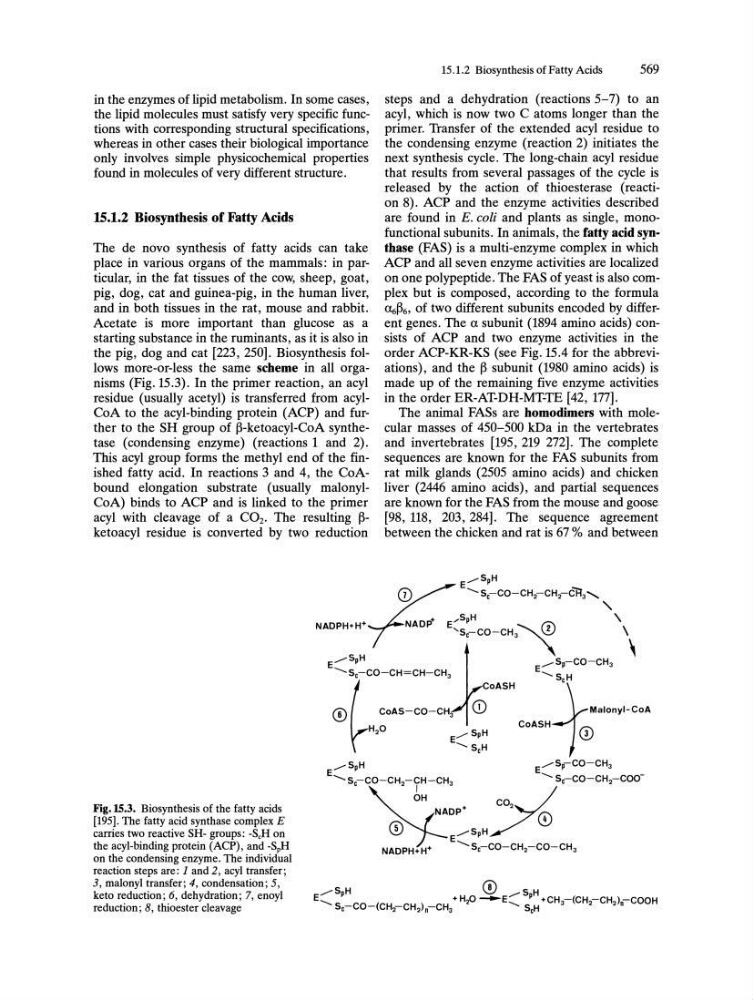
the pig, dog and cat [223, 250]. Biosynthesis follows more-or-Iess the same scheme in all organisms (Fig. 15.3). In the primer reaction, an acyl
residue (usually acetyl) is transferred from acylCoA to the acyl-binding protein (ACP) and further to the SH group of ~-ketoacyl-CoA synthetase (condensing enzyme) (reactions 1 and 2).
This acyl group forms the methyl end of the finished fatty acid. In reactions 3 and 4, the CoAbound elongation substrate (usually malonylCoA) binds to ACP and is linked to the primer
acyl with cleavage of a CO2• The resulting ~keto acyl residue is converted by two reduction
15.1.2 Biosynthesis of Fatty Acids
569
steps and a dehydration (reactions 5-7) to an
acyl, which is now two C atoms longer than the
primer. Transfer of the extended acyl residue to
the condensing enzyme (reaction 2) initiates the
next synthesis cycle. The long-chain acyl residue
that results from several passages of the cycle is
released by the action of thioesterase (reaction 8). ACP and the enzyme activities described
are found in E. coli and plants as single, monofunctional subunits. In animals, the fatty acid synthase (FAS) is a multi-enzyme complex in which
ACP and all seven enzyme activities are localized
on one polypeptide. The FAS of yeast is also complex but is composed, according to the formula
a6~6' of two different subunits encoded by different genes. The a subunit (1894 amino acids) consists of ACP and two enzyme activities in the
order ACP-KR-KS (see Fig. 15.4 for the abbreviations), and the ~ subunit (1980 amino acids) is
made up of the remaining five enzyme activities
in the order ER-AT-DH-MT-TE [42, 177].
The animal FASs are homodimers with molecular masses of 450-500 kDa in the vertebrates
and invertebrates [195, 219 272]. The complete
sequences are known for the FAS subunits from
rat milk glands (2505 amino acids) and chicken
liver (2446 amino acids), and partial sequences
are known for the FAS from the mouse and goose
[98, 118, 203,284]. The sequence agreement
between the chicken and rat is 67 % and between
Fig.15.3. Biosynthesis of the fatty acids
[195]. The fatty acid synthase complex E
carries two reactive SH- groups: -ScH on
the acyl-binding protein (ACP), and -SpH
on the condensing enzyme. The individual
reaction steps are: 1 and 2, acyl transfer;
3, malonyl transfer; 4, condensation; 5,
keto reduction; 6, dehydration; 7, enoyl
reduction; 8, thioester cleavage
.......-SpH
CD /,S H
E ......... S -CO-(CH -CH ) -CH + H20 --E....... p +CH3-(CH2-CH2)n-COOH
c
2
2 n
3
ScH