

14.12.2 Synthesis of Succinate, Volatile Fatty Acids and Alanine
551
(Fig. 14.10). In the reduction pathway, malate is
converted to fumarate by fumarase, and further
to succinate with the formation of ATP. These
processes were discovered in 1961 in the roundworm Ascaris lumbricoides and studied initially in
these and other endoparasitic worms [9,221];
since 19n they have been characterized in freeliving animals such as Arenicola marina and MytiIus edulis [224]. The fumarate reductase includes
part of the electron transport system of the inner
mitochondrial membrane. Inhibitor experiments
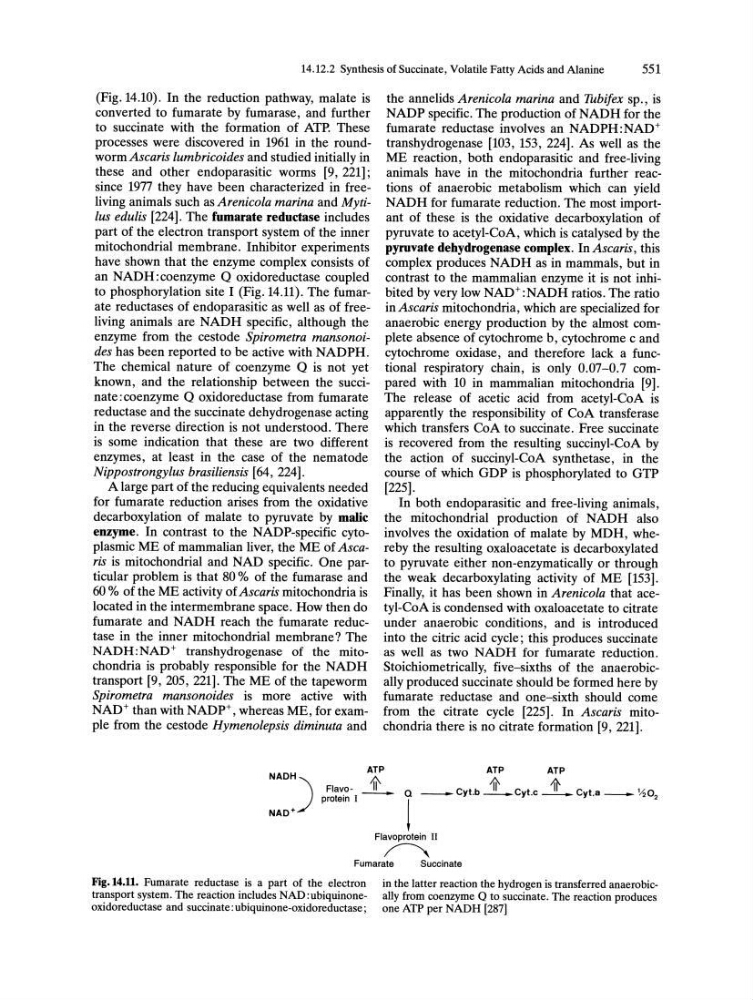
have shown that the enzyme complex consists of
an NADH:coenzyme Q oxidoreductase coupled
to phosphorylation site I (Fig. 14.11). The fumarate reductases of endoparasitic as well as of freeliving animals are NADH specific, although the
enzyme from the cestode Spirometra mansonoides has been reported to be active with NADPH.
The chemical nature of coenzyme Q is not yet
known, and the relationship between the succinate: coenzyme Q oxidoreductase from fumarate
reductase and the succinate dehydrogenase acting
in the reverse direction is not understood. There
is some indication that these are two different
enzymes, at least in the case of the nematode
Nippostrongylus brasiliensis [64, 224].
A large part of the reducing equivalents needed
for fumarate reduction arises from the oxidative
decarboxylation of malate to pyruvate by malic
enzyme. In contrast to the NADP-specific cytoplasmic ME of mammalian liver, the ME of Ascaris is mitochondrial and NAD specific. One particular problem is that 80 % of the fumarase and
60 % of the ME activity of Ascaris mitochondria is
located in the intermembrane space. How then do
fumarate and NADH reach the fumarate reductase in the inner mitochondrial membrane? The
NADH:NAD+ transhydrogenase of the mitochondria is probably responsible for the NADH
transport [9, 205, 221]. The ME ofthe tapeworm
Spirometra mansonoides is more active with
NAD+ than with NADP+, whereas ME, for example from the cestode Hymenolepsis diminuta and
the annelids Arenicola marina and Tubi/ex sp., is
NADP specific. The production of NADH for the
fumarate reductase involves an NADPH:NAD+
transhydrogenase [103, 153, 224]. As well as the
ME reaction, both endoparasitic and free-living
animals have in the mitochondria further reactions of anaerobic metabolism which can yield
NADH for fumarate reduction. The most important of these is the oxidative decarboxylation of
pyruvate to acetyl-CoA, which is catalysed by the
pyruvate dehydrogenase complex. In Ascaris, this
complex produces NADH as in mammals, but in
contrast to the mammalian enzyme it is not inhibited by very low NAD+:NADH ratios. The ratio
in Ascaris mitochondria, which are specialized for
anaerobic energy production by the almost complete absence of cytochrome b, cytochrome c and
cytochrome oxidase, and therefore lack a functional respiratory chain, is only 0.07-0.7 compared with 10 in mammalian mitochondria [9].
The release of acetic acid from acetyl-CoA is
apparently the responsibility of CoA transferase
which transfers CoA to succinate. Free succinate
is recovered from the resulting succinyl-CoA by
the action of succinyl-CoA synthetase, in the
course of which GDP is phosphorylated to GTP
[225].
In both endoparasitic and free-living animals,
the mitochondrial production of NADH also
involves the oxidation of malate by MDH, whereby the resulting oxaloacetate is decarboxylated
to pyruvate either non-enzymatically or through
the weak decarboxylating activity of ME [153].
Finally, it has been shown in Arenicola that acetyl-CoA is condensed with oxaloacetate to citrate
under anaerobic conditions, and is introduced
into the citric acid cycle; this produces succinate
as well as two NADH for fumarate reduction.
Stoichiometrically, five-sixths of the anaerobically produced succinate should be formed here by
fumarate reductase and one-sixth should come
from the citrate cycle [225]. In Ascaris mitochondria there is no citrate formation [9, 221].
NADH)
NAD+
ATP
Flavo1i'
-
Q
ATP
ATP
11'
1r'
1
_
Cyt.b _Cyt.c _
Cyt.a _
V:10 2
protein I
!
Flavoprotein II
~
Fumarate
Succinate
Fig.14.11. Fumarate reductase is a part of the electron
transport system. The reaction includes NAD:ubiquinoneoxidoreductase and succinate: ubiquinone-oxidoreductase;
in the latter reaction the hydrogen is transferred anaerobically from coenzyme Q to succinate. The reaction produces
one ATP per NADH [287]