

550
14 Glycolysis
Glycogen
Aspartale
Pyruvate
~ Ct- Ketoglularate
~
ATP
Glutamate
t
11'
Phosphoenol7
Oxaloacetate
Alanine
pyruvate
CO2
~ NAOH+H+
NAO+
Malate
CYTOSOL
;.:-:.:.;.;.;.:.;.:.:.:.;.;.;.;.:.;.;.:.;.;.:.:.:.;.:.:.:.:.:.:.:.:.:.:.:.:.:.
.:.:.:.:.:.:.:.: .•. ; ..................... ;.;.;.:.;.:.:.;.;.:.:.:.:.:.:.:.;.:.;.;.;.;.;.;.:.:.:.:.:.;.:.: ... .
MITOCHOND RI ON
NAO+ NAOH +H+
~
Malate~ pyru v a t e , ~ Acetate
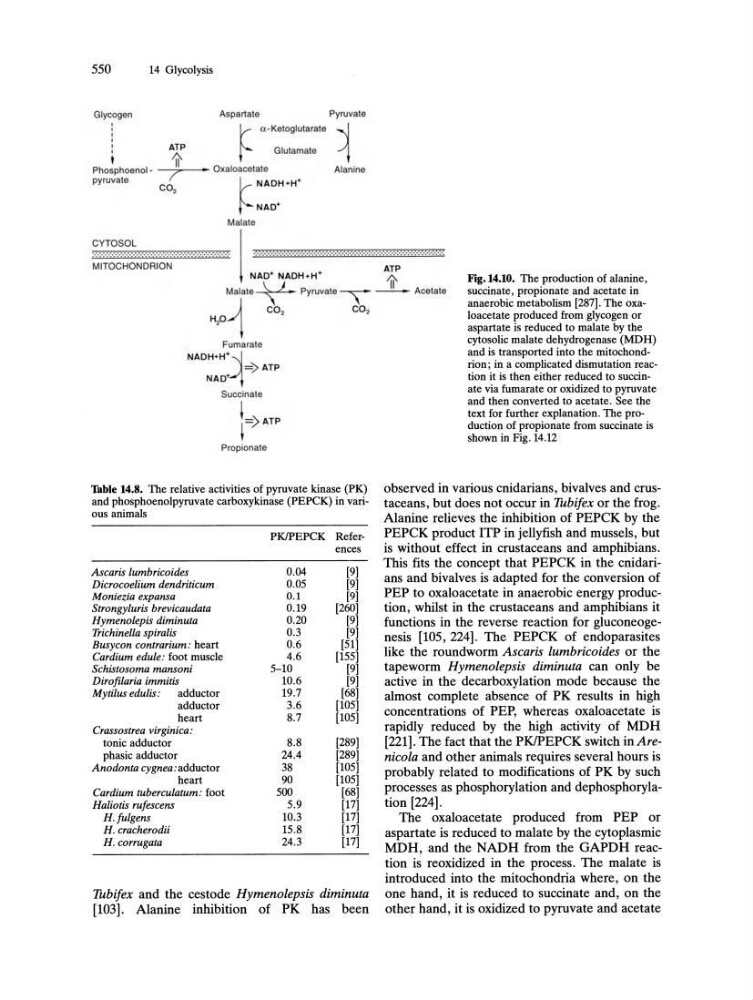
Fig.14.10. The production of alanine,
succinate, propionate and acetate in
anaerobic metabolism [287]. The oxaloacetate produced from glycogen or
aspartate is reduced to malate by the
cytosolic malate dehydrogenase (MDH)
and is transported into the mitochondrion ; in a complicated dismutation reaction it is then either reduced to succinate via fumarate or oxidized to pyruvate
and then converted to acetate. See the
text for further explanation. The production of propionate from succinate is
shown in Fig. 14.12
J CO2
CO2
HP- l
Fumarate
NAOH+ H+~ =) ATP
NAO+
Succinate
~=> ATP
~
Propionate
Table 14.8. The relative activities of pyruvate kinase (PK)
and phosphoenolpyruvate carboxykinase (PEPCK) in various animals
Ascaris lumbricoides
Dicrocoelium dendriticum
Moniezia expansa
Strongyluris brevicaudata
Hymenolepis diminuta
Trichinella spiralis
Busycon contrarium : heart
Cardium edule: foot muscle
Schistosoma mansoni
Dirofilaria immitis
Mytilus edulis:
adductor
adductor
heart
Crassostrea virginica :
tonic adductor
phasic adductor
Anodonta cygnea:adductor
heart
Cardium tuberculatum : foot
Haliotis rufescens
H · fulgens
H. cracherodii
H . corrugata
PKlPEPCK References
0.04
0.05
0.1
0.19
0.20
0.3
0.6
4.6
5-10
10.6
19.7
3.6
8.7
8.8
24.4
38
90
500
5.9
10.3
15.8
24.3
[9]
[9]
[9]
[260]
[9]
[9]
[51]
[155]
[9]
[9]
[68]
[105]
[105]
[289]
[289]
[105]
[105]
[68]
[17]
[17]
[17]
[17]
Tubifex and the cestode Hymenolepsis diminuta
[103]. Alanine inhibition of PK has been
observed in various cnidarians, bivalves and crustaceans, but does not occur in TUbifex or the frog.
Alanine relieves the inhibition of PEPCK by the
PEPCK product ITP in jellyfish and mussels, but
is without effect in crustaceans and amphibians.
This fits the concept that PEPCK in the cnidarians and bivalves is adapted for the conversion of
PEP to oxaloacetate in anaerobic energy production, whilst in the crustaceans and amphibians it
functions in the reverse reaction for gluconeogenesis [105,224]. The PEPCK of endoparasites
like the roundworm Ascaris lumbricoides or the
tapeworm Hymenolepsis diminuta can only be
active in the decarboxylation mode because the
almost complete absence of PK results in high
concentrations of PEP, whereas oxaloacetate is
rapidly reduced by the high activity of MDH
[221]. The fact that the PKJPEPCK switch in Arenicola and other animals requires several hours is
probably related to modifications of PK by such
processes as phosphorylation and dephosphorylation [224] .
The oxaloacetate produced from PEP or
aspartate is reduced to malate by the cytoplasmic
MDH, and the NADH from the GAPDH reaction is reoxidized in the process. The malate is
introduced into the mitochondria where, on the
one hand, it is reduced to succinate and, on the
other hand, it is oxidized to pyruvate and acetate