

14.12.2 Synthesis of Succinate, Volatile Fatty Acids and Alanine
549
Pyruvate
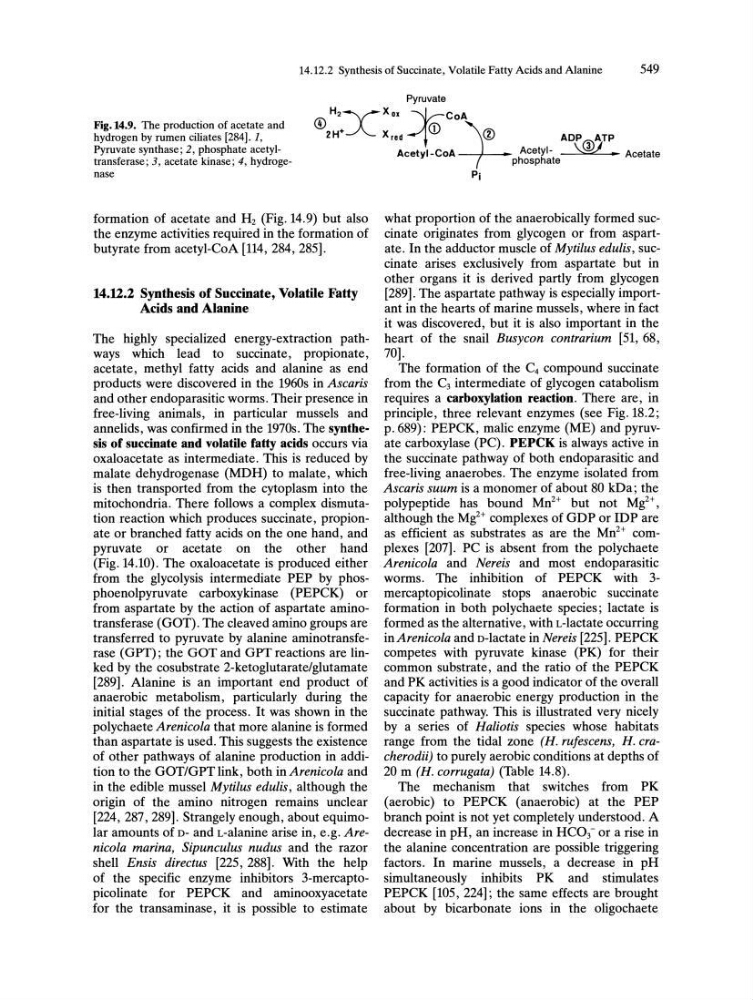
Fig.14.9. The production of acetate and
hydrogen by rumen ciliates [284]. 1,
Pyruvate synthase; 2, phosphate acetyltransferase; 3, acetate kinase; 4, hydrogenase
H2XXOX ~COA
2H+
Xred
®
ADP AIP
®
CD ~
Acetyl-CoA
Acetyl\..@,) .. Acetate
formation of acetate and Hz (Fig. 14.9) but also
the enzyme activities required in the formation of
butyrate from acetyl-CoA [114,284,285].
14.12.2 Synthesis of Succinate, Volatile Fatty
Acids and Alanine
The highly specialized energy-extraction pathways which lead to succinate, propionate,
acetate, methyl fatty acids and alanine as end
products were discovered in the 1960s in Ascaris
and other endoparasitic worms. Their presence in
free-living animals, in particular mussels and
annelids, was confirmed in the 1970s. The synthesis of succinate and volatile fatty acids occurs via
oxaloacetate as intermediate. This is reduced by
malate dehydrogenase (MDH) to malate, which
is then transported from the cytoplasm into the
mitochondria. There follows a complex dismutation reaction which produces succinate, propionate or branched fatty acids on the one hand, and
pyruvate or acetate on the other hand
(Fig. 14.10). The oxaloacetate is produced either
from the glycolysis intermediate PEP by phosphoenolpyruvate carboxykinase (PEPCK) or
from aspartate by the action of aspartate aminotransferase (GOT). The cleaved amino groups are
transferred to pyruvate by alanine aminotransferase (GPT); the GOT and GPT reactions are linked by the cosubstrate 2-ketoglutarate/glutamate
[289]. Alanine is an important end product of
anaerobic metabolism, particularly during the
initial stages of the process. It was shown in the
polychaete Arenicola that more alanine is formed
than aspartate is used. This suggests the existence
of other pathways of alanine production in addition to the GOT/GPT link, both in Arenicola and
in the edible mussel Mytilus edulis, although the
origin of the amino nitrogen remains unclear
[224, 287, 289]. Strangely enough, about equimolar amounts of D- and L-alanine arise in, e.g. Arenicola marina, Sipunculus nudus and the razor
shell Ensis directus [225, 288]. With the help
of the specific enzyme inhibitors 3-mercaptopicolinate for PEPCK and aminooxyacetate
for the transaminase, it is possible to estimate
phosphate
Pi
what proportion of the anaerobically formed succinate originates from glycogen or from aspartate. In the adductor muscle of Mytilus edulis, succinate arises exclusively from aspartate but in
other organs it is derived partly from glycogen
[289]. The aspartate pathway is especially important in the hearts of marine mussels, where in fact
it was discovered, but it is also important in the
heart of the snail Busycon contrarium [51, 68,
70].
The formation of the C4 compound succinate
from the C3 intermediate of glycogen catabolism
requires a carboxylation reaction. There are, in
principle, three relevant enzymes (see Fig. 18.2;
p. 689): PEPCK, malic enzyme (ME) and pyruvate carboxylase (PC). PEPCK is always active in
the succinate pathway of both endoparasitic and
free-living anaerobes. The enzyme isolated from
Ascaris suum is a monomer of about 80 kDa; the
polypeptide has bound Mn2+ but not Mgz+,
although the Mg2+ complexes of GDP or IDP are
as efficient as substrates as are the Mnz+ complexes [207]. PC is absent from the polychaete
Arenicola and Nereis and most endoparasitic
worms. The inhibition of PEPCK with 3mercaptopicolinate stops anaerobic succinate
formation in both polychaete species; lactate is
formed as the alternative, with L-Iactate occurring
inArenicola and D-Iactate in Nereis [225]. PEPCK
competes with pyruvate kinase (PK) for their
common substrate, and the ratio of the PEPCK
and PK activities is a good indicator of the overall
capacity for anaerobic energy production in the
succinate pathway. This is illustrated very nicely
by a series of Haliotis species whose habitats
range from the tidal zone (H. rufescens, H. cracherodii) to purely aerobic conditions at depths of
20 m (H. corrugata) (Table 14.8).
The mechanism that switches from PK
(aerobic) to PEPCK (anaerobic) at the PEP
branch point is not yet completely understood. A
decrease in pH, an increase in HC03- or a rise in
the alanine concentration are possible triggering
factors. In marine mussels, a decrease in pH
simultaneously inhibits PK and stimulates
PEPCK [105, 224]; the same effects are brought
about by bicarbonate ions in the oligochaete