

538
14 Glycolysis
a)
COOH
NADH+H+
NAD+
COOH
6=0 ""' ..... ~-"'-----=_./'"""----. . . . . . .
~ Ho-6H
I
I
CH3
CH3
COOH
I
HC-OH
I
CH3
Pyruvate
L - Lactate
or
D - Lactate
COOH
I
C=O
COOH NADH+H+
NAD+
COOH COOH
+ H 2 N-6H
""' ...... =---"' -----=:::,-""/==------= . . . . . . . .
: : : : . . . H6 - N - tH
I
I
I H
I
CH 3
R
CH 3
R
Pyruvate + a-Aminoacid
b)
COOH COOH
I
I
HC-N-CH
I H
I
CH3
(CH2)3
~H
I
/C"",
H2N NH
Octopine
Opine
COOH COOH
COOH
COOH
I
I
I
I
HC- N-CH
I H
2
HC -N-CH
I
H
I
CH3
CH3
CH 3
D-Strombine
meso - Alanopine
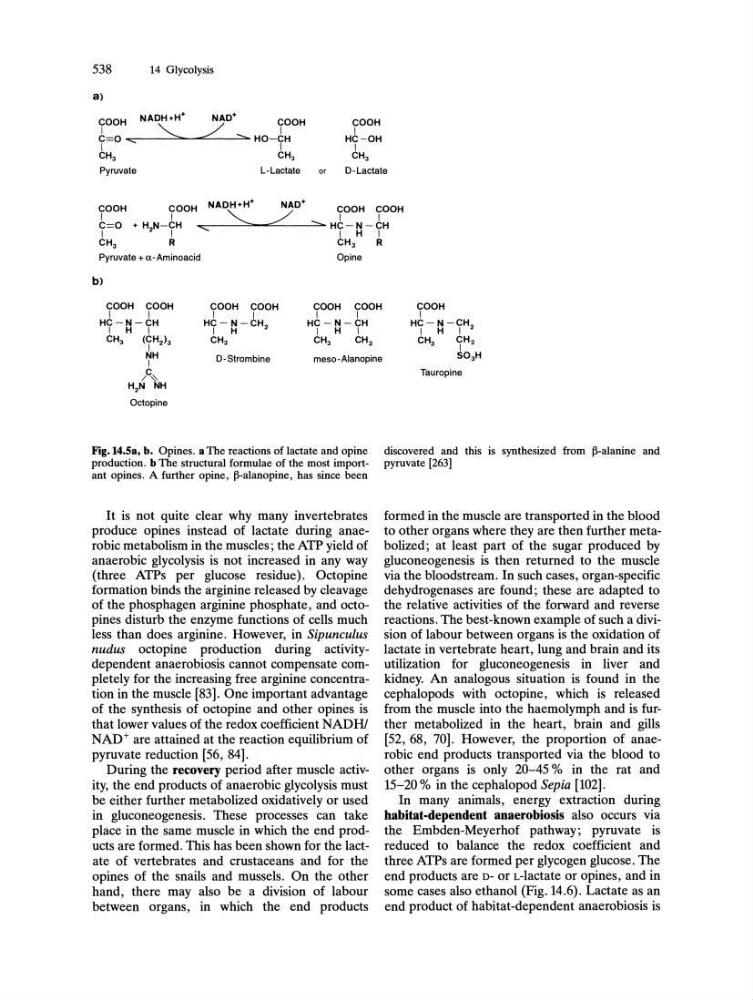
Fig. 14.5a, b. Opines. a The reactions of lactate and opine
production. b The structural formulae of the most important opines. A further opine, ~-alanopine, has since been
It is not quite clear why many invertebrates
produce opines instead of lactate during anaerobic metabolism in the muscles; the ATP yield of
anaerobic glycolysis is not increased in any way
(three ATPs per glucose residue). Octopine
formation binds the arginine released by cleavage
of the phosphagen arginine phosphate, and octopines disturb the enzyme functions of cells much
less than does arginine. However, in Sipunculus
nudus octopine production during activitydependent anaerobiosis cannot compensate completely for the increasing free arginine concentration in the muscle [83]. One important advantage
of the synthesis of octopine and other opines is
that lower values of the redox coefficient NADHI
NAD+ are attained at the reaction equilibrium of
pyruvate reduction [56, 84].
During the recovery period after muscle activity, the end products of anaerobic glycolysis must
be either further metabolized oxidatively or used
in gluconeogenesis. These processes can take
place in the same muscle in which the end products are formed. This has been shown for the lactate of vertebrates and crustaceans and for the
opines of the snails and mussels. On the other
hand, there may also be a division of labour
between organs, in which the end products
COOH
I
HC- N -CH
I H I 2
CH 3
CH 2
I
S03H
Tauropine
discovered and this is synthesized from ~-alanine and
pyruvate [263]
formed in the muscle are transported in the blood
to other organs where they are then further metabolized; at least part of the sugar produced by
gluconeogenesis is then returned to the muscle
via the bloodstream. In such cases, organ-specific
dehydrogenases are found; these are adapted to
the relative activities of the forward and reverse
reactions. The best-known example of such a division of labour between organs is the oxidation of
lactate in vertebrate heart, lung and brain and its
utilization for gluconeogenesis in liver and
kidney. An analogous situation is found in the
cephalopods with octopine, which is released
from the muscle into the haemolymph and is further metabolized in the heart, brain and gills
[52, 68, 70]. However, the proportion of anaerobic end products transported via the blood to
other organs is only 20-45 % in the rat and
15-20 % in the cephalopod Sepia [102].
In many animals, energy extraction during
habitat-dependent anaerobiosis also occurs via
the Embden-Meyerhof pathway; pyruvate is
reduced to balance the redox coefficient and
three ATPs are formed per glycogen glucose. The
end products are D- or L-Iactate or opines, and in
some cases also ethanol (Fig. 14.6). Lactate as an
end product of habitat-dependent anaerobiosis is