

in many molluscs that the intensity of energyyielding metabolism is drastically reduced during
habitat-dependent anaerobiosis; for example, in
Mytilus edulis it is reduced to 5 % and in isolated
adductor muscles of various species it is reduced
to 12.5-20% [68,83,155,289]. Whilst there is a
lO-fold increase in energy turnover during
activity-dependent anaerobiosis in Cardium
tuberculatum, this is reduced 20-fold during the
habitat-dependent process [156]; the contributions of the two processes to energy-yielding
metabolism in the same tissue may differ by as
much as 500: 1 [68]. The goldfish also reduces its
energy turnover to 20 % during persistent anoxia
[102]. The mechanisms regulating the reduction in
metabolism in hypoxic and anoxic conditions are
not completely understood. The crustaceans
appear to have a much less efficient regulatory
mechanism; for example, ATP production in the
isopod Cirolana borealis is reduced by only 25 %
during experimental anoxia. The basic difference
between activity- and habitat-dependent anaerobiosis also shows itself in the metabolic pathways
and end products involved.
14.10.2 End Products of Anaerobic
Metabolism
The end product of anaerobic glycolysis in vertebrate muscle is L-Iactic acid, which Berzelius
first discovered in the meat of hunted deer. Lactate is the main product of activity-dependent
anaerobiosis in the vertebrates and the arthropods, but is also produced in the body-wall muscles of the leech Hirudo medicinalis and other
annelids, and following experimental irritation of
the foot muscle of the cockle Cardium edule
[70, 71, 83, 155, 288]. L-Lactate or D-Iactate is
produced according to the stereo-specificity of
the lactate dehydrogenase involved (see Table 14.6, p. 542). The reduction of pyruvate to lactate by lactate dehydrogenase results in the reoxidation of NADH from the GAPDH reaction, and
restoration of the redox balance of glycolysis;
three ATPs are produced per glucose residue of
glycogen. Invertebrates, however, possess other
enzymes that reduce pyruvate and thereby
reoxidize NADH. These catalyze the reductive
condensation of pyruvate with arginine, glycine,
alanine, taurine or ~-alanine to so-called opines,
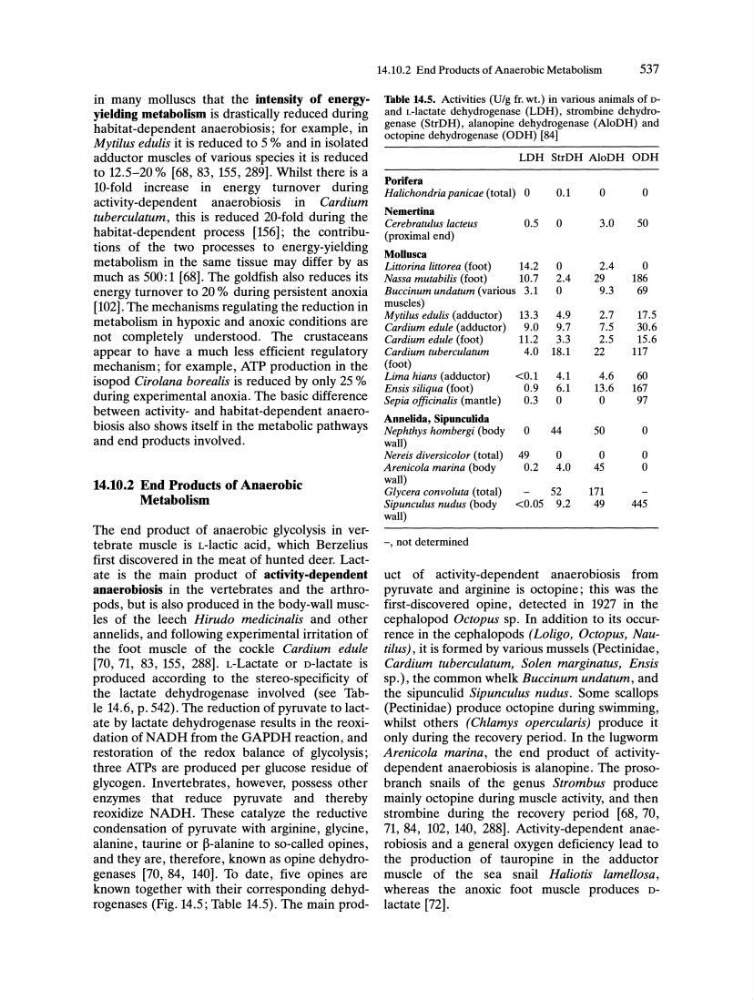
and they are, therefore, known as opine dehydrogenases [70, 84, 140]. To date, five opines are
known together with their corresponding dehydrogenases (Fig. 14.5; Table 14.5). The main prod14.10.2 End Products of Anaerobic Metabolism
537
Table 14.5. Activities (U/g fro wt.) in various animals of Dand L-Iactate dehydrogenase (LDH), strombine dehydrogenase (StrDH), alanopine dehydrogenase (AloDH) and
octopine dehydrogenase (ODH) [84]
LDH StrDH AloDH ODH
Porifera
Halichondria panicae (total) 0
0.1
0
0
Nemertina
Cerebratulus lacteus
0.5
0
3.0
50
(proximal end)
Mollusca
Littorina littorea (foot)
14.2
0
2.4
0
Nassa mutabilis (foot)
10.7
2.4
29
186
Buccinum undatum (various 3.1
0
9.3
69
muscles)
Mytilus edulis (adductor)
13.3
4.9
2.7
17.5
Cardium edule (adductor)
9.0
9.7
7.5
30.6
Cardium edule (foot)
11.2
3.3
2.5
15.6
Cardium tuberculatum
4.0 18.1
22
117
(foot)
Lima hians (adductor)
<0.1
4.1
4.6
60
Ensis siliqua (foot)
0.9
6.1
13.6
167
Sepia officinalis (mantle)
0.3
0
0
97
Annelida, Sipunculida
Nephthys hombergi (body
0
44
50
0
wall)
Nereis diversicolor (total) 49
0
0
(}
Arenicola marina (body
0.2
4.0
45
0
wall)
Glycera convoluta (total)
52
171
Sipunculus nudus (body
<0.05 9.2
49
445
wall)
-, not determined
uct of activity-dependent anaerobiosis from
pyruvate and arginine is octopine; this was the
first-discovered opine, detected in 1927 in the
cephalopod Octopus sp. In addition to its occurrence in the cephalopods (Loligo, Octopus, Nautilus), it is formed by various mussels (Pectinidae,
Cardium tuberculatum, Solen marginatus, Ensis
sp.), the common whelk Buccinum undatum, and
the sipunculid Sipunculus nudus. Some scallops
(Pectinidae) produce octopine during swimming,
whilst others (Chlamys opercularis) produce it
only during the recovery period. In the lugworm
Arenicola marina, the end product of activitydependent anaerobiosis is alanopine. The prosobranch snails of the genus Strombus produce
mainly octopine during muscle activity, and then
strombine during the recovery period [68, 70,
71, 84, 102, 140, 288]. Activity-dependent anaerobiosis and a general oxygen deficiency lead to
the production of tauropine in the adductor
muscle of the sea snail Haliotis lamellosa,
whereas the anoxic foot muscle produces Dlactate [72].