

536
14 Glycolysis
of the energy requirement [68]. The maximal rate
of ATP production in muscle is reached during
utilization of the energy-rich phosphates of ATP
and phosphagen; the second highest rate is
achieved during anaerobic glycogen catabolism;
and the lowest rate occurs during the aerobic
process. However, the reserves of energy-rich
phosphate are used up in a relatively short time,
and the anaerobic supply of energy, because of its
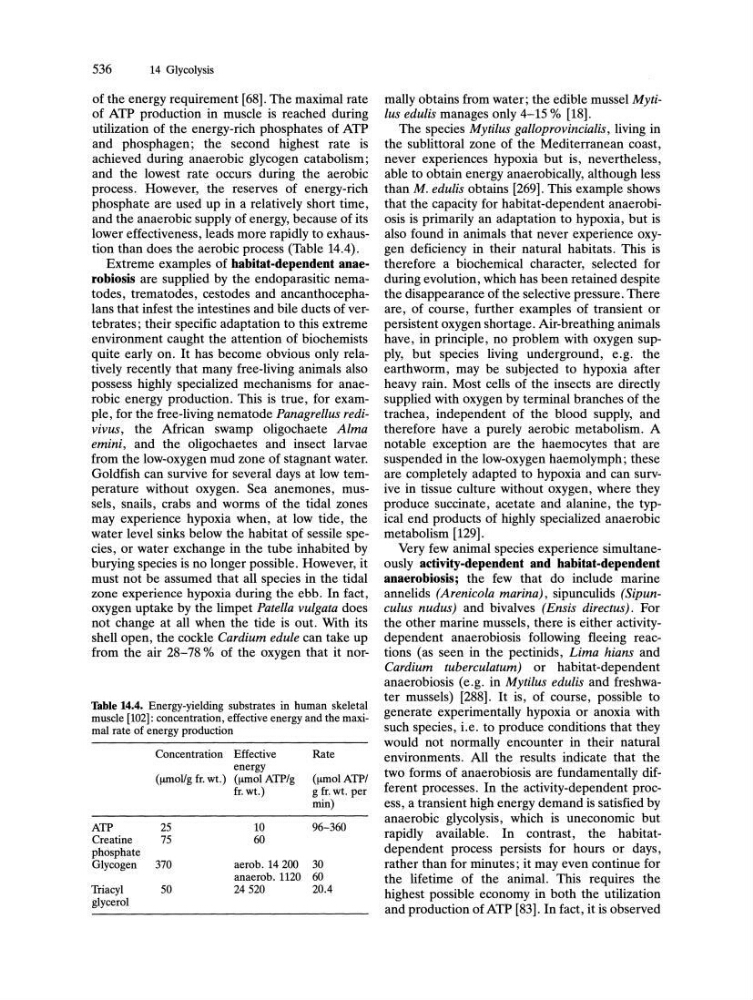
lower effectiveness, leads more rapidly to exhaustion than does the aerobic process (Table 14.4).
Extreme examples of habitat-dependent anaerobiosis are supplied by the endoparasitic nematodes, trematodes, cestodes and ancanthocephalans that infest the intestines and bile ducts of vertebrates; their specific adaptation to this extreme
environment caught the attention of biochemists
quite early on. It has become obvious only relatively recently that many free-living animals also
possess highly specialized mechanisms for anaerobic energy production. This is true, for example, for the free-living nematode Panagrellus redivivus, the African swamp oligochaete Alma
emini, and the oligochaetes and insect larvae
from the low-oxygen mud zone of stagnant water.
Goldfish can survive for several days at low temperature without oxygen. Sea anemones, mussels, snails, crabs and worms of the tidal zones
may experience hypoxia when, at low tide, the
water level sinks below the habitat of sessile species, or water exchange in the tube inhabited by
burying species is no longer possible. However, it
must not be assumed that all species in the tidal
zone experience hypoxia during the ebb. In fact,
oxygen uptake by the limpet Patella vulgata does
not change at all when the tide is out. With its
shell open, the cockle Cardium edule can take up
from the air 28-78 % of the oxygen that it norTable 14.4. Energy-yielding substrates in human skeletal
muscle [102]: concentration, effective energy and the maximal rate of energy production
ATP
Creatine
phosphate
Glycogen
Triacyl
glycerol
Concentration Effective
energy
(flmoUg fro wt.) (flmol ATP/g
fro wt.)
Rate
(flmol ATPI
g fro wt. per
min)
25
10
96-360
75
370
50
60
aerob. 14 200 30
anaerob. 1120 60
24520
2004
mally obtains from water; the edible mussel MytiIus edulis manages only 4-15 % [18].
The species Mytilus galloprovincialis, living in
the sublittoral zone of the Mediterranean coast,
never experiences hypoxia but is, nevertheless,
able to obtain energy anaerobically, although less
than M. edulis obtains [269]. This example shows
that the capacity for habitat-dependent anaerobiosis is primarily an adaptation to hypoxia, but is
also found in animals that never experience oxygen deficiency in their natural habitats. This is
therefore a biochemical character, selected for
during evolution, which has been retained despite
the disappearance of the selective pressure. There
are, of course, further examples of transient or
persistent oxygen shortage. Air-breathing animals
have, in principle, no problem with oxygen supply, but species living underground, e.g. the
earthworm, may be subjected to hypoxia after
heavy rain. Most cells of the insects are directly
supplied with oxygen by terminal branches of the
trachea, independent of the blood supply, and
therefore have a purely aerobic metabolism. A
notable exception are the haemocytes that are
suspended in the low-oxygen haemolymph; these
are completely adapted to hypoxia and can survive in tissue culture without oxygen, where they
produce succinate, acetate and alanine, the typical end products of highly specialized anaerobic
metabolism [129].
Very few animal species experience simultaneously activity-dependent and habitat-dependent
anaerobiosis; the few that do include marine
annelids (Arenicola marina), sipunculids (Sipunculus nudus) and bivalves (Ensis directus). For
the other marine mussels, there is either activitydependent anaerobiosis following fleeing reactions (as seen in the pectinids, Lima hians and
Cardium tuberculatum) or habitat-dependent
anaerobiosis (e.g. in Mytilus edulis and freshwater mussels) [288]. It is, of course, possible to
generate experimentally hypoxia or anoxia with
such species, i.e. to produce conditions that they
would not normally encounter in their natural
environments. All the results indicate that the
two forms of anaerobiosis are fundamentally different processes. In the activity-dependent process, a transient high energy demand is satisfied by
anaerobic glycolysis, which is uneconomic but
rapidly available. In contrast, the habitatdependent process persists for hours or days,
rather than for minutes; it may even continue for
the lifetime of the animal. This requires the
highest possible economy in both the utilization
and production of ATP [83]. In fact, it is observed