

472
13 The Structure and Metabolism of Carbohydrates
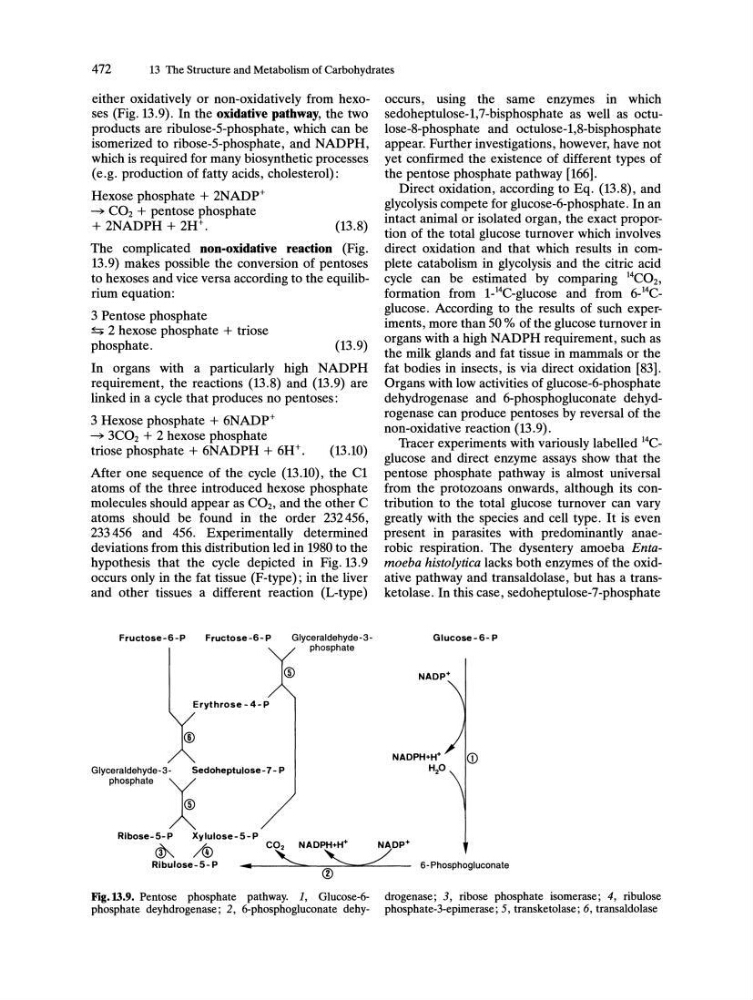
either oxidatively or non-oxidatively from hexoses (Fig. 13.9). In the oxidative pathway, the two
products are ribulose-5-phosphate, which can be
isomerized to ribose-5-phosphate, and NADPH,
which is required for many biosynthetic processes
(e.g. production of fatty acids, cholesterol):
Hexose phosphate + 2NADP+
~ CO2 + pentose phosphate
+ 2NADPH + 2H+.
(13.8)
The complicated non-oxidative reaction (Fig.
13.9) makes possible the conversion of pentoses
to hexoses and vice versa according to the equilibrium equation:
3 Pentose phosphate
~ 2 hexose phosphate + triose
phosphate.
(13.9)
In organs with a particularly high NADPH
requirement, the reactions (13.8) and (13.9) are
linked in a cycle that produces no pentoses:
3 Hexose phosphate + 6NADP+
~ 3C02 + 2 hexose phosphate
triose phosphate + 6NADPH + 6H+.
(13.10)
After one sequence of the cycle (13.10), the C1
atoms of the three introduced hexose phosphate
molecules should appear as CO2, and the other C
atoms should be found in the order 232456,
233456 and 456. Experimentally determined
deviations from this distribution led in 1980 to the
hypothesis that the cycle depicted in Fig. 13.9
occurs only in the fat tissue (F-type); in the liver
and other tissues a different reaction (L-type)
Fructose-6-P
Fructose-6-P
Glyceraldehyde-3phosphate
®
Erythrose-4-P
Glyceraldehyde-3Sedoheptulose-7 - P
ph"ph,., ~
Ribose-5-P
Xylulose-5-P
+ /0
CO 2
NADPH+H+
~"
'---- 'Ribulose-5-P
..
Fig.13.9. Pentose phosphate pathway. 1, Glucose-6phosphate deyhdrogenase; 2, 6-phosphogluconate dehyoccurs, using the same enzymes in which
sedoheptulose-1,7-bisphosphate as well as octulose-8-phosphate and octulose-1,8-bisphosphate
appear. Further investigations, however, have not
yet confirmed the existence of different types of
the pentose phosphate pathway [166].
Direct oxidation, according to Eq. (13.8), and
glycolysis compete for glucose-6-phosphate. In an
intact animal or isolated organ, the exact proportion of the total glucose turnover which involves
direct oxidation and that which results in complete catabolism in glycolysis and the citric acid
cycle can be estimated by comparing 14C02,
formation from 1- 14 C-glucose and from 6_ 14 C_
glucose. According to the results of such experiments, more than 50 % of the glucose turnover in
organs with a high NADPH requirement, such as
the milk glands and fat tissue in mammals or the
fat bodies in insects, is via direct oxidation [83].
Organs with low activities of glucose-6-phosphate
dehydrogenase and 6-phosphogluconate dehydrogenase can produce pentoses by reversal of the
non-oxidative reaction (13.9).
Tracer experiments with variously labelled 14C_
glucose and direct enzyme assays show that the
pentose phosphate pathway is almost universal
from the protozoans onwards, although its contribution to the total glucose turnover can vary
greatly with the species and cell type. It is even
present in parasites with predominantly anaerobic respiration. The dysentery amoeba Entamoeba histolytica lacks both enzymes of the oxidative pathway and transaldolase, but has a transketolase. In this case, sedoheptulose-7-phosphate
Glucose-6-P
6-Phosphogluconate
drogenase; 3, ribose phosphate isomerase; 4, ribulose
phosphate-3-epimerase; 5, transketolase; 6, transaldolase