

13.3.2 Formation of Pentoses and NADPH in the Pentose Phosphate Pathway
473
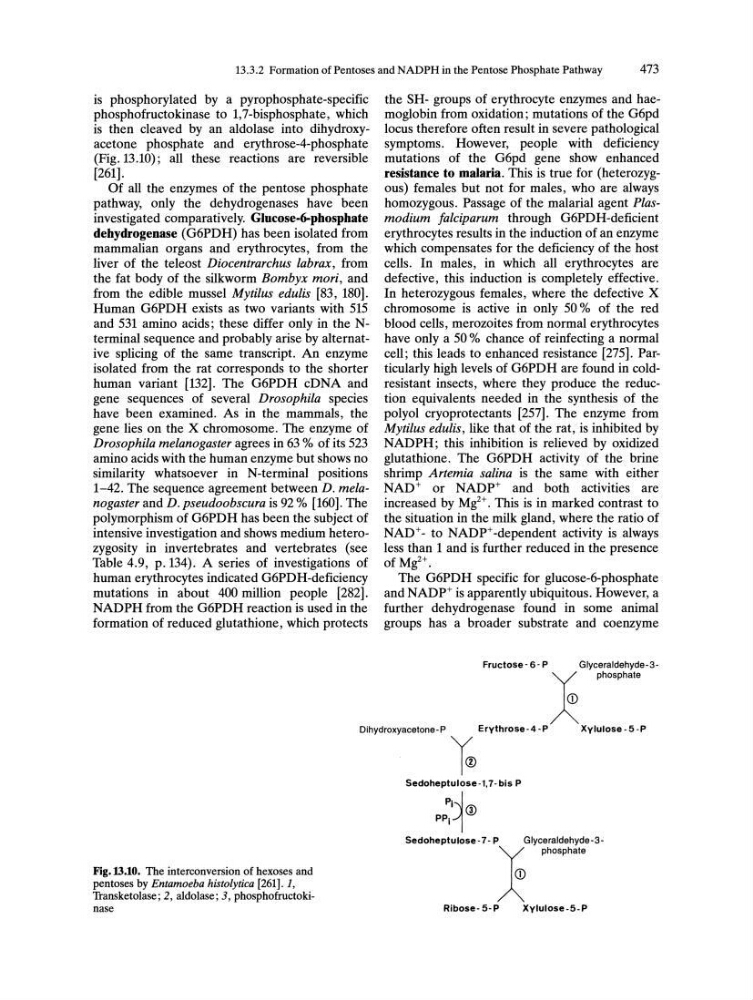
is phosphorylated by a pyrophosphate-specific
phosphofructokinase to 1,7-bisphosphate, which
is then cleaved by an aldolase into dihydroxyacetone phosphate and erythrose-4-phosphate
(Fig. 13.10); all these reactions are reversible
[261].
Of all the enzymes of the pentose phosphate
pathway, only the dehydrogenases have been
investigated comparatively. Glucose-6-phosphate
dehydrogenase (G6PDH) has been isolated from
mammalian organs and erythrocytes, from the
liver of the teleost Diocentrarchus labrax, from
the fat body of the silkworm Bombyx mori, and
from the edible mussel Mytilus edulis [83, 180].
Human G6PDH exists as two variants with 515
and 531 amino acids; these differ only in the Nterminal sequence and probably arise by alternative splicing of the same transcript. An enzyme
isolated from the rat corresponds to the shorter
human variant [132]. The G6PDH cDNA and
gene sequences of several Drosophila species
have been examined. As in the mammals, the
gene lies on the X chromosome. The enzyme of
Drosophila melanogaster agrees in 63 % of its 523
amino acids with the human enzyme but shows no
similarity whatsoever in N-terminal positions
1-42. The sequence agreement between D. melanogaster and D. pseudoobscura is 92 % [160]. The
polymorphism of G6PDH has been the subject of
intensive investigation and shows medium heterozygosity in invertebrates and vertebrates (see
Table 4.9, p.134). A series of investigations of
human erythrocytes indicated G6PDH-deficiency
mutations in about 400 million people [282].
NADPH from the G6PDH reaction is used in the
formation of reduced glutathione, which protects
the SH- groups of erythrocyte enzymes and haemoglobin from oxidation; mutations of the G6pd
locus therefore often result in severe pathological
symptoms. However, people with deficiency
mutations of the G6pd gene show enhanced
resistance to malaria. This is true for (heterozygous) females but not for males, who are always
homozygous. Passage of the malarial agent Plasmodium falciparum through G6PDH-deficient
erythrocytes results in the induction of an enzyme
which compensates for the deficiency of the host
cells. In males, in which all erythrocytes are
defective, this induction is completely effective.
In heterozygous females, where the defective X
chromosome is active in only 50 % of the red
blood cells, merozoites from normal erythrocytes
have only a 50 % chance of reinfecting a normal
cell; this leads to enhanced resistance [275]. Particularly high levels of G6PDH are found in coldresistant insects, where they produce the reduction equivalents needed in the synthesis of the
polyol cryoprotectants [257]. The enzyme from
Mytilus edulis, like that of the rat, is inhibited by
NADPH; this inhibition is relieved by oxidized
glutathione. The G6PDH activity of the brine
shrimp Artemia salina is the same with either
NAD+ or NADP+ and both activities are
increased by Mgz+. This is in marked contrast to
the situation in the milk gland, where the ratio of
NAD+ - to NADP+ -dependent activity is always
less than 1 and is further reduced in the presence
of Mgz+.
The G6PDH specific for glucose-6-phosphate
and NADP+ is apparently Ubiquitous. However, a
further dehydrogenase found in some animal
groups has a broader substrate and coenzyme
Fructose - 6 - P
Glyceraldehyde-3~
phosphate
A
Dihydro>
Fig.n.IO. The interconversion of hexoses and
pentoses by Entamoeba histolytica [261]. 1,
Transketolase; 2, aldolase; 3, phosphofructokinase
Sedoheptulose-l,7-bis P
PP~@
Sedoheptulose -7 - P
Glyceraldehyde-3~
phosphate
A
Ribose-5-P
Xylulose-5-P