

13.3.2 Formation of Pentoses and NADPH in the Pentose Phosphate Pathway
471
Galactose
ATP lQ)
ADP-'"+
Galactose-l-P
UDP-GIC~
Glc-l-P
®
UDP-Galactose
!®
UDP-Glucose
Pp.-J
UT~ --1®
Glucose -1- P
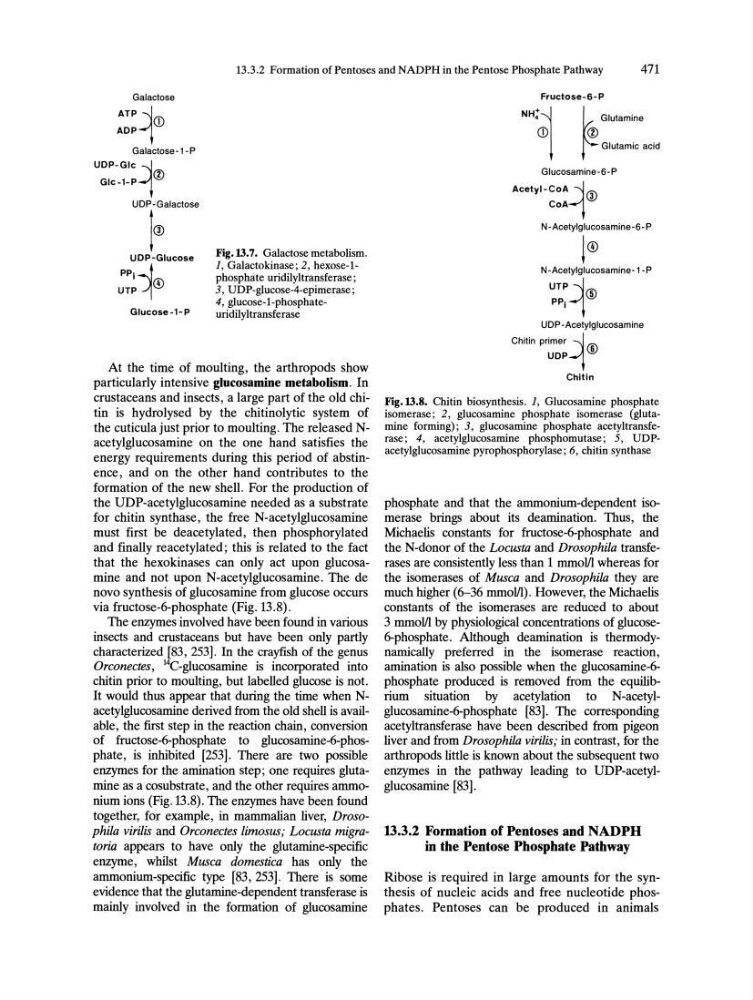
Fig.n.7. Galactose metabolism.
1, Galactokinase; 2, hexose-1phosphate uridilyltransferase;
3, UDP-glucose-4-epimerase;
4, glucose-1-phosphateuridilyltransferase
At the time of moulting, the arthropods show
particularly intensive glucosamine metabolism. In
crustaceans and insects, a large part of the old chitin is hydrolysed by the chitinolytic system of
the cuticula just prior to moulting. The released Nacetylglucosamine on the one hand satisfies the
energy requirements during this period of abstinence, and on the other hand contributes to the
formation of the new shell. For the production of
the UDP-acetylglucosamine needed as a substrate
for chitin synthase, the free N-acetylglucosamine
must first be deacetylated, then phosphorylated
and finally reacetylated; this is related to the fact
that the hexokinases can only act upon glucosamine and not upon N-acetylglucosamine. The de
novo synthesis of glucosamine from glucose occurs
via fructose-6-phosphate (Fig. 13.8).
The enzymes involved have been found in various
insects and crustaceans but have been only partly
characterized [83, 253]. In the crayfish of the genus
Orconectes, 14C-glucosamine is incorporated into
chitin prior to moulting, but labelled glucose is not.
It would thus appear that during the time when Nacetylglucosamine derived from the old shell is available, the first step in the reaction chain, conversion
of fructose-6-phosphate to glucosamine-6-phosphate, is inhibited [253]. There are two possible
enzymes for the amination step; one requires glutamine as a cosubstrate, and the other requires ammonium ions (Fig. 13.8). The enzymes have been found
together, for example, in mammalian liver, Drosophila virilis and Orconectes limosus; Locusta migratoria appears to have only the glutamine-specific
enzyme, whilst Musca domestica has only the
ammonium-specific type [83,253]. There is some
evidence that the glutamine-dependent transferase is
mainly involved in the formation of glucosamine
Fructose-6-P
~
Glutamine
®
Glutamic acid
Glucosamine-6-P
Acetyl-CoA "' 1®
COA.-'+
N -Acetylglucosamine-6- P
t®
N-Acetylglucosamine-l-P
UTP l®
PPi -'"~
UDP-Acetylglucosamine
Chitin primer ~ ®
UDP4
Chitin
Fig.n.s. Chitin biosynthesis. 1, Glucosamine phosphate
isomerase; 2, glucosamine phosphate isomerase (glutamine forming); 3, glucosamine phosphate acetyltransferase; 4, acetylglucosamine phosphomutase; 5, UDPacetylglucosamine pyrophosphorylase; 6, chitin synthase
phosphate and that the ammonium-dependent isomerase brings about its deamination. Thus, the
Michaelis constants for fructose-6-phosphate and
the N-donor of the Locusta and Drosophila transferases are consistently less than 1 mmolll whereas for
the isomerases of Musca and Drosophila they are
much higher (6-36 mmolll). However, the Michaelis
constants of the isomerases are reduced to about
3 mmolll by physiological concentrations of glucose6-phosphate. Although deamination is thermodynamically preferred in the isomerase reaction,
amination is also possible when the glucosamine-6phosphate produced is removed from the equilibrium situation by acetylation to N-acetylglucosamine-6-phosphate [83]. The corresponding
acetyltransferase have been described from pigeon
liver and from Drosophila virilis; in contrast, for the
arthropods little is known about the subsequent two
enzymes in the pathway leading to UDP-acetylglucosamine [83].
13.3.2 Formation of Pentoses and NADPH
in the Pentose Phosphate Pathway
Ribose is required in large amounts for the synthesis of nucleic acids and free nucleotide phosphates. Pentoses can be produced in animals