

470
13 The Structure and Metabolism of Carbohydrates
bonds requires the transfer of a sugar residue
from a donor (usually DDP, other nucleoside
diphosphates or dolichol pyrophosphate) to an
acceptor through the action of a specific glycosyltransferase. Thus, numerous ~-glucosides and
~-glucuronides can be produced from UDPglucose and UDP-glucuronic acid; the oligosacchari des and polysaccharides arise by a similar
process. In the biosynthesis of trehalose,
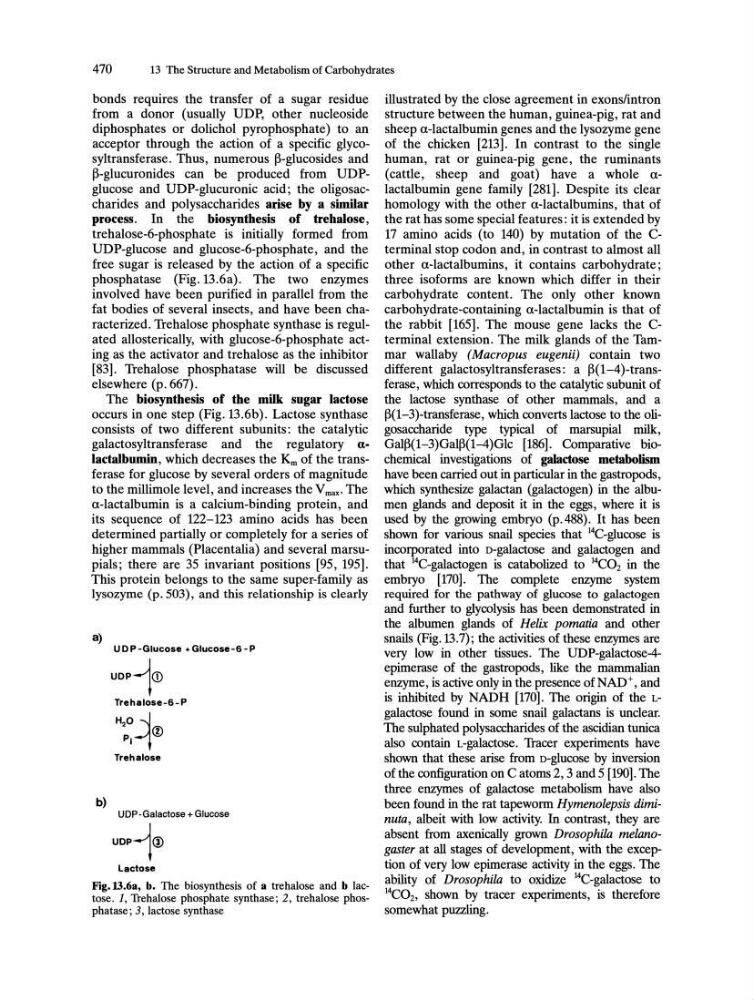
trehalose-6-phosphate is initially formed from
UDP-glucose and glucose-6-phosphate, and the
free sugar is released by the action of a specific
phosphatase (Fig. 13.6a). The two enzymes
involved have been purified in parallel from the
fat bodies of several insects, and have been characterized. Trehalose phosphate synthase is regulated allosterically, with glucose-6-phosphate acting as the activator and trehalose as the inhibitor
[83]. Trehalose phosphatase will be discussed
elsewhere (p. 667).
The biosynthesis of the milk sugar lactose
occurs in one step (Fig. 13.6b). Lactose synthase
consists of two different subunits: the catalytic
galactosyltransferase and the regulatory alactalbumin, which decreases the Km of the transferase for glucose by several orders of magnitude
to the millimole level, and increases the V max. The
a-lactalbumin is a calcium-binding protein, and
its sequence of 122-123 amino acids has been
determined partially or completely for a series of
higher mammals (Placentalia) and several marsupials; there are 35 invariant positions [95, 195].
This protein belongs to the same super-family as
lysozyme (p. 503), and this relationship is clearly
a)
b)
U 0 P -Glucose + Glucose-6 - P
UDP1CD
Trehalose-6 - P
H20 ~®
Pi -1
Trehalose
UDP-Galactose + Glucose
UDP1~
Lactose
Fig.13.6a, b. The biosynthesis of a trehalose and b lactose. 1, Trehalose phosphate synthase; 2, trehalose phosphatase; 3, lactose synthase
illustrated by the close agreement in exons/intron
structure between the human, guinea-pig, rat and
sheep a-lactalbumin genes and the lysozyme gene
of the chicken [213]. In contrast to the single
human, rat or guinea-pig gene, the ruminants
(cattle, sheep and goat) have a whole alactalbumin gene family [281]. Despite its clear
homology with the other a-Iactalbumins, that of
the rat has some special features: it is extended by
17 amino acids (to 140) by mutation of the Cterminal stop codon and, in contrast to almost all
other a-Iactalbumins, it contains carbohydrate;
three isoforms are known which differ in their
carbohydrate content. The only other known
carbohydrate-containing a-lactalbumin is that of
the rabbit [165]. The mouse gene lacks the Cterminal extension. The milk glands of the Tammar wallaby (Macropus eugenii) contain two
different galactosyltransferases: a ~(1-4)-transferase, which corresponds to the catalytic subunit of
the lactose synthase of other mammals, and a
~(1-3)-transferase, which converts lactose to the oligosaccharide type typical of marsupial milk,
Gal~(1-3)Gal~(I-4)Glc [186]. Comparative biochemical investigations of galactose metabolism
have been carried out in particular in the gastropods,
which synthesize galactan (galactogen) in the albumen glands and deposit it in the eggs, where it is
used by the growing embryo (p.488). It has been
shown for various snail species that 14C-glucose is
incorporated into D-galactose and galactogen and
that 14C-galactogen is catabolized to 14C02 in the
embryo [170]. The complete enzyme system
required for the pathway of glucose to galactogen
and further to glycolysis has been demonstrated in
the albumen glands of Helix pomatia and other
snails (Fig. 13.7); the activities of these enzymes are
very low in other tissues. The UDP-galactose-4epimerase of the gastropods, like the mammalian
enzyme, is active only in the presence of NAD+, and
is inhibited by NADH [170]. The origin of the Lgalactose found in some snail galactans is unclear.
The sulphated polysaccharides of the ascidian tunica
also contain L-galactose. Tracer experiments have
shown that these arise from D-glucose by inversion
of the configuration on C atoms 2, 3 and 5 [190]. The
three enzymes of galactose metabolism have also
been found in the rat tapeworm Hymenolepsis diminuta, albeit with low activity. In contrast, they are
absent from axenically grown Drosophila melanogaster at all stages of development, with the exception of very low epimerase activity in the eggs. The
ability of Drosophila to oxidize 14C-galactose to
14C02, shown by tracer experiments, is therefore
somewhat puzzling.