

13.3.1 The Main Metabolic Reactions of Sugars
469
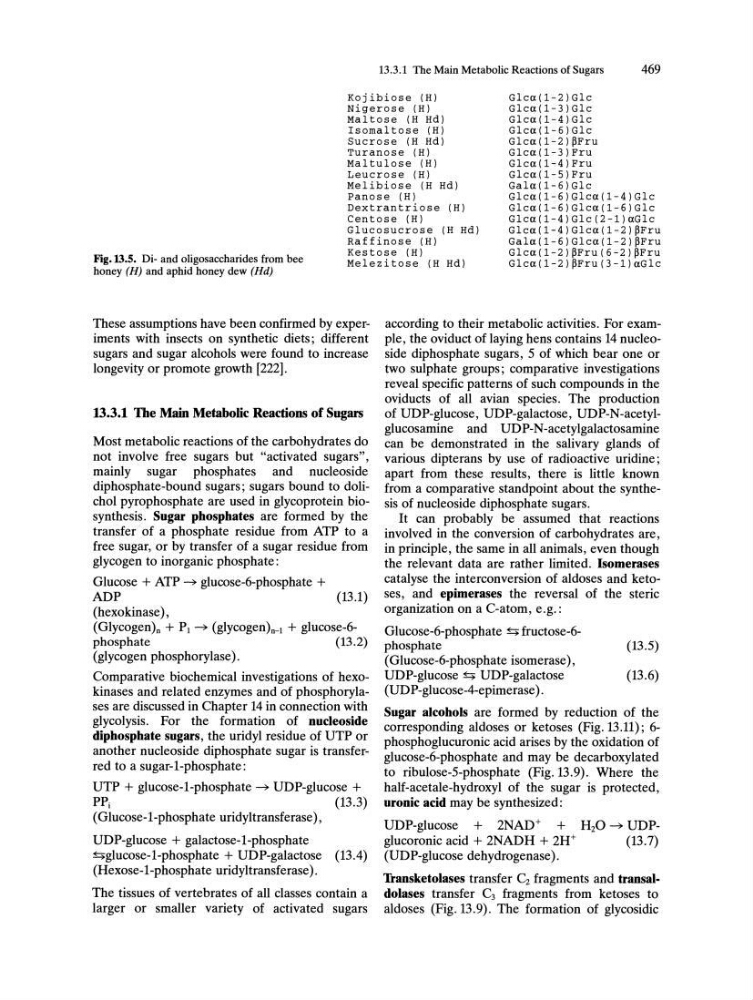
Fig.13.S. Di- and oligosaccharides from bee
honey (H) and aphid honey dew (Hd)
Kojibiose (H)
Nigerose (H)
Maltose (H Hd)
Isomaltose (H)
Sucrose (H Hd)
Turanose (H)
MaHulose (H)
Leucrose (H)
Melibiose (H Hd)
Panose (H)
Dextrantriose (H)
Centose (H)
Glucosucrose (H Hd)
Raffinose (H)
Kestose (H)
Melezitose (H Hd)
Glca(1-2)Glc
Glca(1-3)Glc
Glca(1-4)Glc
Glca(1-6)Glc
Glca(1-2)~Fru
Glca(1-3)Fru
Glca(1-4)Fru
Glca(1-5)Fru
Gala(1-6)Glc
Glca(1-6)Glca(1-4)Glc
Glca(1-6)Glca(1-6)Glc
Glca(1-4)Glc(2-1)aGlc
Glca(1-4)Glca(1-2)~Fru
Gala(1-6)Glca(1-2)~Fru
Glca(1-2)~Fru(6-2)~Fru
Glca(1-2)~Fru(3-1)aGlc
These assumptions have been confirmed by experiments with insects on synthetic diets; different
sugars and sugar alcohols were found to increase
longevity or promote growth [222].
13.3.1 The Main Metabolic Reactions of Sugars
Most metabolic reactions of the carbohydrates do
not involve free sugars but "activated sugars",
mainly sugar phosphates and nucleoside
diphosphate-bound sugars; sugars bound to dolichol pyrophosphate are used in glycoprotein biosynthesis. Sugar phosphates are formed by the
transfer of a phosphate residue from ATP to a
free sugar, or by transfer of a sugar residue from
glycogen to inorganic phosphate:
Glucose + ATP ~ glucose-6-phosphate +
ADP
(13.1)
(hexokinase) ,
(Glycogen)n + PI ~ (glycogen)n_1 + glucose-6phosphate
(13.2)
(glycogen phosphorylase).
Comparative biochemical investigations of hexokinases and related enzymes and of phosphorylases are discussed in Chapter 14 in connection with
glycolysis. For the formation of nucleoside
diphosphate sugars, the uridyl residue of UTP or
another nucleoside diphosphate sugar is transferred to a sugar-1-phosphate:
UTP + glucose-1-phosphate ~ UDP-glucose +
PPj
(13.3)
(Glucose-1-phosphate uridyltransferase),
UDP-glucose + galactose-1-phosphate
~glucose-1-phosphate + UDP-galactose (13.4)
(Hexose-1-phosphate uridyltransferase).
The tissues of vertebrates of all classes contain a
larger or smaller variety of activated sugars
according to their metabolic activities. For example, the oviduct of laying hens contains 14 nucleoside diphosphate sugars, 5 of which bear one or
two sulphate groups; comparative investigations
reveal specific patterns of such compounds in the
oviducts of all avian species. The production
of UDP-glucose, UDP-galactose, UDP-N-acetylglucosamine and UD P-N -acetylgalactosamine
can be demonstrated in the salivary glands of
various dipterans by use of radioactive uridine;
apart from these results, there is little known
from a comparative standpoint about the synthesis of nucleoside diphosphate sugars.
It can probably be assumed that reactions
involved in the conversion of carbohydrates are,
in principle, the same in all animals, even though
the relevant data are rather limited. Isomerases
catalyse the interconversion of aldoses and ketoses, and epimerases the reversal of the steric
organization on a C-atom, e.g.:
Glucose-6-phosphate ~ fructose-6phosphate
(Glucose-6-phosphate isomerase),
UDP-glucose ~ UDP-galactose
(UD P-glucose-4-epimerase).
(13.5)
(13.6)
Sugar alcohols are formed by reduction of the
corresponding aldoses or ketoses (Fig. 13.11); 6phospho glucuronic acid arises by the oxidation of
glucose-6-phosphate and may be decarboxylated
to ribulose-5-phosphate (Fig. 13.9). Where the
half-acetale-hydroxyl of the sugar is protected,
uronic acid may be synthesized:
UDP-glucose + 2NAD+ + H 20 ~ UDPglucoronic acid + 2NADH + 2H+
(13.7)
(UDP-glucose dehydrogenase).
Transketolases transfer C2 fragments and transaldolases transfer C3 fragments from ketoses to
aldoses (Fig. 13.9). The formation of glycosidic