

13.1 Sugars and Sugar Derivatives
465
HOOC H OH H H OH OH
11 I I I I I I
~
-C-C-C-C-C-C-CH OH
21 31 4~51 6 71 81 9 2
HO H H NH2
H H
o
Neuraminic acid
N-Acetyl-Neu
N-Acetyl-4-0-acetyl-Neu
Trypanosoma, Echinoderms,
Enteropneusta, Acrania,
all vertebrates
Ornithorhynchus milk and
N-Acetyl-8-0-acetyl-Neu
N-Acetyl-9-0-acetyl-Neu
N-Acetyl-8,9-0-diacetyl-Neu
N-Acetyl-7,8,9-0-triacetyl-Neu
N-Acetyl-4-0-methyl-Neu
N-Acetyl-9-0-lactyl-Neu
higher mammals
Mammals
Fish, birds, mammals
Mammals
Mammals
Mammals
Mammals
N-Glycolyl-Neu
Trypanosoma, Echinoderms,
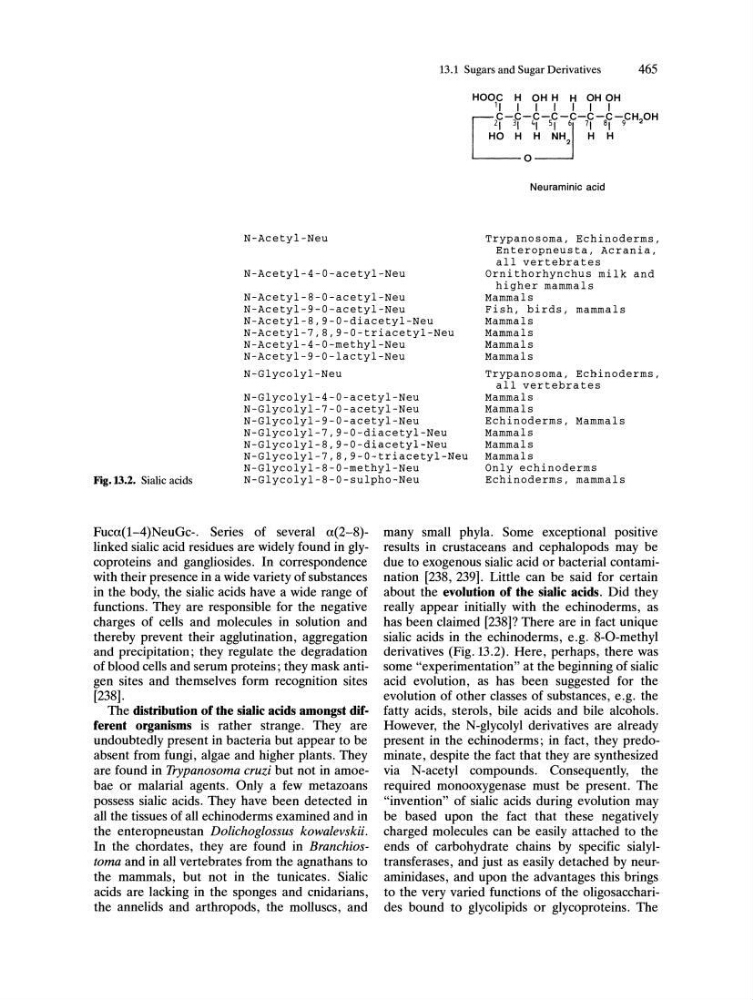
Fig.13.2. Sialic acids
N-Glycolyl-4-0-acetyl-Neu
N-Glycolyl-7-0-acetyl-Neu
N-Glycolyl-9-0-acetyl-Neu
N-Glycolyl-7,9-0-diacetyl-Neu
N-Glycolyl-8,9-0-diacetyl-Neu
N-Glycolyl-7,8,9-0-triacetyl-Neu
N-Glycolyl-8-0-methyl-Neu
N-Glycolyl-8-0-sulpho-Neu
all vertebrates
Mammals
Mammals
Echinoderms, Mammals
Mammals
Mammals
Mammals
Only echinoderms
Echinoderms, mammals
Fuca(1-4)NeuGc-. Series of several a(2-8)linked sialic acid residues are widely found in glycoproteins and gangliosides. In correspondence
with their presence in a wide variety of substances
in the body, the sialic acids have a wide range of
functions. They are responsible for the negative
charges of cells and molecules in solution and
thereby prevent their agglutination, aggregation
and precipitation; they regulate the degradation
of blood cells and serum proteins; they mask antigen sites and themselves form recognition sites
[238].
The distribution of the sialic acids amongst different organisms is rather strange. They are
undoubtedly present in bacteria but appear to be
absent from fungi, algae and higher plants. They
are found in Trypanosoma cruzi but not in amoebae or malarial agents. Only a few metazoans
possess sialic acids. They have been detected in
all the tissues of all echinoderms examined and in
the enteropneustan Dolichoglossus kowalevskii.
In the chordates, they are found in Branchioslorna and in all vertebrates from the agnathans to
the mammals, but not in the tunicates. Sialic
acids are lacking in the sponges and cnidarians,
the annelids and arthropods, the molluscs, and
many small phyla. Some exceptional positive
results in crustaceans and cephalopods may be
due to exogenous sialic acid or bacterial contamination [238, 239]. Little can be said for certain
about the evolution of the sialic acids. Did they
really appear initially with the echinoderms, as
has been claimed [238]? There are in fact unique
sialic acids in the echinoderms, e.g. 8-0-methyl
derivatives (Fig. 13.2). Here, perhaps, there was
some "experimentation" at the beginning of sialic
acid evolution, as has been suggested for the
evolution of other classes of substances, e.g. the
fatty acids, sterols, bile acids and bile alcohols.
However, the N-glycolyl derivatives are already
present in the echinoderms; in fact, they predominate, despite the fact that they are synthesized
via N-acetyl compounds. Consequently, the
required monooxygenase must be present. The
"invention" of sialic acids during evolution may
be based upon the fact that these negatively
charged molecules can be easily attached to the
ends of carbohydrate chains by specific sialyltransferases, and just as easily detached by neuraminidases, and upon the advantages this brings
to the very varied functions of the oligosaccharides bound to glycolipids or glycoproteins. The