

464
13 The Structure and Metabolism of Carbohydrates
media. Of the sugar alcohols resulting from the
reduction of sugars, D-ribitol is ubiquitously
found as a component of flavin nudeotides; Dsorbitol is present at high concentrations in the
seminal fluid of many mammals and, in addition
to glycerol, it acts as an antifreeze agent in overwintering insect eggs and larvae. It could be
shown in the cotton beetle Anthonornus grandis
that the supply of sugar to starving animals
resulted in the appearance of the corresponding
sugar alcohols in the haemolymph, in particular
D-ribitol, D-xylitol, D-arabitol and D-rhamnitol. In
addition to myo-inositol, erythritol, threitol, ribitol and xylitol, the lens of the human eye contains
hepitol and octitol [57, 244].
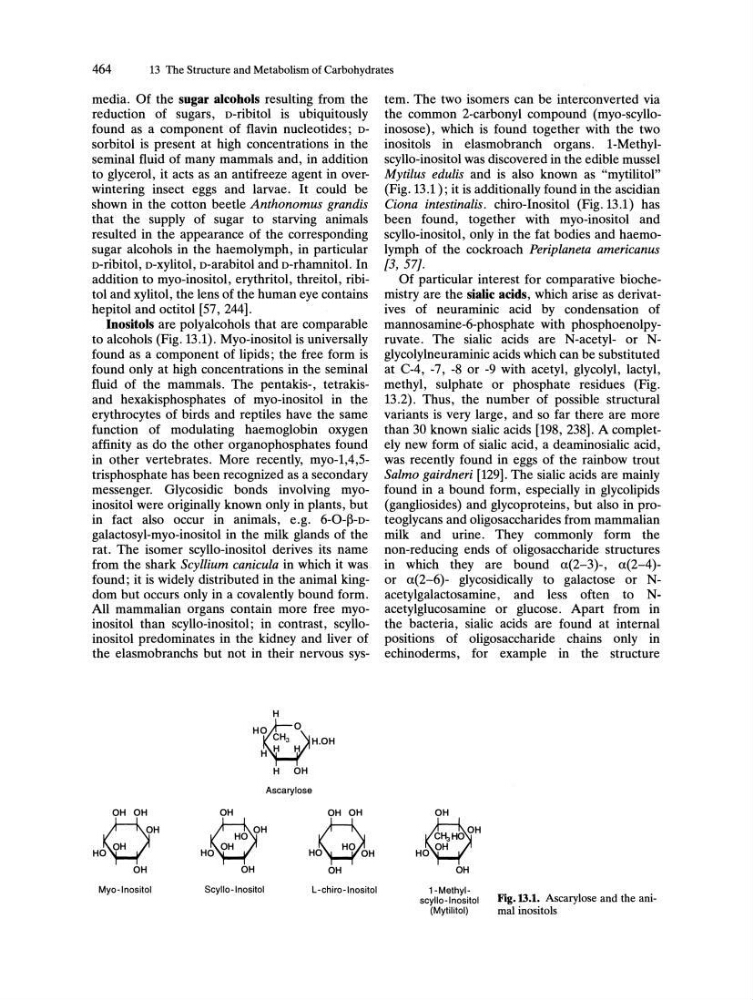
Inositols are polyalcohols that are comparable
to alcohols (Fig. 13.1). Myo-inositol is universally
found as a component of lipids; the free form is
found only at high concentrations in the seminal
fluid of the mammals. The pentakis-, tetrakisand hexakisphosphates of myo-inositol in the
erythrocytes of birds and reptiles have the same
function of modulating haemoglobin oxygen
affinity as do the other organophosphates found
in other vertebrates. More recently, myo-l,4,5trisphosphate has been recognized as a secondary
messenger. Glycosidic bonds involving myoinositol were originally known only in plants, but
in fact also occur in animals, e.g. 6-0-~-Dgalactosyl-myo-inositol in the milk glands of the
rat. The isomer scyllo-inositol derives its name
from the shark Scylliurn canicula in which it was
found; it is widely distributed in the animal kingdom but occurs only in a covalently bound form.
All mammalian organs contain more free myoinositol than scyllo-inositol; in contrast, scylloinositol predominates in the kidney and liver of
the elasmobranchs but not in their nervous sysOH OH
~H
HO~
OH
Myo-Inositol
H
CH3
H.OH
HO~ H H H
H OH
Ascarylose
OH
~H
H~
OH
Scylio -Inositol
OH OH
HGH
OH
L-chiro-Inositol
tern. The two isomers can be interconverted via
the common 2-carbonyl compound (myo-scylloinosose), which is found together with the two
inositols in elasmobranch organs. I-Methylscyllo-inositol was discovered in the edible mussel
Mytilus edulis and is also known as "mytilitol"
(Fig. 13.1); it is additionally found in the ascidian
Ciona intestinalis. chiro-Inositol (Fig.13.1) has
been found, together with myo-inositol and
scyllo-inositol, only in the fat bodies and haemolymph of the cockroach Periplaneta arnericanus
[3,57}.
Of particular interest for comparative biochemistry are the sialic acids, which arise as derivatives of neuraminic acid by condensation of
mannosamine-6-phosphate with phosphoenolpyruvate. The sialic acids are N-acetyl- or Nglycolylneuraminic acids which can be substituted
at C-4, -7, -8 or -9 with acetyl, glycolyl, lactyl,
methyl, sulphate or phosphate residues (Fig.
13.2). Thus, the number of possible structural
variants is very large, and so far there are more
than 30 known sialic acids [198, 238]. A completely new form of sialic acid, a deaminosialic acid,
was recently found in eggs of the rainbow trout
Salrno gairdneri [129]. The sialic acids are mainly
found in a bound form, especially in glycolipids
(gangliosides) and glycoproteins, but also in proteoglycans and oligosaccharides from mammalian
milk and urine. They commonly form the
non-reducing ends of oligosaccharide structures
in which they are bound a(2-3)-, a(2-4)or a(2-6)- glycosidically to galactose or Nacetylgalactosamine, and less often to Nacetylglucosamine or glucose. Apart from in
the bacteria, sialic acids are found at internal
positions of oligosaccharide chains only in
echinoderms, for example in the structure
OH
~~'H
HO OH
OH
1-Methylscylio-Inositol
Fig.n.l. Ascarylose and the ani(Mytilitol)
mal inositols