

466
13 The Structure and Metabolism of Carbohydrates
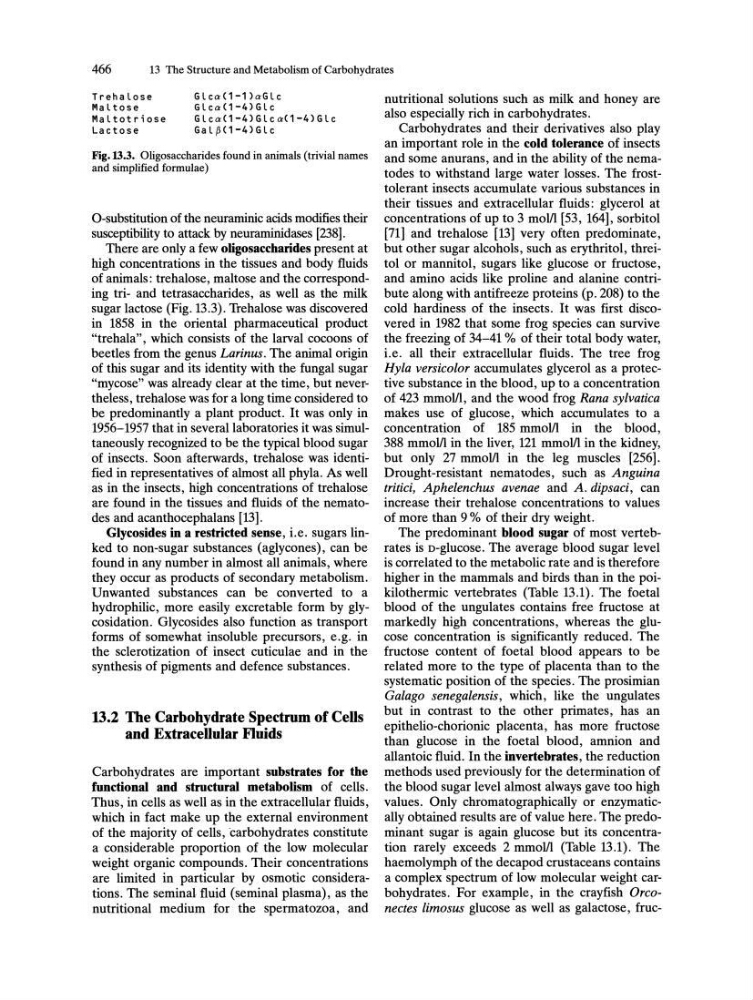
TrehaLose
MaLtose
MaLtotriose
Lactose
GLca(1-1)aGLc
GLca(1-4)GLc
GLca(1-4)GLca(1-4)GLc
GaL~(1-4)GLc
Fig.13.3. Oligosaccharides found in animals (trivial names
and simplified formulae)
O-substitution of the neuraminic acids modifies their
susceptibility to attack by neuraminidases [238].
There are only a few oligosaccharides present at
high concentrations in the tissues and body fluids
of animals: trehalose, maltose and the corresponding tri- and tetrasaccharides, as well as the milk
sugar lactose (Fig. 13.3). Trehalose was discovered
in 1858 in the oriental pharmaceutical product
"trehala", which consists of the larval cocoons of
beetles from the genus Larinus. The animal origin
of this sugar and its identity with the fungal sugar
"mycose" was already clear at the time, but nevertheless, trehalose was for a long time considered to
be predominantly a plant product. It was only in
1956-1957 that in several laboratories it was simultaneously recognized to be the typical blood sugar
of insects. Soon afterwards, trehalose was identified in representatives of almost all phyla. As well
as in the insects, high concentrations of trehalose
are found in the tissues and fluids of the nematodes and acanthocephalans [13].
Glycosides in a restricted sense, i.e. sugars linked to non-sugar substances (aglycones), can be
found in any number in almost all animals, where
they occur as products of secondary metabolism.
Unwanted substances can be converted to a
hydrophilic, more easily excretable form by glycosidation. Glycosides also function as transport
forms of somewhat insoluble precursors, e.g. in
the sclerotization of insect cuticulae and in the
synthesis of pigments and defence substances.
13.2 The Carbohydrate Spectrum of Cells
and Extracellular Fluids
Carbohydrates are important substrates for the
functional and structural metabolism of cells.
Thus, in cells as well as in the extracellular fluids,
which in fact make up the external environment
of the majority of cells, carbohydrates constitute
a considerable proportion of the low molecular
weight organic compounds. Their concentrations
are limited in particular by osmotic considerations. The seminal fluid (seminal plasma), as the
nutritional medium for the spermatozoa, and
nutritional solutions such as milk and honey are
also especially rich in carbohydrates.
Carbohydrates and their derivatives also play
an important role in the cold tolerance of insects
and some anurans, and in the ability of the nematodes to withstand large water losses. The frosttolerant insects accumulate various substances in
their tissues and extracellular fluids: glycerol at
concentrations of up to 3 molll [53, 164], sorbitol
[71] and trehalose [13] very often predominate,
but other sugar alcohols, such as erythritol, threitol or mannitol, sugars like glucose or fructose,
and amino acids like proline and alanine contribute along with antifreeze proteins (p. 208) to the
cold hardiness of the insects. It was first discovered in 1982 that some frog species can survive
the freezing of 34-41 % of their total body water,
i.e. all their extracellular fluids. The tree frog
Byla versicolor accumulates glycerol as a protective substance in the blood, up to a concentration
of 423 mmolll, and the wood frog Rana sylvatica
makes use of glucose, which accumulates to a
concentration of 185 mmolll in the blood,
388 mmolll in the liver, 121 mmolll in the kidney,
but only 27 mmolll in the leg muscles [256].
Drought-resistant nematodes, such as Anguina
tritici, Aphelenchus avenae and A. dipsaci, can
increase their trehalose concentrations to values
of more than 9 % of their dry weight.
The predominant blood sugar of most vertebrates is D-glucose. The average blood sugar level
is correlated to the metabolic rate and is therefore
higher in the mammals and birds than in the poikilothermic vertebrates (Table 13.1). The foetal
blood of the ungulates contains free fructose at
markedly high concentrations, whereas the glucose concentration is significantly reduced. The
fructose content of foetal blood appears to be
related more to the type of placenta than to the
systematic position of the species. The prosimian
Galago senegalensis, which, like the ungulates
but in contrast to the other primates, has an
epithelio-chorionic placenta, has more fructose
than glucose in the foetal blood, amnion and
allantoic fluid. In the invertebrates, the reduction
methods used previously for the determination of
the blood sugar level almost always gave too high
values. Only chromatographically or enzymatically obtained results are of value here. The predominant sugar is again glucose but its concentration rarely exceeds 2 mmolll (Table 13.1). The
haemolymph of the decapod crustaceans contains
a complex spectrum of low molecular weight carbohydrates. For example, in the crayfish Orconectes limos us glucose as well as galactose, fruc-