

are significantly homologous to the enzyme from
soybean. This enzyme is not found in human liver
or, in fact, in any anthropoid, but is present in both
the Old World and New World apes. Loss of the
enzyme in humans is due to mutation of codons
33-Arg and 187-Arg (CGA or AGA) to a stop
codon (TGA) [273]. The selective advantage of the
loss of uratoxidase in the evolution of the hominoids may be that uric acid is an effective antioxidant which can absorb singlet oxygen and oxygen
radicals, and thereby lower the increased risks of
carcinogenesis that accompany the elevated longevity of hominoids [84, 273]. Just why the activity
of uratoxidase in the liver of teleosts varies by a
factor of 40 without any apparent correlation to
systematic position or habitat is not known.
The allantoinase in the liver of the mackerel
Pneumatophorus japonicus is a monomeric protein of 54 kDa, and the allantoicase of the sardine
Sardinops melanosticta is a dimer with subunits of
48 kDa. Both activities are localized in the same
protein molecule in the liver of the frog Rana
catesbeiana, but can be separated by SDS electrophoresis into two different subunits, one of which
has a mass of 54 kDa and functions as an allantoinase, and the other has a mass of 48 kDa and
shows allantoicase activity. Thus, the separate
enzyme proteins of the fish have become associated in the evolution of the amphibians. In the
only study of an invertebrate, the two proteins
were found to be separate in the mussel Anadara
broughtoni [166].
12.11.5 Metabolism of Pyrimidine
Nucleotides
As in the case ofthe purines, in the production of
pyrimidine nucleotides a distinction can be drawn
between de novo synthesis and the use of preformed pyrimidine bases or nucleosides (salvage
pathway); the relative importance of the two
pathways differs greatly with the species or
group. For example, protozoans of the genera
Trypanosoma, Leishmania, Toxoplasma and Plasmodium can synthesize the pyrimidine ring de
novo from aspartate, glutamine and hydrogen
carbonate, but the Trichomonas species and
Lamblia vaginalis cannot [99, 109]. In Drosophila
melanogaster, the pyrimidines taken up during
the larval stage suffice for practically the whole
live cycle; de novo synthesis is required only during egg production [77]. Some species of the
platyhelminths, nemathelminths and dipterans
appear to lack the capacity for de novo synthesis;
12.11.5 Metabolism of Pyrimidine Nucleotides
453
however, in many cases this conclusion is based
on the failure to detect the often very unstable
carbamylphosphate synthetase, or on the
observation that pyrimidine supplementation of
the diet promotes growth.
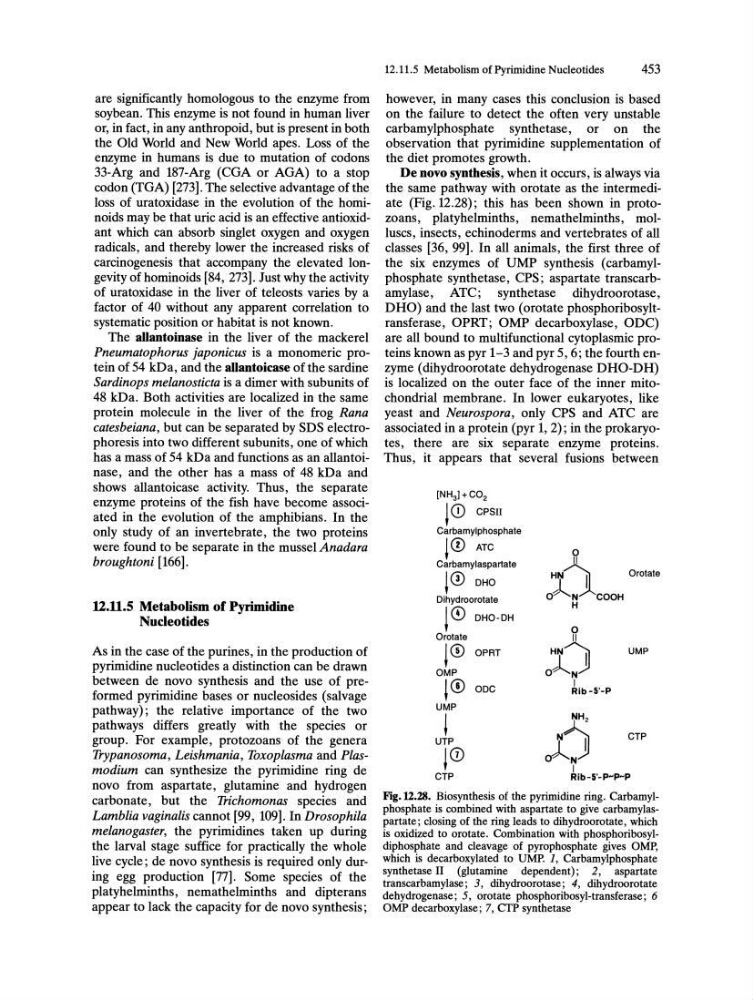
De novo synthesis, when it occurs, is always via
the same pathway with orotate as the intermediate (Fig. 12.28); this has been shown in protozoans, platyhelminths, nemathelminths, molluscs, insects, echinoderms and vertebrates of all
classes [36, 99]. In all animals, the first three of
the six enzymes of UMP synthesis (carbamylphosphate synthetase, CPS; aspartate transcarbamylase, ATC; synthetase dihydroorotase,
DHO) and the last two (orotate phosphoribosyltransferase, OPRT; OMP decarboxylase, ODe)
are all bound to multifunctional cytoplasmic proteins known as pyr 1-3 and pyr 5,6; the fourth enzyme (dihydroorotate dehydrogenase DHO-DH)
is localized on the outer face of the inner mitochondrial membrane. In lower eukaryotes, like
yeast and Neurospora, only CPS and ATC are
associated in a protein (pyr 1, 2); in the prokaryotes, there are six separate enzyme proteins.
Thus, it appears that several fusions between
[NH 3 1+C02
l CD CPSII
Carbamylphosphate
!0 ATC
Carbamyl aspartate
l® DHO
Dihydroorotate
! CD DHO-DH
Orotate
!® OPRT
OMP
!® ODC
UMP
!
UTP
~(!)
CTP
w
H N r
Orotate
o
II
H N r
O~N)
UMP
I
Rib -5'-P
N~ CTP
~NjJ
I
Rib -5'-P~P-P
Fig.12.28. Biosynthesis of the pyrimidine ring, Carbamylphosphate is combined with aspartate to give carbamylaspartate; closing of the ring leads to dihydroorotate, which
is oxidized to orotate. Combination with phosphoribosyldiphosphate and cleavage of pyrophosphate gives OMP,
which is decarboxylated to UMP. 1, Carbamylphosphate
synthetase II (glutamine dependent); 2, aspartate
transcarbamylase; 3, dihydroorotase; 4, dihydroorotate
dehydrogenase; 5, orotate phosphoribosyl-transferase; 6
OMP decarboxylase; 7, CTP synthetase