

454
12 Small Nitrogenous Compounds
genes of the orotate pathway have occurred during evolution. In the "rudimentary" gene of Drosophila melanogaster, the three enzyme activities
of pyr 1-2 are arranged in the coding sequence of
7168 bp in the order CPS-DHO-ATC. The gene
"rudimentary-like" encodes the activities of
OPRT and ODC [73,83]. The golden hamster
also has the activities of CPS, DHO and ATC
together in one polypeptide of 230 kDa [226].
Very little is known comparatively about the
catalytic and regulatory properties of the various
enzymes of the orotate pathway. The elasmobranchs possess two types of CPS, of which the
mitochondrial type in the liver is active in urea
synthesis, and only the cytosolic type, e.g. from
the spleen, is involved in pyrimidine synthesis [7].
The ATC sequence contained in the complex pyr
1-3 of the hamster agrees by up to 44 % with the
isolated enzyme from E. coli. A bacterial strain
which, after gene fusion, produced a hybrid
enzyme from the N-terminal half of mammalian
ATC and the C-terminal half of the bacterial
enzyme, showed normal growth [143]. In the
Kinetoplastida Trypanosoma brucei and Leishmania mexicana, the step from dihydroorotate
to orotate is catalysed not by a mitochondrial
dehydrogenase but by a cytoplasmic, tetrahydrobiopterine-dependent dihydroorotatoxidase;
OPRT and ODC, which are usually cytoplasmic,
are in this case bound to the glycosomes [99].
The reduction of ribose to deoxyribose takes
place on the ribonucleotides. Deoxyribonucleosides, however, can be phosphorylated; thymidine
kinase is especially well known in this respect,
and is found already in Tetrahymena, together
with a non-specific nucleoside phosphotransferase. The methylation of dUMP to dTMP is cataCytosine
Uracil
~-Alanine
Thymine
~-Aminoisobutyric acid
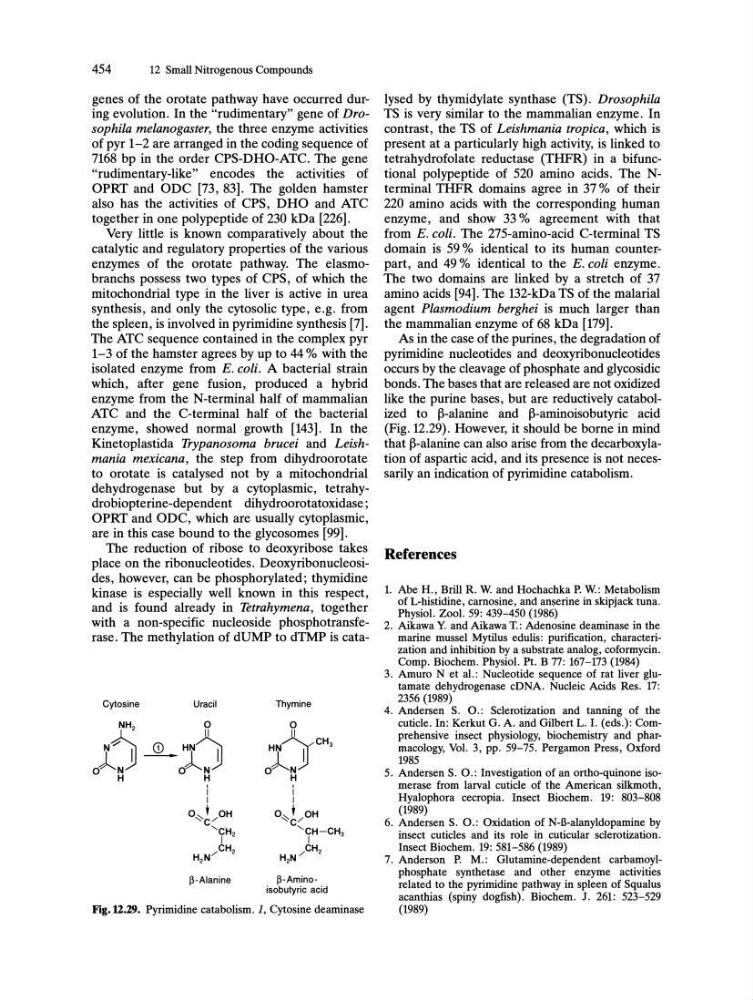
Fig.12.29. Pyrimidine catabolism. 1, Cytosine deaminase
lysed by thymidylate synthase (TS). Drosophila
TS is very similar to the mammalian enzyme. In
contrast, the TS of Leishmania tropica, which is
present at a particularly high activity, is linked to
tetrahydrofolate reductase (THFR) in a bifunctional polypeptide of 520 amino acids. The Nterminal THFR domains agree in 37 % of their
220 amino acids with the corresponding human
enzyme, and show 33 % agreement with that
from E. coli. The 275-amino-acid C-terminal TS
domain is 59 % identical to its human counterpart, and 49 % identical to the E. coli enzyme.
The two domains are linked by a stretch of 37
amino acids [94]. The 132-kDa TS of the malarial
agent Plasmodium berghei is much larger than
the mammalian enzyme of 68 kDa [179].
As in the case of the purines, the degradation of
pyrimidine nucleotides and deoxyribonucleotides
occurs by the cleavage of phosphate and glycosidic
bonds. The bases that are released are not oxidized
like the purine bases, but are reductively catabolized to ~-alanine and ~-aminoisobutyric acid
(Fig. 12.29). However, it should be borne in mind
that ~-alanine can also arise from the decarboxylation of aspartic acid, and its presence is not necessarily an indication of pyrimidine catabolism.
References
1. Abe H., Brill R. W. and Hochachka P. w.: Metabolism
of L-histidine, carnosine, and anserine in skipjack tuna.
Physiol. Zool. 59: 439-450 (1986)
2. Aikawa Y. and Aikawa T.: Adenosine deaminase in the
marine mussel Mytilus edulis: purification, characterization and inhibition by a substrate analog, coformycin.
Compo Biochem. Physiol. Pt. B 77: 167-173 (1984)
3. Amuro N et al.: Nucleotide sequence of rat liver glutamate dehydrogenase cDNA. Nucleic Acids Res. 17:
2356 (1989)
4. Andersen S. 0.: Sclerotization and tanning of the
cuticle. In: Kerkut G. A. and Gilbert L. I. (eds.): Comprehensive insect physiology, biochemistry and pharmacology, Vol. 3, pp. 59-75. Pergamon Press, Oxford
1985
5. Andersen S. 0.: Investigation of an ortho-quinone isomerase from larval cuticle of the American silkmoth,
Hyalophora cecropia. Insect Biochem. 19: 803-808
(1989)
6. Andersen S. 0.: Oxidation of N-B-alanyldopamine by
insect cuticles and its role in cuticular sclerotization.
Insect Biochem. 19: 581-586 (1989)
7. Anderson P. M.: Glutamine-dependent carbamoylphosphate synthetase and other enzyme activities
related to the pyrimidine pathway in spleen of Squalus
acanthias (spiny dogfish). Biochem. J. 261: 523-529
(1989)