

452
12 Small Nitrogenous Compounds
invertebrate adenosine deaminase to have been
characterized in any detail is that from the hepatopancreas of the edible mussel Mytilus edulis; it
has a mass of 140 kDa but is otherwise similar in
its catalytic properties and inhibitory reactions to
the enzymes of the vertebrates and other invertebrates [2].
The oxidation of hypoxanthine to xanthine and
of xanthine to uric acid is brought about by enzymes which are named, according to their electron
acceptors, as xanthine:02 oxidoreductases (xanthine oxidases, XO) or xanthine :NAD+ oxidoreductases (xanthine dehydrogenases, XDH),
although these are apparently just different forms
of the same enzyme. The form that is active in the
cell is possibly XDH, which can be converted to
the XO form. Which of the two enzyme activities
is detected depends upon the animal species examined. In mammals, XO is consistently found,
whereas in birds XDH is found in addition to XO;
XO activity is lacking in the columbiformes. Fish,
amphibians and reptiles, and also the insects have
XDH. Many other invertebrates appear to possess
neither of the two activities [41, 279]. The much
investigated XO of cow milk is immunologically
closely related to the enzyme from bovine liver.
The XDH enzymes of many insects are, with the
exception of minor differences in specificity, very
similar to the XDH from avian liver. In the
insects, as in the vertebrates, these enzymes are
dimers of 280 kDa with two electron-transport
subunits, each with one molybdenum, four iron
ions and an FAD [106]. Because of their broad
specificities, these enzymes are difficult to distinguish from aldehyde oxidases (AO). The substrate
affinities of XDH in the ureotelic mammals and
the ammoniotelic fish are much higher than those
in the uricotelic birds and reptiles [122, 142]. In
mammals, XDH is found mainly in the liver, but
in the clawed frog Xenopus laevis it occurs only in
the kidney [142]. The liver of the camel has an
unusually low XDH activity and contains no guanase. Hence, purine catabolism stops at the level
of hypoxanthine, which is very suitable for recycl~
ing in purine metabolism (salvage pathway). In
this way, the camel is adapted to long periods of
minimal nutrition [159].
12.11.4 Uricolysis
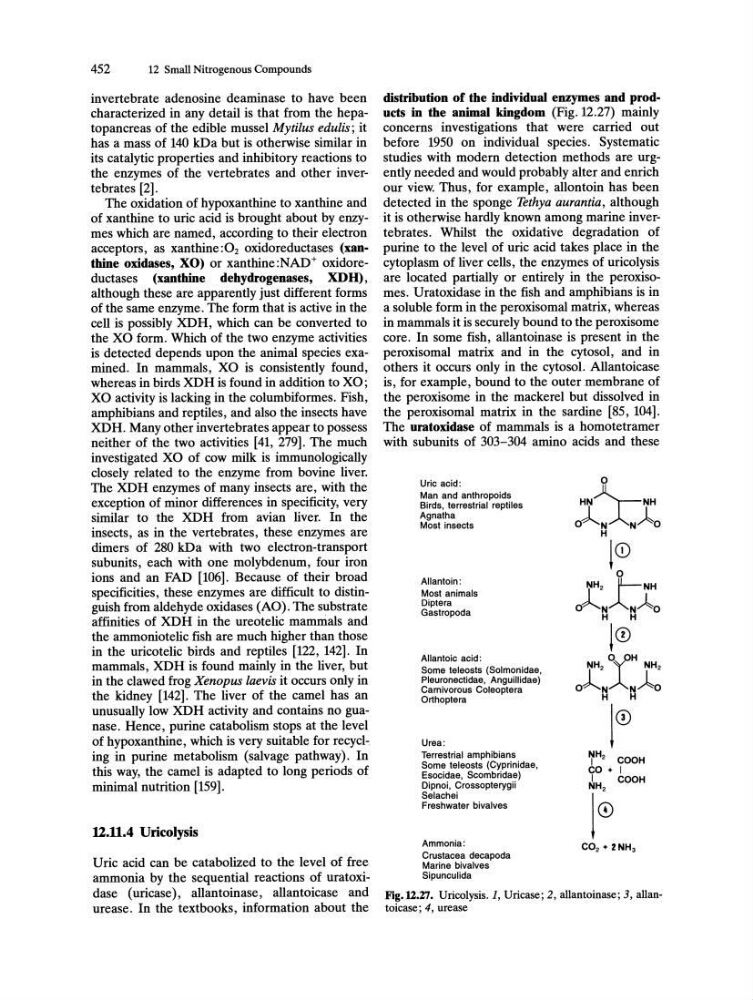
Uric acid can be catabolized to the level of free
ammonia by the sequential reactions of uratoxidase (uricase), allantoinase, allantoicase and
urease. In the textbooks, information about the
distribution of the individual enzymes and products in the animal kingdom (Fig. 12.27) mainly
concerns investigations that were carried out
before 1950 on individual species. Systematic
studies with modern detection methods are urgently needed and would probably alter and enrich
our view. Thus, for example, allontoin has been
detected in the sponge Tethya aurantia, although
it is otherwise hardly known among marine invertebrates. Whilst the oxidative degradation of
purine to the level of uric acid takes place in the
cytoplasm of liver cells, the enzymes of uricolysis
are located partially or entirely in the peroxisomeso Uratoxidase in the fish and amphibians is in
a soluble form in the peroxisomal matrix, whereas
in mammals it is securely bound to the peroxisome
core. In some fish, allantoinase is present in the
peroxisomal matrix and in the cytosol, and in
others it occurs only in the cytosol. Allantoicase
is, for example, bound to the outer membrane of
the peroxisome in the mackerel but dissolved in
the peroxisomal matrix in the sardine [85, 104].
The uratoxidase of mammals is a homotetramer
with subunits of 303-304 amino acids and these
Uric acid:
Man and anthropoids
Birds, terrestrial reptiles
Agnatha
Most insects
Allantoin:
Most animals
Diptera
Gastropoda
Allantoic acid:
Some teleosts (Solmonidae,
Pleuronectidae, Anguillidae)
Carnivorous Coleoptera
Orthoptera
Urea:
Terrestrial amphibians
Some teleosts (Cyprinidae,
Esocidae, Scombridae)
Dipnoi, Crossopterygii
Selachei
Freshwater bivalves
Ammonia:
Crustacea decapoda
Marine bivalves
Sipunculida
Fig.12.27. Uricolysis. 1, Uricase; 2, allantoinase; 3, allantoicase; 4, urease