

446
12 Small Nitrogenous Compounds
y-Glutamyl-transferases transfer the y-glutamyl residue from glutathione or its conjugate to
an amino acid or a peptide; however, the enzyme
also catalyses the hydrolytic cleavage of the yglutamyl bond. y-Glutamyl-transpeptides are
apparently widely distributed and are found in
protozoans, echinoderms, molluscs and insects as
well as in the vertebrates [46, 119, 204].
They are membrane-bound glycoproteins which
occur, e.g. in the rat, as several tissue- and
development-specific isoenzymes [93]. Glutathione-S-transferase and y-glutamyl-transpeptidase
catalyse the first two steps in a detoxification
pathway which leads to the production of S-arylcysteine in insects and mercapto acids in vertebrates. The transpeptidase, which is located in the
plasma membrane, was thought for a time to have
an important role in the uptake of amino acids
into cells (the y-glutamyl cycle). However, there
is also experimental evidence against such a role
[214]. Human transpeptidase is a heterodimer
with a heavy subunit of 42 kDa, which is
anchored in the membrane, and a light subunit of
19 kDa, which carries the y-glutamyl binding site.
The two subunits arise from a common precursor
of 569 amino acids [198]. In larvae of the housefly
Musca domestica, y-glutamyl-transpeptidase is
responsible for the synthesis of the dipeptide yglutamylphenylalanine, whose role in sclerotization has already been described. The enzyme,
which has its highest activities in the Malpighian
tubules and the midgut, can utilize various amino
acids in vitro, despite the fact that in vivo only
the y-glutamylphenylalanine is found. yGlutamylcyclotransferase, which can cleave the
y-glutamyl peptide into 5 oxoproline and free
amino acids, has only low activity in larvae; thus,
y-glutamylphenylalanine is not cleaved but is
released into the haemolymph. The activity of the
enzyme increases considerably in the pupa; it
accumulates and, in contrast to the mammalian
enzyme, is highly specific for y-glutamylphenylalanine. The release of phenylalanine from
the dipeptide prior to sclerotization also involves
y-glutamyl-transpeptidase of the epidermal cells;
this increases markedly in activity at this time and
functions hydrolytically [27, 46].
12.10.2 Histidine Peptides
Three compounds have been described, especially from the skeletal muscles of the vertebrates, whose distribution makes them particularly
interesting from a comparative biochemistry
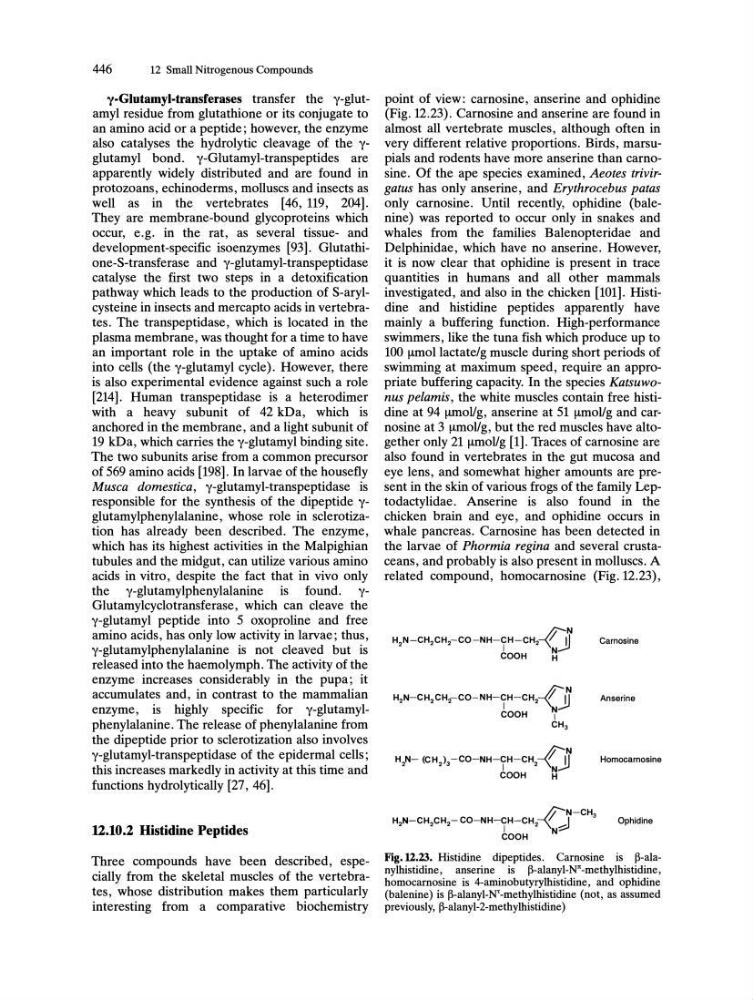
point of view: carnosine, anserine and ophidine
(Fig. 12.23). Carnosine and anserine are found in
almost all vertebrate muscles, although often in
very different relative proportions. Birds, marsupials and rodents have more anserine than carnosine. Of the ape species examined, Aeotes trivirgatus has only anserine, and Erythrocebus patas
only carnosine. Until recently, ophidine (balenine) was reported to occur only in snakes and
whales from the families Balenopteridae and
Delphinidae, which have no anserine. However,
it is now clear that ophidine is present in trace
quantities in humans and all other mammals
investigated, and also in the chicken [101]. Histidine and histidine peptides apparently have
mainly a buffering function. High-performance
swimmers, like the tuna fish which produce up to
100 f,lmollactate/g muscle during short periods of
swimming at maximum speed, require an appropriate buffering capacity. In the species Katsuwonus pelamis, the white muscles contain free histidine at 94 f,lmollg, anserine at 51 f,lmollg and carnosine at 3 f,lmollg, but the red muscles have altogether only 21 f,lmollg [1]. Traces of carnosine are
also found in vertebrates in the gut mucosa and
eye lens, and somewhat higher amounts are present in the skin of various frogs of the family Leptodactylidae. Anserine is also found in the
chicken brain and eye, and ophidine occurs in
whale pancreas. Carnosine has been detected in
the larvae of Phormia regina and several crustaceans, and probably is also present in molluscs. A
related compound, homocarnosine (Fig. 12.23),
H 2 N-CH2 CH 2-CO-NH-?H-CH2- (j
COOH
~
Carnosine
H2N-CH2 CH2-CO-NH-?H-CH2--(j]
COOH
~
Anserine
CH3
H N- (CH ) -CO-NH-CH-CH /l'jJN
2
2 3
I
24.\ •• I
COOH
~
Homocarnosine
~
N-CH
H N-CH CH - CO-NH-CH-CH
/
I
3
2
2
2
I
2
:;:::.J
COOH
N
Ophidine
Fig.12.23. Histidine dipeptides. Carnosine is ~-alanylhistidine, anserine is ~-alanyl-N"-methylhistidine,
homo carnosine is 4-aminobutyrylhistidine, and ophidine
(balenine) is ~-alanyl-N'-methylhistidine (not, as assumed
previously, ~-alanyl-2-methylhistidine)