

12.10.1 Glutathione
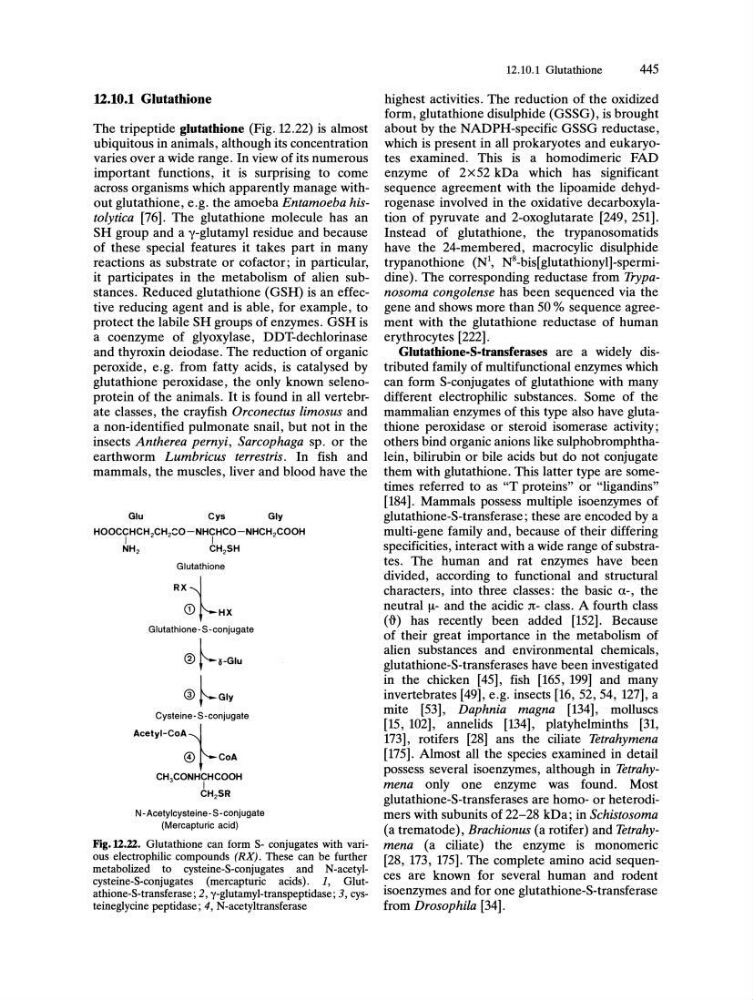
The tripeptide glutathione (Fig. 12.22) is almost
ubiquitous in animals, although its concentration
varies over a wide range. In view of its numerous
important functions, it is surprising to come
across organisms which apparently manage without glutathione, e.g. the amoeba Entamoeba histolytica [76]. The glutathione molecule has an
SH group and a y-glutamyl residue and because
of these special features it takes part in many
reactions as substrate or cofactor; in particular,
it participates in the metabolism of alien substances. Reduced glutathione (GSH) is an effective reducing agent and is able, for example, to
protect the labile SH groups of enzymes. GSH is
a coenzyme of glyoxylase, DDT-dechlorinase
and thyroxin deiodase. The reduction of organic
peroxide, e.g. from fatty acids, is catalysed by
glutathione peroxidase, the only known selenoprotein of the animals. It is found in all vertebrate classes, the crayfish Orconectus limosus and
a non-identified pulmonate snail, but not in the
insects Antherea pernyi, Sarcophaga sp. or the
earthworm Lumbricus terrestris. In fish and
mammals, the muscles, liver and blood have the
Glu
Cys
Gly
HOOCCHCH2CH2~0-NHCHCO-NHCH2COOH
I
I
NH2
CH2SH
Glutathione
RX~
® t-~-GIU
@~GIY
Cysteine - S -conjugate
Acetyl-CoA ~
@ f' -COA
CH 3CONHCHCOOH
I
CH2SR
N - Acetylcysteine - S -conjugate
(Mercapturic acid)
Fig.U.22. Glutathione can form S- conjugates with various electrophilic compounds (RX). These can be further
metabolized to cysteine-S-conjugates and N-acetylcysteine-S-conjugates (mercapturic acids). 1, Glutathione-S-transferase; 2, y-glutamyl-transpeptidase; 3, cysteineglycine peptidase; 4, N -acetyltransferase
12.10.1 Glutathione
445
highest activities. The reduction of the oxidized
form, glutathione disulphide (GSSG), is brought
about by the NADPH-specific GSSG reductase,
which is present in all prokaryotes and eukaryotes examined. This is a homodimeric FAD
enzyme of 2x52 kDa which has significant
sequence agreement with the lipoamide dehydrogenase involved in the oxidative decarboxylation of pyruvate and 2-oxoglutarate [249, 251].
Instead of glutathione, the trypanosomatids
have the 24-membered, macrocylic disulphide
trypanothione (N\ N 8 -bis[glutathionyl]-spermidine). The corresponding reductase from Trypanosoma congolense has been sequenced via the
gene and shows more than 50 % sequence agreement with the glutathione reductase of human
erythrocytes [222].
Glutathione-S-transferases are a widely distributed family of multifunctional enzymes which
can form S-conjugates of glutathione with many
different electrophilic substances. Some of the
mammalian enzymes of this type also have glutathione peroxidase or steroid isomerase activity;
others bind organic anions like sulphobromphthalein, bilirubin or bile acids but do not conjugate
them with glutathione. This latter type are sometimes referred to as "T proteins" or "ligandins"
[184]. Mammals possess multiple isoenzymes of
glutathione-S-transferase; these are encoded by a
multi-gene family and, because of their differing
specificities, interact with a wide range of substrates. The human and rat enzymes have been
divided, according to functional and structural
characters, into three classes: the basic U-, the
neutral fl- and the acidic Jt- class. A fourth class
(it) has recently been added [152]. Because
of their great importance in the metabolism of
alien substances and environmental chemicals,
glutathione-S-transferases have been investigated
in the chicken [45], fish [165, 199] and many
invertebrates [49], e.g. insects [16, 52,54, 127], a
mite [53], Daphnia magna [134], molluscs
[15, 102], annelids [134], platyhelminths [31,
173], rotifers [28] ans the ciliate Tetrahymena
[175]. Almost all the species examined in detail
possess several isoenzymes, although in Tetrahymena only one enzyme was found. Most
glutathione-S-transferases are homo- or heterodimers with subunits of 22-28 kDa; in Schistosoma
(a trematode), Brachionus (a rotifer) and Tetrahymena (a ciliate) the enzyme is monomeric
[28, 173, 175]. The complete amino acid sequences are known for several human and rodent
isoenzymes and for one glutathione-S-transferase
from Drosophila [34].
The tripeptide glutathione (Fig. 12.22) is almost
ubiquitous in animals, although its concentration
varies over a wide range. In view of its numerous
important functions, it is surprising to come
across organisms which apparently manage without glutathione, e.g. the amoeba Entamoeba histolytica [76]. The glutathione molecule has an
SH group and a y-glutamyl residue and because
of these special features it takes part in many
reactions as substrate or cofactor; in particular,
it participates in the metabolism of alien substances. Reduced glutathione (GSH) is an effective reducing agent and is able, for example, to
protect the labile SH groups of enzymes. GSH is
a coenzyme of glyoxylase, DDT-dechlorinase
and thyroxin deiodase. The reduction of organic
peroxide, e.g. from fatty acids, is catalysed by
glutathione peroxidase, the only known selenoprotein of the animals. It is found in all vertebrate classes, the crayfish Orconectus limosus and
a non-identified pulmonate snail, but not in the
insects Antherea pernyi, Sarcophaga sp. or the
earthworm Lumbricus terrestris. In fish and
mammals, the muscles, liver and blood have the
Glu
Cys
Gly
HOOCCHCH2CH2~0-NHCHCO-NHCH2COOH
I
I
NH2
CH2SH
Glutathione
RX~
® t-~-GIU
@~GIY
Cysteine - S -conjugate
Acetyl-CoA ~
@ f' -COA
CH 3CONHCHCOOH
I
CH2SR
N - Acetylcysteine - S -conjugate
(Mercapturic acid)
Fig.U.22. Glutathione can form S- conjugates with various electrophilic compounds (RX). These can be further
metabolized to cysteine-S-conjugates and N-acetylcysteine-S-conjugates (mercapturic acids). 1, Glutathione-S-transferase; 2, y-glutamyl-transpeptidase; 3, cysteineglycine peptidase; 4, N -acetyltransferase
12.10.1 Glutathione
445
highest activities. The reduction of the oxidized
form, glutathione disulphide (GSSG), is brought
about by the NADPH-specific GSSG reductase,
which is present in all prokaryotes and eukaryotes examined. This is a homodimeric FAD
enzyme of 2x52 kDa which has significant
sequence agreement with the lipoamide dehydrogenase involved in the oxidative decarboxylation of pyruvate and 2-oxoglutarate [249, 251].
Instead of glutathione, the trypanosomatids
have the 24-membered, macrocylic disulphide
trypanothione (N\ N 8 -bis[glutathionyl]-spermidine). The corresponding reductase from Trypanosoma congolense has been sequenced via the
gene and shows more than 50 % sequence agreement with the glutathione reductase of human
erythrocytes [222].
Glutathione-S-transferases are a widely distributed family of multifunctional enzymes which
can form S-conjugates of glutathione with many
different electrophilic substances. Some of the
mammalian enzymes of this type also have glutathione peroxidase or steroid isomerase activity;
others bind organic anions like sulphobromphthalein, bilirubin or bile acids but do not conjugate
them with glutathione. This latter type are sometimes referred to as "T proteins" or "ligandins"
[184]. Mammals possess multiple isoenzymes of
glutathione-S-transferase; these are encoded by a
multi-gene family and, because of their differing
specificities, interact with a wide range of substrates. The human and rat enzymes have been
divided, according to functional and structural
characters, into three classes: the basic U-, the
neutral fl- and the acidic Jt- class. A fourth class
(it) has recently been added [152]. Because
of their great importance in the metabolism of
alien substances and environmental chemicals,
glutathione-S-transferases have been investigated
in the chicken [45], fish [165, 199] and many
invertebrates [49], e.g. insects [16, 52,54, 127], a
mite [53], Daphnia magna [134], molluscs
[15, 102], annelids [134], platyhelminths [31,
173], rotifers [28] ans the ciliate Tetrahymena
[175]. Almost all the species examined in detail
possess several isoenzymes, although in Tetrahymena only one enzyme was found. Most
glutathione-S-transferases are homo- or heterodimers with subunits of 22-28 kDa; in Schistosoma
(a trematode), Brachionus (a rotifer) and Tetrahymena (a ciliate) the enzyme is monomeric
[28, 173, 175]. The complete amino acid sequences are known for several human and rodent
isoenzymes and for one glutathione-S-transferase
from Drosophila [34].