

442
12 Small Nitrogenous Compounds
NH2
I
H
HN=C -NH-CH 2 CH 2 -co - NH- T
-(CH 2 )4 - CH 3
Phascoline
OH
Phascolosomine
~H2
~
HN=C -NH -CH 2CH2-0-P-O-CH2-CH -NH-CO-CH-CH2-COOH
I
I
I
OH
COOH
NH2
NH2
NH2
I
I
HN=C-NH - (CH 2)s - HN-C=NH
NH2
NH2
I
I
HN=C -NH- (CH 2 )3 -NH - (CH 2 )4 -HN -C=NH
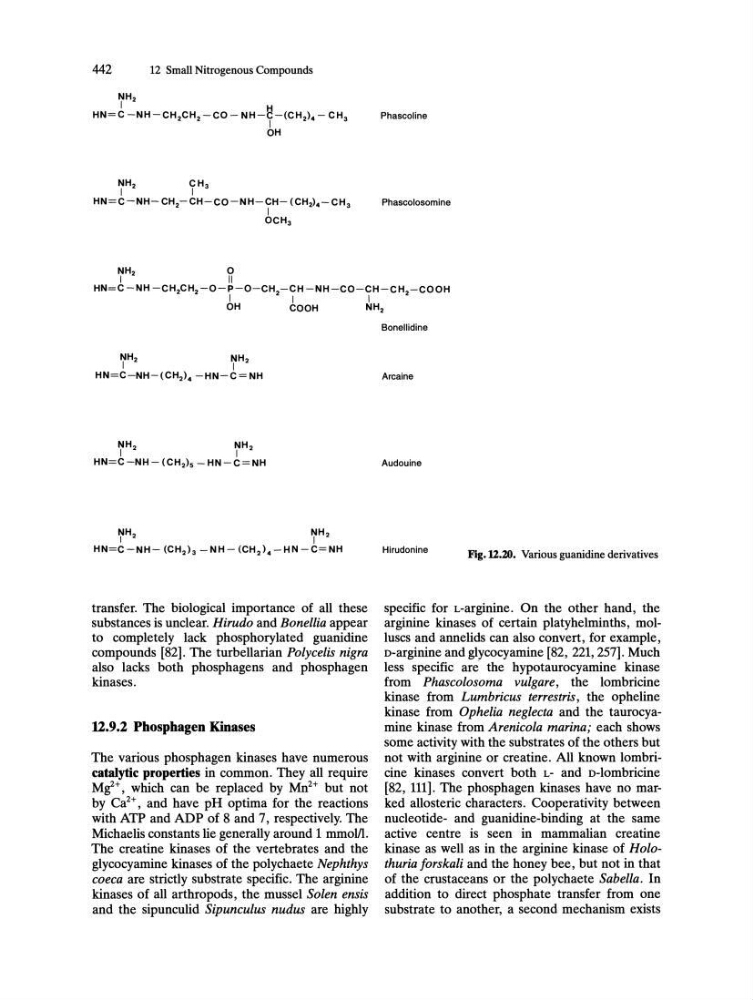
transfer. The biological importance of all these
substances is unclear. Hirudo and Bonellia appear
to completely lack phosphorylated guanidine
compounds [82]. The turbellarian Polycelis nigra
also lacks both phosphagens and phosphagen
kinases.
12.9.2 Phosphagen Kinases
The various phosphagen kinases have numerous
catalytic properties in common. They all require
Mi+, which can be replaced by Mn2+ but not
by Ca 2 +, and have pH optima for the reactions
with ATP and ADP of 8 and 7, respectively. The
Michaelis constants lie generally around 1 mmolll.
The creatine kinases of the vertebrates and the
glycocyamine kinases of the polychaete Nephthys
coeca are strictly substrate specific. The arginine
kinases of all arthropods, the mussel Solen ensis
and the sipunculid Sipunculus nudus are highly
Bonellidine
Arcaine
Audouine
Hirudonine
Fig.12.20. Various guanidine derivatives
specific for L-arginine. On the other hand, the
arginine kinases of certain platyhelminths, molluscs and annelids can also convert, for example,
D-arginine and glycocyamine [82,221,257]. Much
less specific are the hypotaurocyamine kinase
from Phascolosoma vulgare, the lombricine
kinase from Lumbricus terrestris, the opheline
kinase from Ophelia neglecta and the taurocyamine kinase from Arenicola marina; each shows
some activity with the substrates of the others but
not with arginine or creatine. All known lombricine kinases convert both L- and D-Iombricine
[82, 111]. The phosphagen kinases have no marked allosteric characters. Cooperativity between
nucleotide- and guanidine-binding at the same
active centre is seen in mammalian creatine
kinase as well as in the arginine kinase of Holothuria forskali and the honey bee, but not in that
of the crustaceans or the polychaete Sabella. In
addition to direct phosphate transfer from one
substrate to another, a second mechanism exists
12 Small Nitrogenous Compounds
NH2
I
H
HN=C -NH-CH 2 CH 2 -co - NH- T
-(CH 2 )4 - CH 3
Phascoline
OH
Phascolosomine
~H2
~
HN=C -NH -CH 2CH2-0-P-O-CH2-CH -NH-CO-CH-CH2-COOH
I
I
I
OH
COOH
NH2
NH2
NH2
I
I
HN=C-NH - (CH 2)s - HN-C=NH
NH2
NH2
I
I
HN=C -NH- (CH 2 )3 -NH - (CH 2 )4 -HN -C=NH
transfer. The biological importance of all these
substances is unclear. Hirudo and Bonellia appear
to completely lack phosphorylated guanidine
compounds [82]. The turbellarian Polycelis nigra
also lacks both phosphagens and phosphagen
kinases.
12.9.2 Phosphagen Kinases
The various phosphagen kinases have numerous
catalytic properties in common. They all require
Mi+, which can be replaced by Mn2+ but not
by Ca 2 +, and have pH optima for the reactions
with ATP and ADP of 8 and 7, respectively. The
Michaelis constants lie generally around 1 mmolll.
The creatine kinases of the vertebrates and the
glycocyamine kinases of the polychaete Nephthys
coeca are strictly substrate specific. The arginine
kinases of all arthropods, the mussel Solen ensis
and the sipunculid Sipunculus nudus are highly
Bonellidine
Arcaine
Audouine
Hirudonine
Fig.12.20. Various guanidine derivatives
specific for L-arginine. On the other hand, the
arginine kinases of certain platyhelminths, molluscs and annelids can also convert, for example,
D-arginine and glycocyamine [82,221,257]. Much
less specific are the hypotaurocyamine kinase
from Phascolosoma vulgare, the lombricine
kinase from Lumbricus terrestris, the opheline
kinase from Ophelia neglecta and the taurocyamine kinase from Arenicola marina; each shows
some activity with the substrates of the others but
not with arginine or creatine. All known lombricine kinases convert both L- and D-Iombricine
[82, 111]. The phosphagen kinases have no marked allosteric characters. Cooperativity between
nucleotide- and guanidine-binding at the same
active centre is seen in mammalian creatine
kinase as well as in the arginine kinase of Holothuria forskali and the honey bee, but not in that
of the crustaceans or the polychaete Sabella. In
addition to direct phosphate transfer from one
substrate to another, a second mechanism exists