

12.9.2 Phosphagen Kinases
443
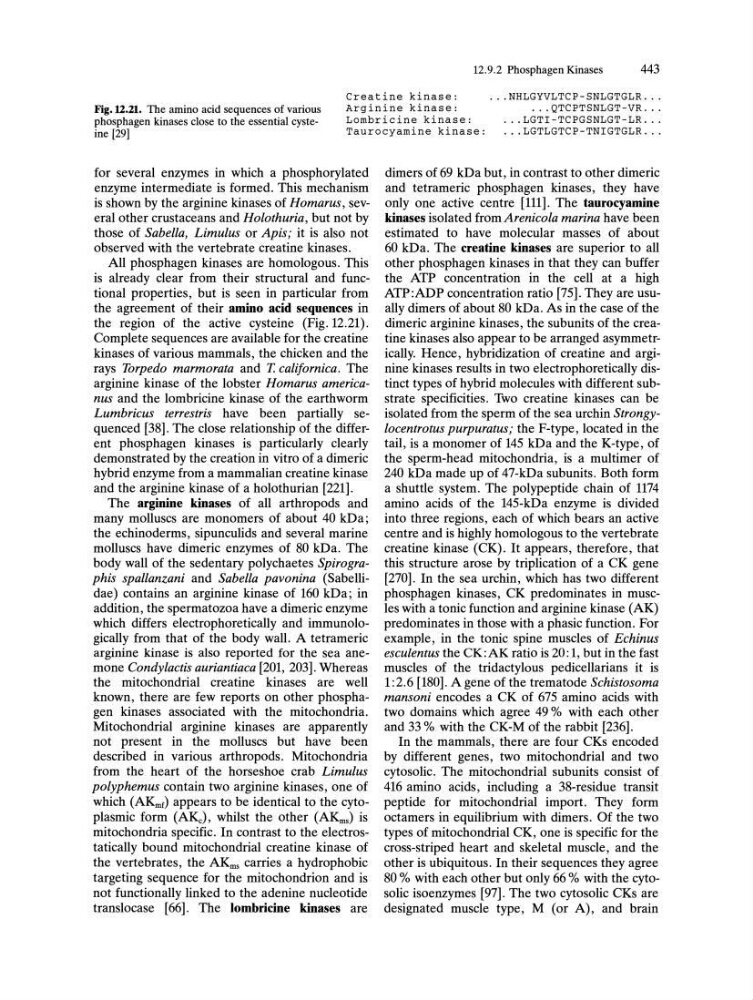
Creatine kinase:
... NHLGYVLTCP-SNLGTGLR .. .
Fig. 12.21. The amino acid sequences of various
phosphagen kinases close to the essential cysteine [29]
Arginine kinase:
... QTCPTSNLGT-VR .. .
Lombricine kinase:
... LGTI-TCPGSNLGT-LR .. .
Taurocyamine kinase:
... LGTLGTCP-TNIGTGLR .. .
for several enzymes in which a phosphorylated
enzyme intermediate is formed. This mechanism
is shown by the arginine kinases of Homarus, several other crustaceans and Holothuria, but not by
those of Sabella, Limulus or Apis; it is also not
observed with the vertebrate creatine kinases.
All phosphagen kinases are homologous. This
is already clear from their structural and functional properties, but is seen in particular from
the agreement of their amino acid sequences in
the region of the active cysteine (Fig. 12.21).
Complete sequences are available for the creatine
kinases of various mammals, the chicken and the
rays Torpedo marmorata and T. californica. The
arginine kinase of the lobster Homarus americanus and the lombricine kinase of the earthworm
Lumbricus terrestris have been partially sequenced [3S]. The close relationship of the different phosphagen kinases is particularly clearly
demonstrated by the creation in vitro of a dimeric
hybrid enzyme from a mammalian creatine kinase
and the arginine kinase of a holothurian [221].
The arginine kinases of all arthropods and
many molluscs are monomers of about 40 kDa;
the echinoderms, sipunculids and several marine
molluscs have dimeric enzymes of SO kDa. The
body wall of the sedentary polychaetes Spirographis spallanzani and Sabella pavonina (Sabellidae) contains an arginine kinase of 160 kDa; in
addition, the spermatozoa have a dimeric enzyme
which differs electrophoretically and immunologically from that of the body wall. A tetrameric
arginine kinase is also reported for the sea anemone Condylactis auriantiaca [201, 203]. Whereas
the mitochondrial creatine kinases are well
known, there are few reports on other phosphagen kinases associated with the mitochondria.
Mitochondrial arginine kinases are apparently
not present in the molluscs but have been
described in various arthropods. Mitochondria
from the heart of the horseshoe crab Limulus
polyphemus contain two arginine kinases, one of
which (AKmf) appears to be identical to the cytoplasmic form (AKc) , whilst the other (AKms) is
mitochondria specific. In contrast to the electrostatically bound mitochondrial creatine kinase of
the vertebrates, the AKms carries a hydrophobic
targeting sequence for the mitochondrion and is
not functionally linked to the adenine nucleotide
translocase [66]. The lombricine kinases are
dimers of 69 kDa but, in contrast to other dimeric
and tetrameric phosphagen kinases, they have
only one active centre [111]. The taurocyamine
kinases isolated from Arenicola marina have been
estimated to have molecular masses of about
60 kDa. The creatine kinases are superior to all
other phosphagen kinases in that they can buffer
the ATP concentration in the cell at a high
ATP:ADP concentration ratio [75]. They are usually dimers of about SO kDa. As in the case of the
dimeric arginine kinases, the subunits of the creatine kinases also appear to be arranged asymmetrically. Hence, hybridization of creatine and arginine kinases results in two electrophoretically distinct types of hybrid molecules with different substrate specificities. Two creatine kinases can be
isolated from the sperm of the sea urchin Strongylocentrotus purpuratus; the F-type, located in the
tail, is a monomer of 145 kDa and the K-type, of
the sperm-head mitochondria, is a multimer of
240 kDa made up of 47-kDa subunits. Both form
a shuttle system. The polypeptide chain of 1174
amino acids of the 145-kDa enzyme is divided
into three regions, each of which bears an active
centre and is highly homologous to the vertebrate
creatine kinase (CK). It appears, therefore, that
this structure arose by triplication of a CK gene
[270]. In the sea urchin, which has two different
phosphagen kinases, CK predominates in muscles with a tonic function and arginine kinase (AK)
predominates in those with a phasic function. For
example, in the tonic spine muscles of Echinus
esculentus the CK: AK ratio is 20: 1, but in the fast
muscles of the tridactylous pedicellarians it is
1:2.6 [1S0]. A gene ofthe trematode Schistosoma
mansoni encodes a CK of 675 amino acids with
two domains which agree 49 % with each other
and 33 % with the CK-M of the rabbit [236].
In the mammals, there are four CKs encoded
by different genes, two mitochondrial and two
cytosolic. The mitochondrial subunits consist of
416 amino acids, including a 3S-residue transit
peptide for mitochondrial import. They form
octamers in equilibrium with dimers. Of the two
types of mitochondrial CK, one is specific for the
cross-striped heart and skeletal muscle, and the
other is ubiquitous. In their sequences they agree
SO % with each other but only 66 % with the cytosolic isoenzymes [97]. The two cytosolic CKs are
designated muscle type, M (or A), and brain
443
Creatine kinase:
... NHLGYVLTCP-SNLGTGLR .. .
Fig. 12.21. The amino acid sequences of various
phosphagen kinases close to the essential cysteine [29]
Arginine kinase:
... QTCPTSNLGT-VR .. .
Lombricine kinase:
... LGTI-TCPGSNLGT-LR .. .
Taurocyamine kinase:
... LGTLGTCP-TNIGTGLR .. .
for several enzymes in which a phosphorylated
enzyme intermediate is formed. This mechanism
is shown by the arginine kinases of Homarus, several other crustaceans and Holothuria, but not by
those of Sabella, Limulus or Apis; it is also not
observed with the vertebrate creatine kinases.
All phosphagen kinases are homologous. This
is already clear from their structural and functional properties, but is seen in particular from
the agreement of their amino acid sequences in
the region of the active cysteine (Fig. 12.21).
Complete sequences are available for the creatine
kinases of various mammals, the chicken and the
rays Torpedo marmorata and T. californica. The
arginine kinase of the lobster Homarus americanus and the lombricine kinase of the earthworm
Lumbricus terrestris have been partially sequenced [3S]. The close relationship of the different phosphagen kinases is particularly clearly
demonstrated by the creation in vitro of a dimeric
hybrid enzyme from a mammalian creatine kinase
and the arginine kinase of a holothurian [221].
The arginine kinases of all arthropods and
many molluscs are monomers of about 40 kDa;
the echinoderms, sipunculids and several marine
molluscs have dimeric enzymes of SO kDa. The
body wall of the sedentary polychaetes Spirographis spallanzani and Sabella pavonina (Sabellidae) contains an arginine kinase of 160 kDa; in
addition, the spermatozoa have a dimeric enzyme
which differs electrophoretically and immunologically from that of the body wall. A tetrameric
arginine kinase is also reported for the sea anemone Condylactis auriantiaca [201, 203]. Whereas
the mitochondrial creatine kinases are well
known, there are few reports on other phosphagen kinases associated with the mitochondria.
Mitochondrial arginine kinases are apparently
not present in the molluscs but have been
described in various arthropods. Mitochondria
from the heart of the horseshoe crab Limulus
polyphemus contain two arginine kinases, one of
which (AKmf) appears to be identical to the cytoplasmic form (AKc) , whilst the other (AKms) is
mitochondria specific. In contrast to the electrostatically bound mitochondrial creatine kinase of
the vertebrates, the AKms carries a hydrophobic
targeting sequence for the mitochondrion and is
not functionally linked to the adenine nucleotide
translocase [66]. The lombricine kinases are
dimers of 69 kDa but, in contrast to other dimeric
and tetrameric phosphagen kinases, they have
only one active centre [111]. The taurocyamine
kinases isolated from Arenicola marina have been
estimated to have molecular masses of about
60 kDa. The creatine kinases are superior to all
other phosphagen kinases in that they can buffer
the ATP concentration in the cell at a high
ATP:ADP concentration ratio [75]. They are usually dimers of about SO kDa. As in the case of the
dimeric arginine kinases, the subunits of the creatine kinases also appear to be arranged asymmetrically. Hence, hybridization of creatine and arginine kinases results in two electrophoretically distinct types of hybrid molecules with different substrate specificities. Two creatine kinases can be
isolated from the sperm of the sea urchin Strongylocentrotus purpuratus; the F-type, located in the
tail, is a monomer of 145 kDa and the K-type, of
the sperm-head mitochondria, is a multimer of
240 kDa made up of 47-kDa subunits. Both form
a shuttle system. The polypeptide chain of 1174
amino acids of the 145-kDa enzyme is divided
into three regions, each of which bears an active
centre and is highly homologous to the vertebrate
creatine kinase (CK). It appears, therefore, that
this structure arose by triplication of a CK gene
[270]. In the sea urchin, which has two different
phosphagen kinases, CK predominates in muscles with a tonic function and arginine kinase (AK)
predominates in those with a phasic function. For
example, in the tonic spine muscles of Echinus
esculentus the CK: AK ratio is 20: 1, but in the fast
muscles of the tridactylous pedicellarians it is
1:2.6 [1S0]. A gene ofthe trematode Schistosoma
mansoni encodes a CK of 675 amino acids with
two domains which agree 49 % with each other
and 33 % with the CK-M of the rabbit [236].
In the mammals, there are four CKs encoded
by different genes, two mitochondrial and two
cytosolic. The mitochondrial subunits consist of
416 amino acids, including a 3S-residue transit
peptide for mitochondrial import. They form
octamers in equilibrium with dimers. Of the two
types of mitochondrial CK, one is specific for the
cross-striped heart and skeletal muscle, and the
other is ubiquitous. In their sequences they agree
SO % with each other but only 66 % with the cytosolic isoenzymes [97]. The two cytosolic CKs are
designated muscle type, M (or A), and brain