

440
12 Small Nitrogenous Compounds
protein biosynthesis, whereas that associated with
the ER and the plasma membrane has a function
in ion pumping [24,211]. Creatine phosphatedependent energy transport has also been
detected in sea-urchin spermatozoa [270]. It can
be assumed that the other phosphagens of the
invertebrates also take part in shuttle systems,
although there is at present no direct evidence for
this.
12.9.1 Biosynthesis and Occurrence
A classical thesis of comparative biochemistry
states that creatine phosphate occurs only in vertebrates, and that all other animals ("invertebrates") have arginine phosphate. This simple concept was destroyed in the 1950s by the discovery
in some sea urchins of creatine phosphate togeo
ther with arginine phosphate, and the identification of a series of other phosphagens in annelids.
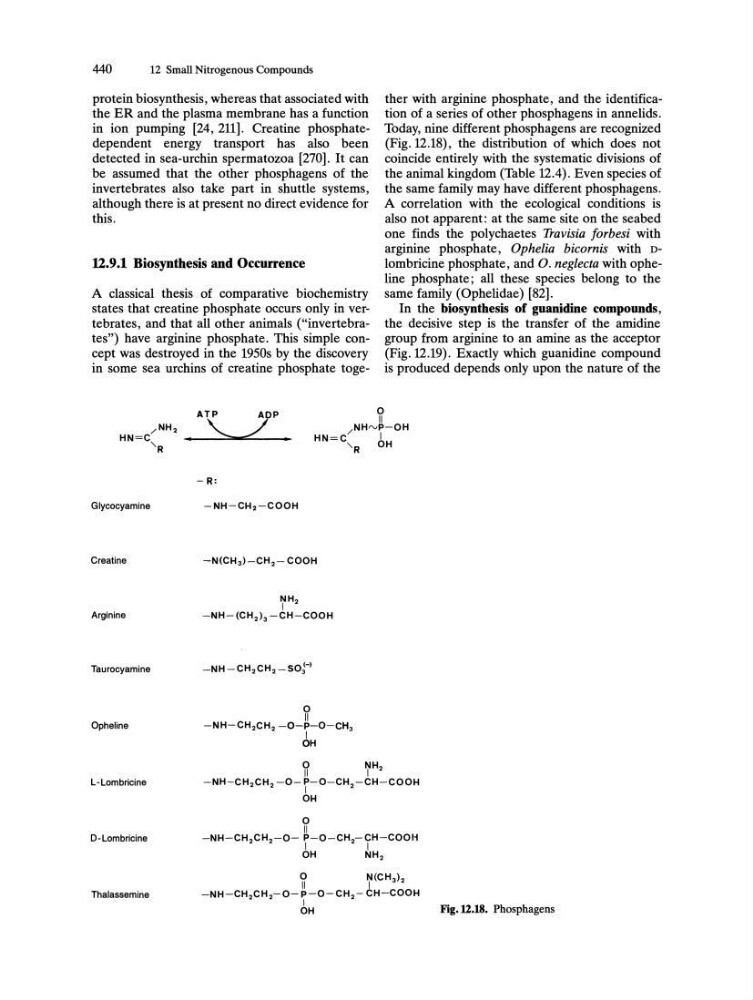
Today, nine different phosphagens are recognized
(Fig. 12.18), the distribution of which does not
coincide entirely with the systematic divisions of
the animal kingdom (Table 12.4). Even species of
the same family may have different phosphagens.
A correlation with the ecological conditions is
also not apparent: at the same site on the seabed
one finds the polychaetes Travisia forbesi with
arginine phosphate, Ophelia bicornis with Dlombricine phosphate, and O. neglecta with opheline phosphate; all these species belong to the
same family (Ophelidae) [82].
In the biosynthesis of guanidine compounds,
the decisive step is the transfer of the amidine
group from arginine to an amine as the acceptor
(Fig. 12.19). Exactly which guanidine compound
is produced depends only upon the nature of the
II
/NH"'P-OH
HN=C
I
'R
OH
- R:
Glycocyamine
-NH-CH 2 -COOH
Creatine
Arginine
Taurocyamine
Opheline
o
NH2
II
I
L - Lombricine
-NH-CH 2 CH -O-P-O-CH -CH-COOH
2
I
2
OH
D - Lombricine
Thalassemine
12 Small Nitrogenous Compounds
protein biosynthesis, whereas that associated with
the ER and the plasma membrane has a function
in ion pumping [24,211]. Creatine phosphatedependent energy transport has also been
detected in sea-urchin spermatozoa [270]. It can
be assumed that the other phosphagens of the
invertebrates also take part in shuttle systems,
although there is at present no direct evidence for
this.
12.9.1 Biosynthesis and Occurrence
A classical thesis of comparative biochemistry
states that creatine phosphate occurs only in vertebrates, and that all other animals ("invertebrates") have arginine phosphate. This simple concept was destroyed in the 1950s by the discovery
in some sea urchins of creatine phosphate togeo
ther with arginine phosphate, and the identification of a series of other phosphagens in annelids.
Today, nine different phosphagens are recognized
(Fig. 12.18), the distribution of which does not
coincide entirely with the systematic divisions of
the animal kingdom (Table 12.4). Even species of
the same family may have different phosphagens.
A correlation with the ecological conditions is
also not apparent: at the same site on the seabed
one finds the polychaetes Travisia forbesi with
arginine phosphate, Ophelia bicornis with Dlombricine phosphate, and O. neglecta with opheline phosphate; all these species belong to the
same family (Ophelidae) [82].
In the biosynthesis of guanidine compounds,
the decisive step is the transfer of the amidine
group from arginine to an amine as the acceptor
(Fig. 12.19). Exactly which guanidine compound
is produced depends only upon the nature of the
II
/NH"'P-OH
HN=C
I
'R
OH
- R:
Glycocyamine
-NH-CH 2 -COOH
Creatine
Arginine
Taurocyamine
Opheline
o
NH2
II
I
L - Lombricine
-NH-CH 2 CH -O-P-O-CH -CH-COOH
2
I
2
OH
D - Lombricine
Thalassemine