

438
12 Small Nitrogenous Compounds
Table 12.3. The concentration (l-tg/g fresh weight) of octopamine (0) and noradrenalin (N) in various animal species
Species and tissue
0
N
Reference
Molluscs
Helix aspersa CNS
0.13 0.07 [121]
Peristernia nassatula
125
[271]
hypobranchial gland
Octopus vulgaris CNS
1.2
4.4
[121]
Posterior salivary gland
1300
[14]
Annelids and arthropods
Lumbricus terrestris CNS
5.3
1.4
[121]
Homarus sp. CNS
0.23 0
[121]
Periplaneta americanus CNS
3.9
0.37 [121]
Echinoderms
Pycnopodia helianthoides
0.26 2.13 [121]
arm nerve
Vertebrates
Rat brain
0.005 0.43 [121]
CNS, central nervous system
nin, is apparently found only in the vertebrates,
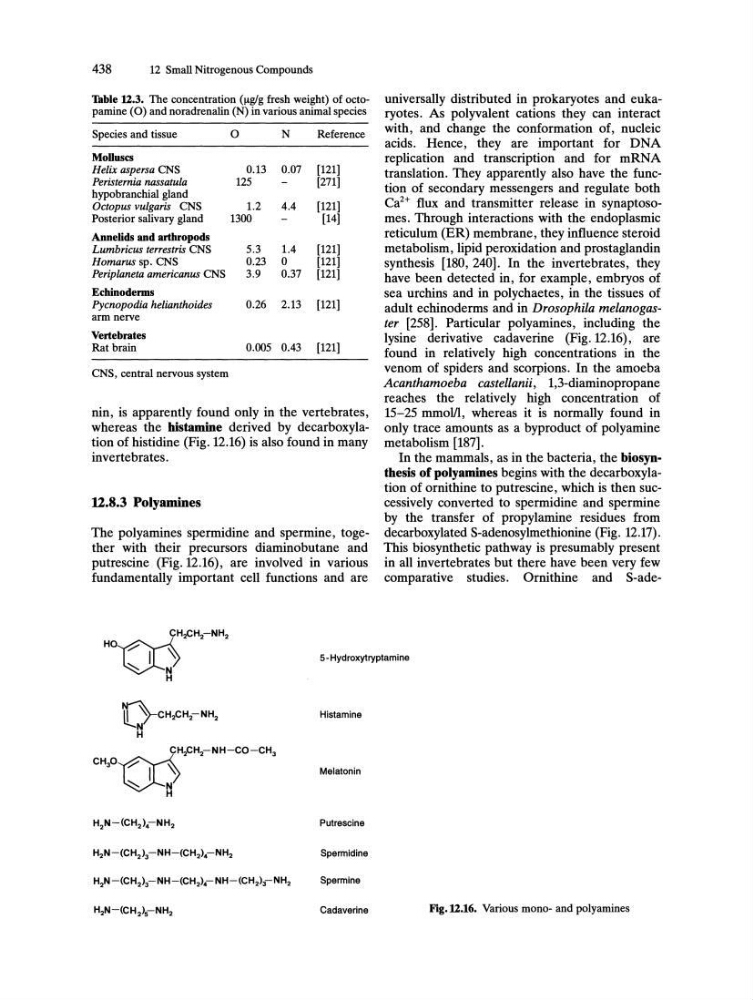
whereas the histamine derived by decarboxylation of histidine (Fig. 12.16) is also found in many
invertebrates.
12.8.3 Polyamines
The polyamines spermidine and spermine, together with their precursors diaminobutane and
putrescine (Fig.12.16), are involved in various
fundamentally important cell functions and are
universally distributed in prokaryotes and eukaryotes. As polyvalent cations they can interact
with, and change the conformation of, nucleic
acids. Hence, they are important for DNA
replication and transcription and for mRNA
translation. They apparently also have the function of secondary messengers and regulate both
Ca 2 + flux and transmitter release in synaptosomeso Through interactions with the endoplasmic
reticulum (ER) membrane, they influence steroid
metabolism, lipid peroxidation and prostaglandin
synthesis [180, 240]. In the invertebrates, they
have been detected in, for example, embryos of
sea urchins and in polychaetes, in the tissues of
adult echinoderms and in Drosophila melanogaster [258]. Particular polyamines, including the
lysine derivative cadaverine (Fig. 12.16), are
found in relatively high concentrations in the
venom of spiders and scorpions. In the amoeba
Acanthamoeba castellanii, 1,3-diaminopropane
reaches the relatively high concentration of
15-25 mmol/l, whereas it is normally found in
only trace amounts as a byproduct of polyamine
metabolism [187].
In the mammals, as in the bacteria, the biosynthesis of polyamines begins with the decarboxylation of ornithine to putrescine, which is then successively converted to spermidine and spermine
by the transfer of propylamine residues from
decarboxylated S-adenosylmethionine (Fig. 12.17).
This biosynthetic pathway is presumably present
in all invertebrates but there have been very few
comparative studies. Ornithine and S-ade5 -Hydroxytryptamine
o-CH2CH2-NH2
H
Histamine
Melatonin
Putrescine
Spermidine
Spermine
Cadaverine
Fig.12.16. Various mono- and polyamines
12 Small Nitrogenous Compounds
Table 12.3. The concentration (l-tg/g fresh weight) of octopamine (0) and noradrenalin (N) in various animal species
Species and tissue
0
N
Reference
Molluscs
Helix aspersa CNS
0.13 0.07 [121]
Peristernia nassatula
125
[271]
hypobranchial gland
Octopus vulgaris CNS
1.2
4.4
[121]
Posterior salivary gland
1300
[14]
Annelids and arthropods
Lumbricus terrestris CNS
5.3
1.4
[121]
Homarus sp. CNS
0.23 0
[121]
Periplaneta americanus CNS
3.9
0.37 [121]
Echinoderms
Pycnopodia helianthoides
0.26 2.13 [121]
arm nerve
Vertebrates
Rat brain
0.005 0.43 [121]
CNS, central nervous system
nin, is apparently found only in the vertebrates,
whereas the histamine derived by decarboxylation of histidine (Fig. 12.16) is also found in many
invertebrates.
12.8.3 Polyamines
The polyamines spermidine and spermine, together with their precursors diaminobutane and
putrescine (Fig.12.16), are involved in various
fundamentally important cell functions and are
universally distributed in prokaryotes and eukaryotes. As polyvalent cations they can interact
with, and change the conformation of, nucleic
acids. Hence, they are important for DNA
replication and transcription and for mRNA
translation. They apparently also have the function of secondary messengers and regulate both
Ca 2 + flux and transmitter release in synaptosomeso Through interactions with the endoplasmic
reticulum (ER) membrane, they influence steroid
metabolism, lipid peroxidation and prostaglandin
synthesis [180, 240]. In the invertebrates, they
have been detected in, for example, embryos of
sea urchins and in polychaetes, in the tissues of
adult echinoderms and in Drosophila melanogaster [258]. Particular polyamines, including the
lysine derivative cadaverine (Fig. 12.16), are
found in relatively high concentrations in the
venom of spiders and scorpions. In the amoeba
Acanthamoeba castellanii, 1,3-diaminopropane
reaches the relatively high concentration of
15-25 mmol/l, whereas it is normally found in
only trace amounts as a byproduct of polyamine
metabolism [187].
In the mammals, as in the bacteria, the biosynthesis of polyamines begins with the decarboxylation of ornithine to putrescine, which is then successively converted to spermidine and spermine
by the transfer of propylamine residues from
decarboxylated S-adenosylmethionine (Fig. 12.17).
This biosynthetic pathway is presumably present
in all invertebrates but there have been very few
comparative studies. Ornithine and S-ade5 -Hydroxytryptamine
o-CH2CH2-NH2
H
Histamine
Melatonin
Putrescine
Spermidine
Spermine
Cadaverine
Fig.12.16. Various mono- and polyamines