

12.8.2 Amines Derived from Tyrosine, Tryptophan and Histidine
437
ated to homarine by reversal of the transfer reaction. Some marine crustaceans contain the isomer
trigonelline (Fig.12.14), and further N-methylated bases are known in the molluscs [10].
12.8.2 Amines Derived from lYrosine,
Tryptophan and Histidine
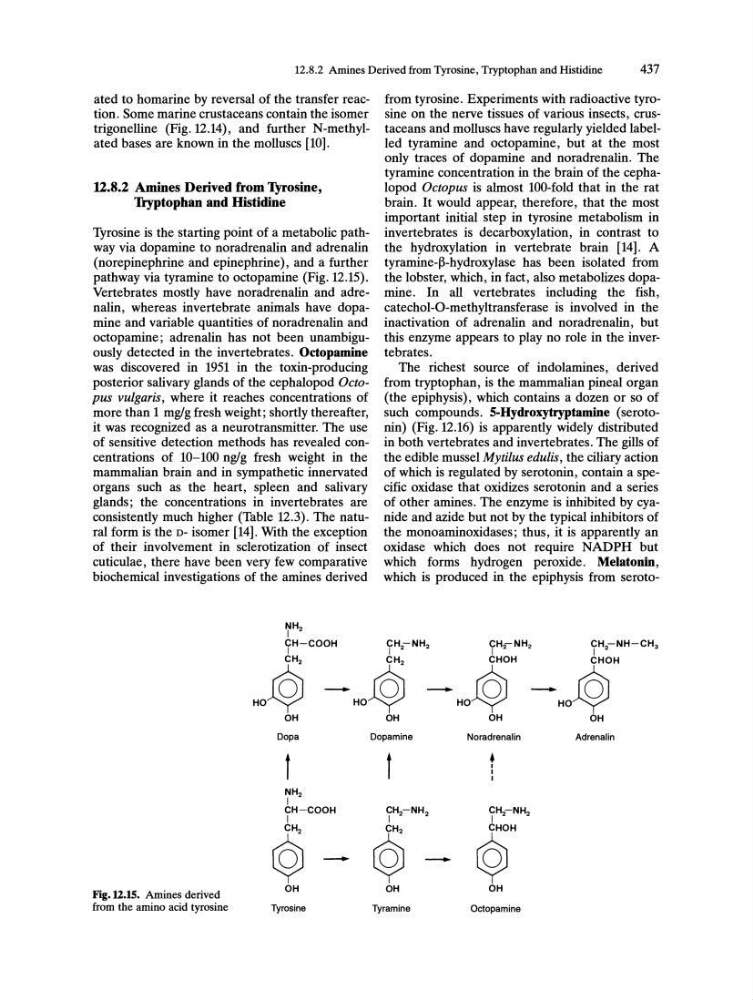
Tyrosine is the starting point of a metabolic pathway via dopamine to noradrenalin and adrenalin
(norepinephrine and epinephrine), and a further
pathway via tyramine to octopamine (Fig. 12.15).
Vertebrates mostly have noradrenalin and adrenalin, whereas invertebrate animals have dopamine and variable quantities of noradrenalin and
octopamine; adrenalin has not been unambiguously detected in the invertebrates. Octopamine
was discovered in 1951 in the toxin-producing
posterior salivary glands of the cephalopod Octopus vulgaris, where it reaches concentrations of
more than 1 mglg fresh weight; shortly thereafter,
it was recognized as a neurotransmitter. The use
of sensitive detection methods has revealed concentrations of 10-100 nglg fresh weight in the
mammalian brain and in sympathetic innervated
organs such as the heart, spleen and salivary
glands; the concentrations in invertebrates are
consistently much higher (Table 12.3). The natural form is the D- isomer [14]. With the exception
of their involvement in sclerotization of insect
cuticulae, there have been very few comparative
biochemical investigations of the amines derived
NH2
I
CH-COOH
I
from tyrosine. Experiments with radioactive tyrosine on the nerve tissues of various insects, crustaceans and molluscs have regularly yielded labelled tyramine and octopamine, but at the most
only traces of dopamine and noradrenalin. The
tyramine concentration in the brain of the cephalopod Octopus is almost 100-fold that in the rat
brain. It would appear, therefore, that the most
important initial step in tyrosine metabolism in
invertebrates is decarboxylation, in contrast to
the hydroxylation in vertebrate brain [14]. A
tyramine-~-hydroxylase has been isolated from
the lobster, which, in fact, also metabolizes dopamine. In all vertebrates including the fish,
catechol-O-methyltransferase is involved in the
inactivation of adrenalin and noradrenalin, but
this enzyme appears to play no role in the invertebrates.
The richest source of indolamines, derived
from tryptophan, is the mammalian pineal organ
(the epiphysis), which contains a dozen or so of
such compounds. 5-Hydroxytryptamine (serotonin) (Fig. 12.16) is apparently widely distributed
in both vertebrates and invertebrates. The gills of
the edible mussel Mytilus edulis, the ciliary action
of which is regulated by serotonin, contain a specific oxidase that oxidizes serotonin and a series
of other amines. The enzyme is inhibited by cyanide and azide but not by the typical inhibitors of
the monoaminoxidases; thus, it is apparently an
oxidase which does not require NADPH but
which forms hydrogen peroxide. Melatonin,
which is produced in the epiphysis from serotoCH 2 -NH,
I
CH2- NH2
CH 2 -NH-CH 3
I
I
HoIQJ -0 HO~ _HO~H _HO~H
OH
OH
OH
OH
Dopa
Dopamine
Noradrenalin
Adrenalin
t
t
•
I
I
I
NH2
I
CH-COOH
CH 2 -NH 2
CH 2 -NH 2
I
I
I
~ ~
CHOH
-
- cQJ
Fig.12.1S. Amines derived
OH
OH
OH
from the amino acid tyrosine
Tyrosine
Tyramine
Octopamine
437
ated to homarine by reversal of the transfer reaction. Some marine crustaceans contain the isomer
trigonelline (Fig.12.14), and further N-methylated bases are known in the molluscs [10].
12.8.2 Amines Derived from lYrosine,
Tryptophan and Histidine
Tyrosine is the starting point of a metabolic pathway via dopamine to noradrenalin and adrenalin
(norepinephrine and epinephrine), and a further
pathway via tyramine to octopamine (Fig. 12.15).
Vertebrates mostly have noradrenalin and adrenalin, whereas invertebrate animals have dopamine and variable quantities of noradrenalin and
octopamine; adrenalin has not been unambiguously detected in the invertebrates. Octopamine
was discovered in 1951 in the toxin-producing
posterior salivary glands of the cephalopod Octopus vulgaris, where it reaches concentrations of
more than 1 mglg fresh weight; shortly thereafter,
it was recognized as a neurotransmitter. The use
of sensitive detection methods has revealed concentrations of 10-100 nglg fresh weight in the
mammalian brain and in sympathetic innervated
organs such as the heart, spleen and salivary
glands; the concentrations in invertebrates are
consistently much higher (Table 12.3). The natural form is the D- isomer [14]. With the exception
of their involvement in sclerotization of insect
cuticulae, there have been very few comparative
biochemical investigations of the amines derived
NH2
I
CH-COOH
I
from tyrosine. Experiments with radioactive tyrosine on the nerve tissues of various insects, crustaceans and molluscs have regularly yielded labelled tyramine and octopamine, but at the most
only traces of dopamine and noradrenalin. The
tyramine concentration in the brain of the cephalopod Octopus is almost 100-fold that in the rat
brain. It would appear, therefore, that the most
important initial step in tyrosine metabolism in
invertebrates is decarboxylation, in contrast to
the hydroxylation in vertebrate brain [14]. A
tyramine-~-hydroxylase has been isolated from
the lobster, which, in fact, also metabolizes dopamine. In all vertebrates including the fish,
catechol-O-methyltransferase is involved in the
inactivation of adrenalin and noradrenalin, but
this enzyme appears to play no role in the invertebrates.
The richest source of indolamines, derived
from tryptophan, is the mammalian pineal organ
(the epiphysis), which contains a dozen or so of
such compounds. 5-Hydroxytryptamine (serotonin) (Fig. 12.16) is apparently widely distributed
in both vertebrates and invertebrates. The gills of
the edible mussel Mytilus edulis, the ciliary action
of which is regulated by serotonin, contain a specific oxidase that oxidizes serotonin and a series
of other amines. The enzyme is inhibited by cyanide and azide but not by the typical inhibitors of
the monoaminoxidases; thus, it is apparently an
oxidase which does not require NADPH but
which forms hydrogen peroxide. Melatonin,
which is produced in the epiphysis from serotoCH 2 -NH,
I
CH2- NH2
CH 2 -NH-CH 3
I
I
HoIQJ -0 HO~ _HO~H _HO~H
OH
OH
OH
OH
Dopa
Dopamine
Noradrenalin
Adrenalin
t
t
•
I
I
I
NH2
I
CH-COOH
CH 2 -NH 2
CH 2 -NH 2
I
I
I
~ ~
CHOH
-
- cQJ
Fig.12.1S. Amines derived
OH
OH
OH
from the amino acid tyrosine
Tyrosine
Tyramine
Octopamine